


The Election Handed Democrats a Cost Mandate. Managed Care Still Runs on the Jan. 1 Calendar
Democrats now have the leverage to investigate and negotiate, but the Medicaid work-requirements implementation clock, the presidential veto power, and the Centers for Medicare & Medicaid Services (CMS) rulemaking authority mean government payers should plan for state-by-state variation and tougher oversight, not necessarily repeal.
The Headline and the Operating Calendar
Democrats outperformed in the midterm elections on Nov. 2, 2026, gaining control of both chambers of Congress. As a result, powerful congressional committees overseeing Medicaid and Medicare will be chaired by Democrats, including incoming Senate Finance Chair Ron Wyden (D-OR). Health costs did a lot of the selling: Voters told Kaiser Family Foundation they trust Democrats over Republicans on healthcare, 49% to 30%.[1] That is a verdict on prices and frustration.
The new Congress is not seated until Jan. 3, 2027, President Donald Trump has promised vetoes, and CMS still writes the rules. Medicaid work requirements, six-month renewals, and new address reporting arrive Jan. 1, 2027, under the One Big Beautiful Bill Act (OBBBA), H.R. 1, which the new majority cannot touch before then.
The officials with near-term leverage are the governors-elect who take over Medicaid state agencies in January and the federal and state legislative oversight committees that want to know how health plans used the Medicaid payments they received from federal and state budgets. Plan executives that read only the headline may assume H.R. 1’s Medicaid requirements will be repealed or removed. The more likely scenario is a negotiated delay of the more controversial and difficult to implement provisions, and tougher scrutiny from both parties, with wide variation between states.
What Does the Election Change for Medicaid Implementation?
H.R. 1 remains the law. Starting Jan. 1, 2027, the majority of Medicaid expansion adults ages 19 to 64 must show 80 hours per month of work, community service, or similar activity unless they are excluded or exempt. States can ask for good-faith relief, but only case by case: Initial extensions are capped at six months, carry quarterly reporting, and cannot run past Dec. 31, 2028.[2]
Six-month eligibility renewals for Medicaid expansion adults apply to renewals scheduled on or after Jan. 1, 2027, and retroactive coverage shrinks to one month for expansion adults and two months for everyone else.[3-4] The Congressional Budget Office projects 10 million more uninsured people in 2034 under the law, including 7.5 million from the Medicaid provisions.[5-6] Those national baseline projections can inform planning but are not forecasts of any individual health plan’s enrollment.
Congress’s Dec. 11, 2026, deadline to fund the government offers an opportunity to negotiate a delay in H.R. 1’s Medicaid requirements, but no such proposal has been publicly confirmed.[7] A statutory delay needs either the president’s signature or two-thirds of both chambers, and an election supplies neither. Markets bet on delay anyway: Centene stock rose about 8% and Molina’s about 6% the day after the midterms, while J.P. Morgan analysts said major change remains unlikely.[8]
The administration’s best argument is that it has met every statutory deadline. CMS issued the interim final rule June 1, 2026, published it June 3, 2026, and made it effective July 31, 2026.[9] Even Iowa’s incoming Democratic governor says he wants “a work requirement and not a paperwork requirement,” which is a fair sign the idea has bipartisan roots.[10]
States’ best argument is that CMS changed the rules while states were building the capability to comply with the law into their Medicaid Enterprise Systems (MES). On Oct. 29, 2026, a federal court vacated the rule’s medical-frailty standard for the plaintiff states and imposed a six-month enforcement stay on frailty determinations, though it left Jan. 1, 2027 alone.[11] Governors of California, Maine, New Mexico, Oregon, and Virginia had already asked the Department of Health and Human Services (HHS) on Oct. 1, 2026 to tie the deadline to readiness.[12]
Where change comes fastest is the statehouse. Iowa’s Governor-elect Rob Sand promised to start replacing private Medicaid management on his first day in office and has talked about nonprofit-based managed care; however, Iowa’s three Medicaid Managed Care Organization (MCO) contracts (Iowa Total Care, Molina, and Wellpoint) run to June 30, 2031, and an executive order is not a termination notice.[13-14] Georgia’s Pathways approval expires Dec. 31, 2026 absent renewal.[15] Medicaid expansion in Texas or Georgia requires approval from the state legislature; electing a governor who supports expansion does not, by itself, preempt those requirements.
The money problem arrives later. In expansion states, the provider tax threshold drops to the lower of the current rate or 5.5% in fiscal year 2028, then 5.0%, 4.5%, 4.0%, and 3.5% through fiscal year 2032, with nursing facility and intermediate care taxes.[16] Grandfathered state-directed payments step down 10 points a year starting with rating periods on or after Jan. 1, 2028, toward 100% of Medicare in expansion states and 110% elsewhere.[17] Unless Congress rewrites the statute, the election changes none of that arithmetic.
What Should Medicare Advantage and Special Needs Plans Expect in 2027?
Medicare Advantage (MA) enters 2027 with an average 2.48% payment increase, more than $13 billion, up from the 0.09% CMS proposed in January. CMS also kept the 2024 risk model and dropped diagnoses from audio-only visits and from chart reviews not tied to a service.[18] The industry will feel these changes as a relief, though individual plans will see different numbers and the payment increase still may not outpace rising healthcare cost trends.
Expect the findings from the Medicare Payment Advisory Commission to anchor the hearings: MA payments run about 14% above traditional Medicare in 2026, roughly $76 billion.[19] That figure measures payments against a counterfactual and says nothing about plan profit, a distinction that tends to disappear by the second hearing. The bills waiting in the wings include Sen. Bill Cassidy (R-Louisiana) and Sen. Jeff Merkley (D-Oregon)’s No UPCODE Act, the bipartisan H.R. 9734 on physician review of automated denials, and Rep. Lloyd Doggett (D-Texas)’s Save MEDICARE Act with its chart-review exclusions and quality-bonus sunset.[20-21] All of them must be reintroduced in the 120th Congress, and the Doggett bill has no obvious Republican path.
For Dual Eligible Special Needs Plans (D-SNPs), the integration clock began running in 2024 and the election does not reset it. The monthly special enrollment period for dual and low-income subsidy enrollees covers standalone drug plan changes, while a separate Integrated Care period serves full-benefit duals seeking aligned coverage. Affected D-SNPs must align new enrollment with the states’ affiliated Medicaid plan in 2027 and achieve full enrollment alignment by Jan. 1, 2030; integrated identification cards and health risk assessments apply to applicable integrated plans in 2027.[22-23]
State budget pressure reaches D-SNPs through State Medicaid Agency Contracts (SMACs), which are due each July, and through managed long-term services and supports (MLTSS) rates.[24] No one has yet quantified that effect, and plans should be skeptical of anyone who claims they have. Chronic Condition Special Needs Plans (C-SNPs) carry a different flag: CMS’s 2027 final rule asked for information on dual enrollment in them, which is a question, not a prohibition.[25] Institutional Special Needs Plans (I-SNPs) get some cushion from the nursing facility tax exemption, but that does not guarantee MLTSS rates.
One more item sits on the calendar. CMS’s Oct. 16, 2026, proposal implementing the Consolidated Appropriations Act, 2026 covers 2028 provider directory rules, $0 generic cost sharing for specified duals and pharmacy benefit manager (PBM) transparency, with comments due Dec. 15, 2026.[26]
What Should Managed Care Plans Document Now?
Work Requirements: Stay on the support side of the line. CMS lets Medicaid MCOs help enrollees comply with the requirements by administering outreach campaigns, sharing information, and referring people to work programs. An MCO with financial ties to the state’s Medicaid eligibility process cannot decide whether an enrollee is compliant, track their hours, or send noncompliance notices.[27] Examiners will look hardest at where an MCO’s helping ends and its deciding begins, so plans should document that line now.
Address and Death Data: New duties on Jan. 1, 2027. State Medicaid managed care contracts must require MCOs to pass along enrollee addresses, whether the plan got them directly from the enrollee or verified them with the enrollee. Starting the same day, states check beneficiary records against death data every quarter. When those matches start turning up deceased enrollees, expect states to ask plans to return capitation payments. A separate requirement covers providers; states already check providers for deaths at enrollment and revalidation but add quarterly checks on Jan. 1, 2028.[28]
Access and Prior Authorization: 2 Separate Clocks
Prior Authorization: CMS’s Interoperability and Prior Authorization rule requires decisions within 72 hours for urgent requests and seven calendar days for standard ones. Most of the required application programming interfaces (APIs) for data sharing are due Jan. 1, 2027.[29]
Appointment Access: Medicaid standards apply to rating periods that begin on or after July 9, 2027. Primary care and obstetric visits must be available within 15 business days. Outpatient mental health and substance use visits must be available within 10 business days. Plans must meet these standards for 90% of requests, and secret-shopper surveys start in July 2028.[30]
Mid-Year Changes: If Congress or CMS moves a date in the middle of a rating period, expect rate amendments for that period.
MA Audits and Settlements
Risk Adjustment Data Validation (RADV): CMS is still auditing payment years 2020, 2021, and 2024.[31] Plans may have to repay errors found in the audit sample. Whether CMS can extrapolate those errors across a plan’s entire contract is a separate question, and it is still being contested legally.
False Claims Act Settlements: The Department of Justice (DOJ) settled with Kaiser for $556 million, Aetna for $117.7 million, and the Villages Health for $541.5 million in 2026. Settlements resolve allegations and do not prove them, but they show where enforcement attention is focused.[32-33]
Fraud, Waste, and Abuse in Medicaid
Divided government will not make program integrity less intense — it will make it louder and split the vocabulary. Republicans talk about ineligible and duplicate enrollment, and Democrats talk about provider fraud and the cost of kicking eligible people off the rolls. Both camps can point to real numbers.
The provider-fraud numbers are heavy. Medicaid Fraud Control Units (MFCUs) reported nearly $2 billion in recoveries and 1,185 convictions in fiscal 2025, and personal care attendants accounted for the most fraud convictions.[34] The June 2026 national takedown charged 295 Medicaid defendants tied to more than $518 million in alleged false claims.[35] Fraud concerns have disrupted access to services, as Minnesota ended Housing Stabilization Services on Oct. 31, 2025, and DOJ’s May 2026 case alleged a $46.6 million autism-services scheme.[36-37]
The improper payment numbers need more care. CMS’s fiscal 2025 Payment Error Rate Measurement (PERM) estimate for Medicaid was 6.12%, or $37.39 billion, and 77.17% of it came from insufficient documentation.[38] That is a paperwork finding, not a fraud rate, and even CMS says so. The national eligibility-component baseline is 4.42%.[39]
Work requirements add documentation risk where fraud risk is lowest. Arkansas’s earlier experiment removed roughly 18,000 adults with no measurable gain in employment.[40] Starting in fiscal year 2030, the federal eligibility-error disallowance rules tighten while the 3% threshold stays. From Jan. 1, 2028, states can require documentation only where reasonably available and where “ex parte” data cannot verify compliance. By Oct. 1, 2029, the national duplicate-enrollment system must be running, and a match alone is not grounds to disenroll.[41]
For MCOs the pressure point is referral discipline. Federal rules require prompt referral of potential fraud to the state or the MFCU without waiting for proof of a credible allegation, and separate clocks govern overpayment reporting: 30 days for plan-identified overpayments to the state, 60 days for providers returning them.[42] Contracts add their own demands, and Florida, for one, requires reporting within 15 calendar days of detection and fines of $1,000 a day after that.[43] The U.S. HHS inspector general found that 10% of plans made no provider fraud referrals in 2022, a finding about weak referral controls rather than hidden fraud.[44]
Key Issues to Watch
- A statutory delay of the work requirement by Dec. 31, 2027: Plausible, not the base case. Readiness problems create bargaining pressure, but the president’s signature is still required. Considerations: if no postponement is enacted by that date; administrative extensions alone do not count.
- CMS approves case-by-case, reporting-conditioned extensions during 2027: Likely. The good-faith framework already exists in the rule. Considerations: If no approval appears by Dec. 31, 2027, or if CMS replaces the framework with blanket relief.
- At least two incoming Democratic governors ask for implementation relief within 30 days of taking office: Plausible. Their agencies inherit the readiness gap on Day One. Considerations: if fewer than two make a public request during the 30-day window.
- Iowa starts a formal redesign of Medicaid managed care without sending termination notices in 2027: Likely. Sand’s plan is built around process, and the contracts run to 2031. Considerations: if there is no directive, procurement, or formal action by year-end, or if a termination notice goes out.
- A Republican-supported MA coding bill clears committee in 2027, while a quality-bonus sunset does not: Plausible. Coding has bipartisan sponsors; bonus repeal does not. Considerations: if the reverse happens; a hearing or markup alone does not count.
- CMS keeps sampling in RADV through 2027: Likely. Audit instructions for several payment years are already out. Considerations: if CMS suspends sampling program-wide by policy or court order before year-end.
- The first comparable PERM release that includes 2027 data shows a higher national eligibility error estimate than 4.42%: Plausible. Renewals and verification create new paperwork failure points. Considerations: if the estimate comes in at or below that baseline; changed methods would need caveats.
- No Texas or Georgia Medicaid expansion becomes law in 2027: Likely. Final chamber control and legislative opposition both point that way. Considerations: if either state enacts expansion by Dec. 31, 2027; a bill introduced or passed by one chamber is not enough.
Dates to Watch
Fixed requirements and anticipated rulemaking are different things, so the table marks which is which. The MA annual dates are statutory outer limits, not announced release dates. The Advance Notice must come at least 60 days before the Rate Announcement.[45-46]
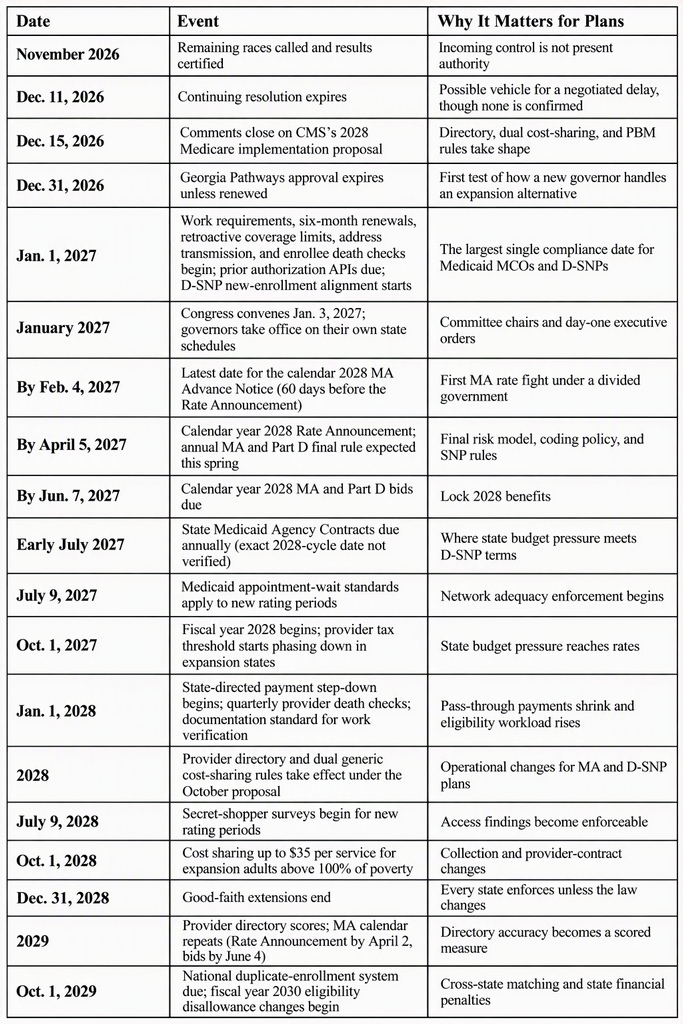
The First 100 Days
Three signals will provide the most information to government program health plans before April 2027. First, whether the Dec. 11, 2026, funding bill carries any Medicaid language, which will show if Jan. 1, 2027, is negotiable. Second, how many new governors ask for relief and how many requests CMS approves. Third, whether the calendar year 2028 Advance Notice holds the 2024 risk model and the chart-review exclusions, because that document will show whether the administration plans to bargain over MA coding or defend it.
References
[1] https://www.kff.org/quick-insights/midterm-voters-give-democrats-a-big-advantage-to-handle-health-care/
[2] https://www.medicaid.gov/medicaid/downloads/ce-requirement-ifc-deck.pdf
[3] https://www.medicaid.gov/federal-policy-guidance/downloads/smd26001.pdf
[4] https://www.medicaid.gov/federal-policy-guidance/downloads/cib11182025.pdf
[5] https://www.kff.org/medicaid/health-provisions-in-the-2025-federal-budget-reconciliation-law/
[6] https://ccf.georgetown.edu/2025/08/14/new-cbo-health-coverage-estimates-of-budget-reconciliation-law/
[7] https://www.congress.gov/119/plaws/publ103/PLAW-119publ103.pdf
[8] https://www.reuters.com/legal/litigation/health-insurers-hospitals-rally-after-sweeping-midterm-win-democrats-2026-11-04/
[9] https://www.federalregister.gov/documents/2026/06/03/2026-11094/medicaid-program-community-engagement-requirement-for-certain-individuals
[10] https://www.iowapublicradio.org/state-government-news/2026-10-28/five-takeaways-final-iowa-governor-debate-rob-sand-and-zach-lahn-midterms-elections-healthcare-cancer-water-quality
[11] https://www.njoag.gov/wp-content/uploads/2026/10/2026-1029_dkt-147-opinion-on-MSJ.pdf
[12] https://apps.oregon.gov/oregon-newsroom/OR/GOV/Posts/Post/governor-kotek-pushes-for-more-time-to-protect-medicaid-coverage
[13] https://www.kcci.com/article/rob-sand-wants-to-end-iowas-privatized-medicaid-system-what-would-replace-it/73805777;
[14] https://hhs.iowa.gov/news-release/2024-09-03/iowa-hhs-announces-intent-award-medicaid-contract
[15] https://www.medicaid.gov/medicaid/section-1115-demonstrations/downloads/ga-pthwys-to-cvrge-wftc-overlay-09252026.pdf
[16] https://www.medicaid.gov/federal-policy-guidance/downloads/cib11182025.pdf
[17] https://www.medicaid.gov/medicaid/managed-care/downloads/sdp-letter-02022026.pdf
[18] https://www.cms.gov/newsroom/fact-sheets/2027-medicare-advantage-part-d-rate-announcement
[19] https://www.medpac.gov/wp-content/uploads/2026/03/Mar26_Ch12_MedPAC_Report_To_Congress_SEC.pdf
[20] https://www.govinfo.gov/app/details/BILLS-119s1105is
[21] https://www.govinfo.gov/app/details/BILLS-119hr9544ih
[22] https://www.cms.gov/newsroom/fact-sheets/contract-year-2025-medicare-advantage-part-d-final-rule-cms-4205-f
[23] https://www.law.cornell.edu/cfr/text/42/422.514
[24] https://www.hhs.gov/guidance/document/d-snps-integration-unified-appeals-grievance-requirements
[25] https://www.cms.gov/newsroom/fact-sheets/contract-year-2027-medicare-advantage-part-d-final-rule
[26] https://www.cms.gov/newsroom/fact-sheets/medicare-program-implementation-sections-6219-6220-6224-consolidated-appropriations-act-2026-cms
[27] https://www.medicaid.gov/medicaid/downloads/ce-requirement-ifc-deck.pdf
[28] https://www.medicaid.gov/federal-policy-guidance/downloads/cib11182025.pdf
[29] https://www.cms.gov/newsroom/fact-sheets/cms-interoperability-prior-authorization-final-rule-cms-0057-f
[30] https://www.ecfr.gov/current/title-42/chapter-IV/subchapter-C/part-438/subpart-B/section-438.68
[31] https://www.cms.gov/data-research/monitoring-programs/medicare-advantage-risk-adjustment-data-validation-radv-program/radv-announcements
[32] https://www.justice.gov/opa/pr/kaiser-permanente-affiliates-pay-556m-resolve-false-claims-act-allegations
[33] https://www.justice.gov/opa/pr/villages-health-system-llc-agrees-5415m-settlement-resolve-false-claims-act-allegations
[34] https://oig.hhs.gov/reports/all/2026/medicaid-fraud-control-units-annual-report-fiscal-year-2025/
[35] https://www.justice.gov/opa/pr/national-health-care-fraud-takedown-results-455-defendants-charged-connection-over-65
[36] https://mn.gov/dhs/about-us/legislative-media/media/news/?id=1053-711321
[37] https://www.justice.gov/opa/pr/minnesota-health-care-fraud-takedown-results-charges-against-15-defendants-over-90m-fraud
[38] https://www.cms.gov/newsroom/fact-sheets/fiscal-year-2025-improper-payments-fact-sheet
[39] https://www.cms.gov/files/document/2025-perm-medicaid-improper-payment-rates.pdf
[40] https://hsph.harvard.edu/news/coverage-losses-substantial-confusion-in-arkansas-following-implementation-of-medicaid-work-requirements/
[41] https://www.medicaid.gov/federal-policy-guidance/downloads/cib11182025.pdf
[42] https://www.ecfr.gov/current/title-42/chapter-IV/subchapter-C/part-438/subpart-H/section-438.608
[43] https://www.flhouse.gov/Statutes/2026/0409.91212/
[44] https://oig.hhs.gov/reports/all/2025/some-medicaid-managed-care-plans-made-few-or-no-referrals-of-potential-provider-fraud/
[45] https://www.law.cornell.edu/uscode/text/42/1395w-23
[46] https://www.law.cornell.edu/cfr/text/42/422.254
© Copyright 2026. The views expressed herein are those of the author(s) and not necessarily the views of Ankura Consulting Group, LLC, its management, its subsidiaries, its affiliates, or its other professionals. Ankura is not a law firm and cannot provide legal advice.

