






Following the U.S. Supreme Court’s Feb. 20 decision in Learning Resources Inc. v. Trump, holding that the International Emergency Economic Powers Act (IEEPA) does not authorize the president to impose tariffs, numerous consumer plaintiffs have filed class actions against major retailers and consumer brands, including IKEA, Costco, Sony, and Nintendo.
Plaintiffs in many of these cases claim that defendant retailers or manufacturers have received “windfall profits generated as a consequence of the unlawful tariffs,” because they passed on tariff costs to their customers prior to receiving a refund.[1] While this argument may sound straightforward, the economics of whether a defendant retailer or manufacturer received a windfall is more complex.
Indeed, as we explain below, under a variety of economic circumstances, defendant firms may have sustained lost profits from tariffs — even if they passed some of the tariff cost into consumer prices and later received a refund.
The Complexity of the Pass-Through Question in the Refund Setting
As an initial matter, it is important to consider whether a defendant firm passed through tariff costs into prices at all and, if so, determine the extent to which pass-through occurred.
Standard economic analysis of pass-through rates dictates that the pass-through of a cost increase, including a tariff, depends on the elasticity of demand facing a firm — i.e., how the quantity it sells responds to price changes — competitive conditions and firm costs.
Depending on these factors, pass-through can range anywhere from 0% to over 100%, and can vary across products, locations, customers, and time. In addition, the price that consumers pay can depend on the pass-through rate occurring at multiple levels of distribution, such as an importer selling to a distributor that sells to a retailer.
In the context of IEEPA tariff refunds, however, an additional important factor is capable of affecting pass-through. When the tariffs were imposed, some firms anticipated that some or all of the tariffs might later be refunded, as was widely reported in the media.[2] Indeed, in 2025, some firms sold claims to potential future tariff refunds to investors based on the possibility that these tariffs would later be refunded.[3]
An economically rational importer paying tariffs would have incorporated the possibility of a future refund into its pricing to its customers, thereby possibly reducing or eliminating pass-through of tariff costs into its prices. This can have important implications for damages and the class certification question.
Whether a particular importer profited overall from IEEPA tariffs and subsequent refunds would depend on supply and demand factors for the product it sold and its pricing response
to the tariffs, including the consideration of a potential future refund.
Several additional factors can also be important. One factor is whether foreign exporters lowered their prices due to the imposition of the tariff, or what economists call the incidence of the tariff.
At least one peer-reviewed economic study of tariffs imposed around 2018 found that foreign exporters did not lower their prices in response to a tariff and that the brunt of the tariff was therefore borne by U.S. importers.[4]
But this is not always the result when tariffs are imposed. Other factors affecting pass-through include competing firms’ response to tariffs in their pricing, and whether and to what extent defendants may have borne additional costs in responding to tariffs, such as management time and legal costs.
Why the Impact on Quantity Is Critical
A critical consideration affecting whether a defendant that passed through some of a tariff obtained windfall profits is how the increased price that it charged may have reduced the quantity of products that it sold.
According to the law of demand, a firm that passes through some or all of the cost of a tariff into the prices it charges will typically experience a reduction in the quantity it sells. The lost profit due to this reduction in quantity is capable of partially, or even entirely, offsetting any profits that a firm may receive from a price increase combined with a tariff refund.
Consider the following illustrative example, based on a simplified example of a monopolist with constant marginal costs and a linear demand curve where the firm’s objective is to set prices to maximize its profits.[5]
Suppose the firm initially faced a marginal cost of $70. In this instance, the firm’s profit is maximized at a price of $85 per unit and sales of 15 units. Now suppose that a tariff of $10 per unit is imposed. Based on the assumption of profit maximization in this example, the firm passes through half of this tariff into a price increase, thereby increasing the price to
$90 and, as shown in the figure below, this price increase causes the quantity it sells to fall from 15 units to 10 units.

As shown below, before the tariff, the hypothetical firm received profits of $225. After the tariff, and before the tariff refund, its profits dropped to $100. It receives a tariff refund of
$100, based on the 10 units it sells and a tariff cost of $10 per unit. Therefore, the profits of the firm drop, even after the refund, from $225 to $200.
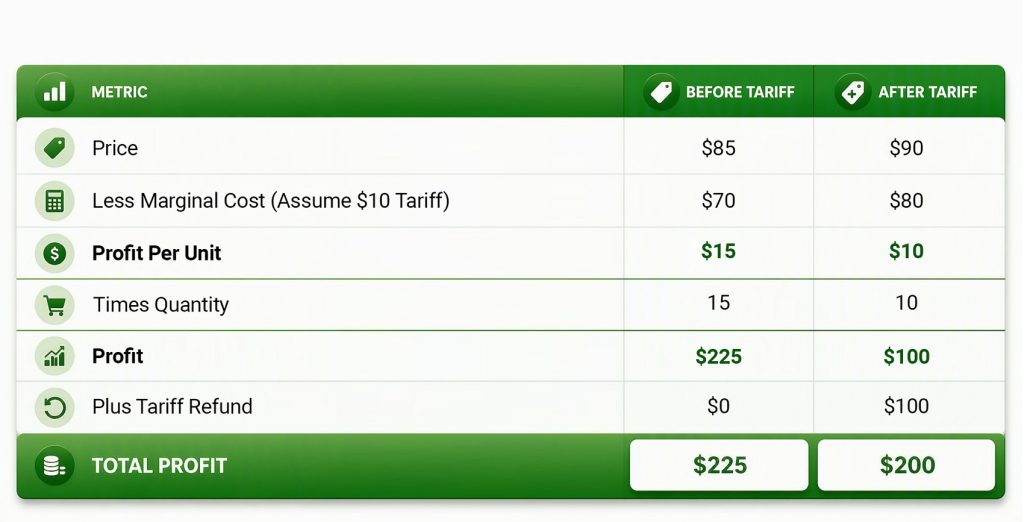
In this example, both the hypothetical defendant/importer and its customers are worse off from the imposition of the tariff that is later refunded. Why? Tariffs can create economic waste or deadweight loss that imposes costs on both consumers and producers.
The imposition of the tariff causes a distortion in market prices that reduces the firm’s quantity sold. The price is not only higher than it would have been absent the tariff, but the price is also higher than the importer would have charged to maximize its own profits.
Although the result in our example can be shown to hold using a variety of alternative assumptions about cost and demand — and does not require the assumption of a monopolist
— different modeling assumptions would lead to different results. This includes the possibility of the importer profiting from a tariff and a subsequent refund.
However, this example illustrates a key point — IEEPA tariffs did not necessarily generate windfall profits for defendants in the recent tariff refund class actions. The issue is more complex, and experts need to consider the defendant’s economic circumstances in order to analyze whether they may have benefited from IEEPA tariffs and subsequent refunds.
Key Takeaways
As consumer plaintiffs continue to bring class actions against retailers and manufacturers, a key consideration will be whether defendants received windfall profits. Although the argument that defendants must have received a windfall by both passing through tariff costs into their prices and receiving a refund appears straightforward, the issue is far more complex.
As we have explained, at least two important economic considerations demonstrate this complexity: (1) the pass-through question and, in particular, whether the defendant may have considered the possibility of a refund in setting its pricing; and (2) the impact on the quantity sold by the defendant, and the corresponding impact on the defendant’s profits. Economic experts that are retained by both plaintiffs and defendants will need to consider these factors.
This article was originally published by Law360 on June 15, 2026.
References
- See, e.g., Complaint, Stockov v. Costco Wholesale Corporation, 1:26-cv-02734, (N.D. Ill.), March 11, 2026. See also Complaint, Walker et al v. Sony Interactive Entertainment LLC, 3:26-cv-04121, (N.D. Cal.), May 6, 2026.
- Lynch, David J., “Wall Street bets against Trump on tariff refunds, while importers suffer,” The Washington Post, September 24, 2025.
- Id.
- See, e.g., Fajgelbaum, Pablo D., Pinelopi K. Goldberg, Patrick J. Kennedy, and Amit K. Khandelwal, “The Return to Protectionism,” The Quarterly Journal of Economics, 2020.
- Defendants in the recent consumer “tariff refund” class actions are typically brand name firms. Because of this, the impact of tariffs on these firms should be assessed under an economic framework in which they have an ability to set prices (and not under an assumption of “perfectly competitive conditions” in which firms are assumed to act as “price takers”).
© Copyright 2026. The views expressed herein are those of the author(s) and not necessarily the views of Ankura Consulting Group, LLC, its management, its subsidiaries, its affiliates, or its other professionals. Ankura is not a law firm and cannot provide legal advice.

