






Introduction
Mergers and acquisitions (M&A) in the banking sector have resurged, marking their highest level of activity since 2021. With 159 deals announced through November 2025, totaling $47.6 billion in value, the market is clearly signaling a definitive return to consolidation.
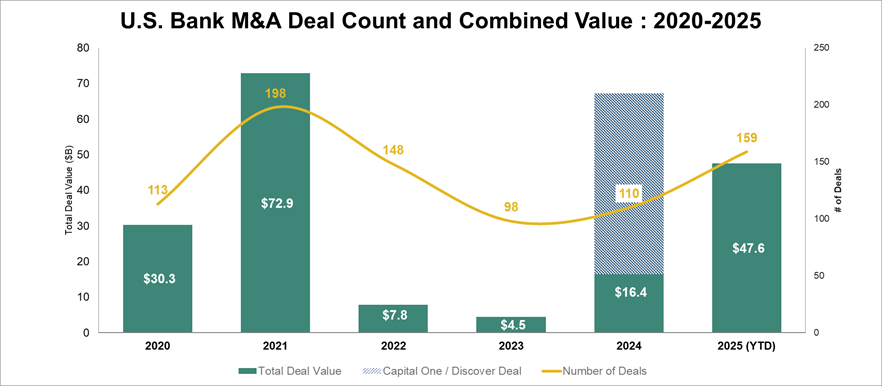
Data as of Nov. 30
Given the substantial investment of valuable time and capital required to execute these transactions, it is imperative that acquirers preserve and leverage the critical information obtained through due diligence. Yet, industry data suggests a significant opportunity remains for banks to better capture this value. An analysis of 100 bank mergers over the past five years reveals a troubling trend where over 50% of buyers saw their efficiency ratio decrease in the years following an acquisition (per S&P data).
To reverse this trend, banks must bridge the gap between deal modeling and integration execution. Rather than treating the financial assumptions used to justify a deal’s price as theoretical targets, successful acquirers view them as a concrete playbook.
This focus is vital, as the first 12 to 18 months following a deal’s closing are critical for future success. Within that window, if organizations can implement real change, deliver on synergy targets, and maintain forecasted revenue growth, they position themselves to outperform peers and achieve the Internal Rate of Return (IRR) and payback periods envisioned during due diligence.
The key to unlocking this value lies in evolving the traditional M&A blueprint. Historically, the process has been sequential and siloed: A deal team builds the financial case, then hands off the plan to a separate integration team that often lacks the context behind the numbers. Engaging a single, integrated team from due diligence through to post-merger integration is the most effective way to ensure the assumptions that justify the deal are the same ones that drive the integration, maximizing value capture.
The Divide: The Pitfalls of a Bifurcated M&A Process
In a traditional M&A process, the deal model is often the first casualty. Because the team that builds the financial case is typically not engaged to oversee the integration, the model, which should be the blueprint for value creation, becomes a historical artifact stored in a deal folder. The strategic rationale, nuanced findings, and critical synergy assumptions from due diligence are poorly transferred, and the “why” behind the numbers is lost.
This disconnect leads to a predictable and costly erosion of deal value:
- Assumption Decay: The financial case evaporates as theoretical synergies are never translated into action. For example, a modeled “5% information technology (IT) cost save” may never consider the licensing fees that increase due to complex lending activities, just as a “10% cross-sell synergy” often fails to account for transaction-related customer attrition.
- Loss of Knowledge: Critical insights gathered during diligence regarding culture, operational risks, technology gaps, and key talent are lost in translation.
- Delayed Momentum: The integration team is forced to relearn the business and the deal’s strategic drivers, wasting valuable time in the crucial initial post-announcement period.
- Value Leakage: When the integration plan is not directly tied to the deal’s financial assumptions, synergies become hopeful targets rather than actionable, tracked goals. The deal’s promised value erodes, not in a single moment, but incrementally across dozens of disconnected workstreams.
The Unified Approach: Building a Bridge from Due Diligence to Integration
To stop value leakage, banks must establish a dedicated integration and synergy diligence workstream from day one of the due diligence process. This team, composed of integration leads and project managers, should work closely with the deal team to translate assumptions into actionable items immediately.
While covering standard diligence essentials, this unified team actively looks for:
- Integration Risks and Opportunities: They ask, “What will it actually take to integrate the acquired portfolio into the existing allowance process, and what will be the incremental costs? How can personnel redundancies be remedied without the loss of key human capital?”
- Cultural Mismatches: They investigate beyond the balance sheet: “How do decision-making and risk appetites differ? Are there any incoming relationships that fall outside the bank’s underwriting standards?”
- Technology and Operational Dependencies: They identify hidden complexities: “Where are the hidden roadblocks in the core conversion process? Will the system have the capabilities required to manage accretion and amortization of the acquired portfolio?”
By involving integration experts early, the team can stress-test synergy assumptions in real-time. For instance, if a “cost save” involves consolidating data centers, the integration team can immediately map out the high-level steps, regulatory compliance requirements, timelines, and risks involved before the deal is signed.
The Implementation: The Power of KPIs and Dashboards
What is not measured cannot be managed. The strategic goals of a merger must be translated into tangible, trackable metrics subject to specific timelines. As most small to midsize banks lack the scale to employ their own permanent Project Management Office (PMO) teams, this discipline must be injected externally or developed specifically for the transaction.
The process starts during due diligence by linking every major synergy and value driver to a proposed key performance indicator (KPI) and an accountable party. These KPIs generally fall into three categories:
- Financial: Cost-save realization (by department with clear noninterest expense reduction targets), revenue synergy capture, and deposit retention.
- Operational: System migration milestones, administrative consolidation, regulatory reporting preparedness, and day one readiness metrics.
- Customer-Focused: Customer retention rates, Net Promoter Score (NPS) changes post-merger, and digital channel adoption.
To govern this, the Integration Management Office (IMO) must create a centralized dashboard that serves as the “single source of truth” for all stakeholders. This dashboard should feature visual tracking of KPIs against targets, clear linkage between KPIs and the workstreams driving them, explicit ownership for each metric, and a proactive path for risk escalation. This transforms integration from a series of disjointed projects into a coordinated, value-focused program.
Key Takeaways
The gap between a deal model’s theory and an integration’s reality is where deal value is most often lost. To bridge this divide, banks must challenge the traditional, siloed M&A blueprint. By engaging integration teams during due diligence, leadership can stress-test assumptions before they become promises, ensuring that synergy targets are actionable rather than aspirational.
Ultimately, investors reward execution, not just intent. By unifying the diligence and integration lifecycles, banks do more than just close a transaction: They de-risk the future, ensuring that the metrics promised to the street become the results delivered to shareholders.
How Ankura Can Help
Translating a deal model into operational reality is a defining challenge for today’s banking leaders. Ankura bridges the critical gap between due diligence and integration, ensuring that the assumptions driving your valuation become the targets driving your execution. Our team works with you from the moment a deal is contemplated to design actionable roadmaps that identify risks and opportunities early, rather than waiting for post-close discovery. We specialize in standing up robust IMOs and deploying the rigorous KPI frameworks and dashboards needed to maintain a single source of truth for leadership. Whether leading complex workstreams or establishing governance, we ensure your integration plan is executed with the same precision used to build your financial model.
To learn more about how we can help you unify your M&A process and maximize deal value, contact us for a confidential discussion.
© Copyright 2025. The views expressed herein are those of the author(s) and not necessarily the views of Ankura Consulting Group, LLC., its management, its subsidiaries, its affiliates, or its other professionals. Ankura is not a law firm and cannot provide legal advice.

