






The Pipeline is Collapsing From the Bottom Up
For decades, the career path after college was clear. One began in an entry-level role, built experience, and ascended professionally. Those first positions taught what classrooms could not. They taught how to work in a professional environment, how to think, and how to lead.
But that entry point is eroding, and soon, it may disappear entirely.
Artificial intelligence (AI) is diminishing the need for entry-level positions. It can now automate the very tasks that once defined the start of a profession, analyzing spreadsheets, drafting reports, and summarizing data. The work that taught judgment and context has become a script of code that is executed in seconds.
And the question is no longer where to start your career, but whether you can start it at all.
The Power of AI
Redefining Productivity Across Every Industry
History shows that power tends to concentrate in the hands of a few. AI, however, represents a rare disruption — an extraordinarily powerful tool available to everyone. Yet as individuals begin to harness this new source of power, many leaders are working just as quickly to reclaim it — using AI not to lift people up, but to tighten control and efficiency from the top.
Across a variety of different industries AI is redefining efficiency:
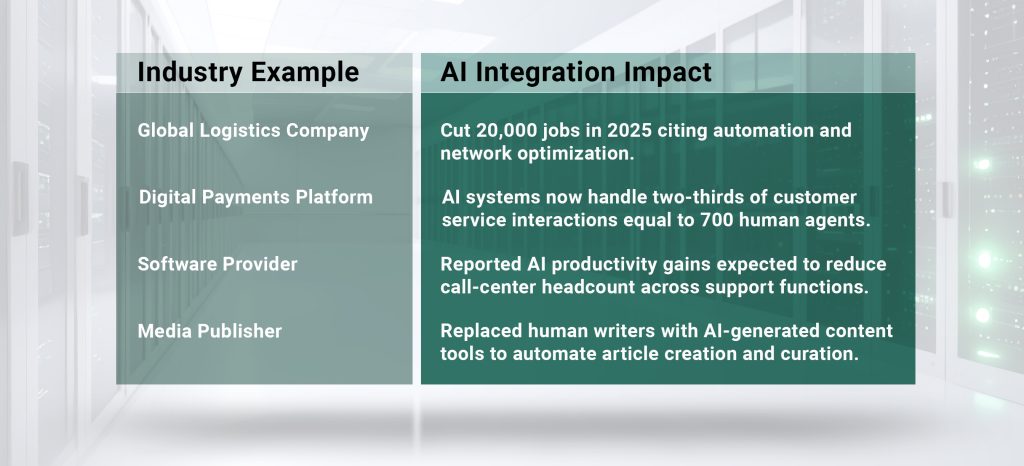
AI is not just automating work — it is rewiring the foundation of how careers begin.
These are not isolated incidents; they represent a fundamental reallocation of human labor.
Entry-level jobs, which once made up over half of a company’s pipeline hires, are disappearing faster than schools and training programs can keep up. Tasks that taught judgment, problem-solving, and collaboration are now completed by AI systems that execute faster than humans can learn.
AI did not just automate tasks; it automated the first decade of a graduates’ career.
The years that used to build experience and context have collapsed into algorithms that simulate expertise instantly. What was once earned through repetition is now produced through replication.
When you remove the entry point, you remove the path forward.
The Structure That Built Experience
This Was the Career On-Ramp — Wide, Accessible, and Essential for Developing Tomorrow’s Leaders

Every industry once followed a version of this structure — broad at the base, narrow at the top. It created space for new talent to enter, learn, and advance. While the chart shows analysts, these roles could just as easily be junior designers, marketing coordinators, operations assistants, human resource (HR) specialists, or customer service representatives. They were the foundation of the organization, the entry point for new graduates and early-career professionals to learn, experiment, and grow.
But more importantly, this model depended on scale at the bottom. Companies once hired large numbers of entry-level employees, expecting that experience would move some into management roles, while only a few would advance to the executive level.
It was a system that built capability by investing in people at the earliest stage of their career.
The Power of Scale
AI Becomes the Force Multiplier — 1 Person, 4 Times the Output
AI has become the ultimate force multiplier — increasing productivity, precision, and revenue all at once. Companies should treat AI as a revenue growth strategy, using it to expand capacity, accelerate output, and scale operations without adding headcount.

Each data scientist now manages a team of AI assistants that perform the analytical groundwork — gathering data, modeling outcomes, and producing reports. These assistants do not just automate tasks; they extend human capability.
With them, one person can now produce the output of four full-time employees, essentially taking on what used to be four separate jobs within the organization.
One person’s skills are amplified through intelligent systems that work around the clock.
It is not about replacing talent; it is about magnifying it.
The Safe Bet in an Uncertain Market

How Companies Choose Stability When the Market is Unclear
In this model, companies use AI to stabilize rather than scale. They focus on cost reduction, efficiency, and margin protection.
While the Revenue Growth Strategy leans into AI as a force multiplier to expand output and take on more risk, the Cost-Out Model minimizes exposure. The logic is simple: If AI can automate repetitive, transactional work, then headcount can be reduced without sacrificing core output.
Where the revenue model needed four data scientists supported by AI assistants to produce exponential results, this model only has one data scientist doing the work of four. That makes this the safest model in the short term, with less volatility, more predictability, and stronger profit margins.
But safety has a cost. This approach protects the balance sheet while shrinking the bench.
It limits the organization’s ability to innovate or rebound when the market shifts. The very people who could have adapted to the business are already gone.
AI Did Not Close the Career On-Ramp: It Changed the Materials We Will Use to Rebuild It
In the Future Work State — AI Should Not Be Replaced but Be an Avenue of Growth
Across all three models, one truth stands out: the career on-ramp is narrowing.
The baseline pyramid built experience from the ground up.
The revenue growth model replaced much of that foundation with AI leverage, one person now doing the work of four.
And the cost-out model compressed it even further keeping the lane open, but shrinking it from four people to one.
The result? The opportunities to learn are shrinking, there are fewer roles to grow through, and a generation of workers trying to merge onto a highway that is moving faster than ever.
But the on-ramp is not gone, it is just under construction. The question is whether companies will rebuild it or let it keep narrowing until no one new can enter.
If organizations continue optimizing only for speed or cost, the next generation of talent will never have a chance to learn. The “entry level” will become a closed gate, not because people cannot do the work, but because the work no longer exists in a form they can learn from.
If we rethink how AI is used — not as a substitute for people, but as a tool to amplify and teach, the on-ramp can reopen.
AI can train, guide, and accelerate development, allowing early-career employees to build judgment faster than ever before.
The path forward is not about choosing between efficiency and growth. It is about redesigning current systems, where both can coexist
The companies that win in the next decade will not be the ones that simply adopted AI; they will be the ones that used AI to rebuild the career on-ramp.
Listen to the conversation on the career on‑ramp on The Impact Exchange.
© Copyright 2026. The views expressed herein are those of the author(s) and not necessarily the views of Ankura Consulting Group, LLC, its management, its subsidiaries, its affiliates, or its other professionals. Ankura is not a law firm and cannot provide legal advice.

