






Introduction
Manufacturers operating across regulated and emerging markets continue to rely heavily on third‑party distributors to access local customers, navigate customs requirements, understand local sales channels, and execute sales activities efficiently. This distribution model is commercially effective and often necessary, particularly in jurisdictions where direct market access is impractical.
However, distributor‑driven models also introduce structural oversight challenges that manufacturers do not always fully appreciate or control. In practice, these challenges commonly include:
- Limited visibility over distributors’ books and records and the quality of underlying financial information retained by the distributors;
- Exposure to anti‑bribery and anti‑corruption (ABC) risks arising from gifts, payments, and interactions with customers, politically exposed persons, and government bodies;
- Trade sanctions and export control risks across higher‑risk or rapidly changing jurisdictions;
- Inventory leakage, sales diversion, and pricing misconduct across multiple sales channels;
- Heightened risk of concealed related‑party transactions and fund diversion; and
- Reliance on smaller, family‑run organisations that may not have sophisticated governance or compliance frameworks, particularly when distributing multinational products in higher‑risk markets.
Regulatory expectations relating to third‑party oversight of distributors continue to evolve, with enforcement authorities making clear that manufacturers cannot outsource compliance risk through distributors. Recent enforcement actions[1] globally have reinforced these expectations and increased scrutiny of manufacturers’ ability to demonstrate effective oversight of distributor activities.
This article sets out the key risk areas most commonly observed in distributor compliance reviews based on our experience, as well as practical measures manufacturers can deploy to strengthen distributor oversight in a proportionate and commercially workable manner.
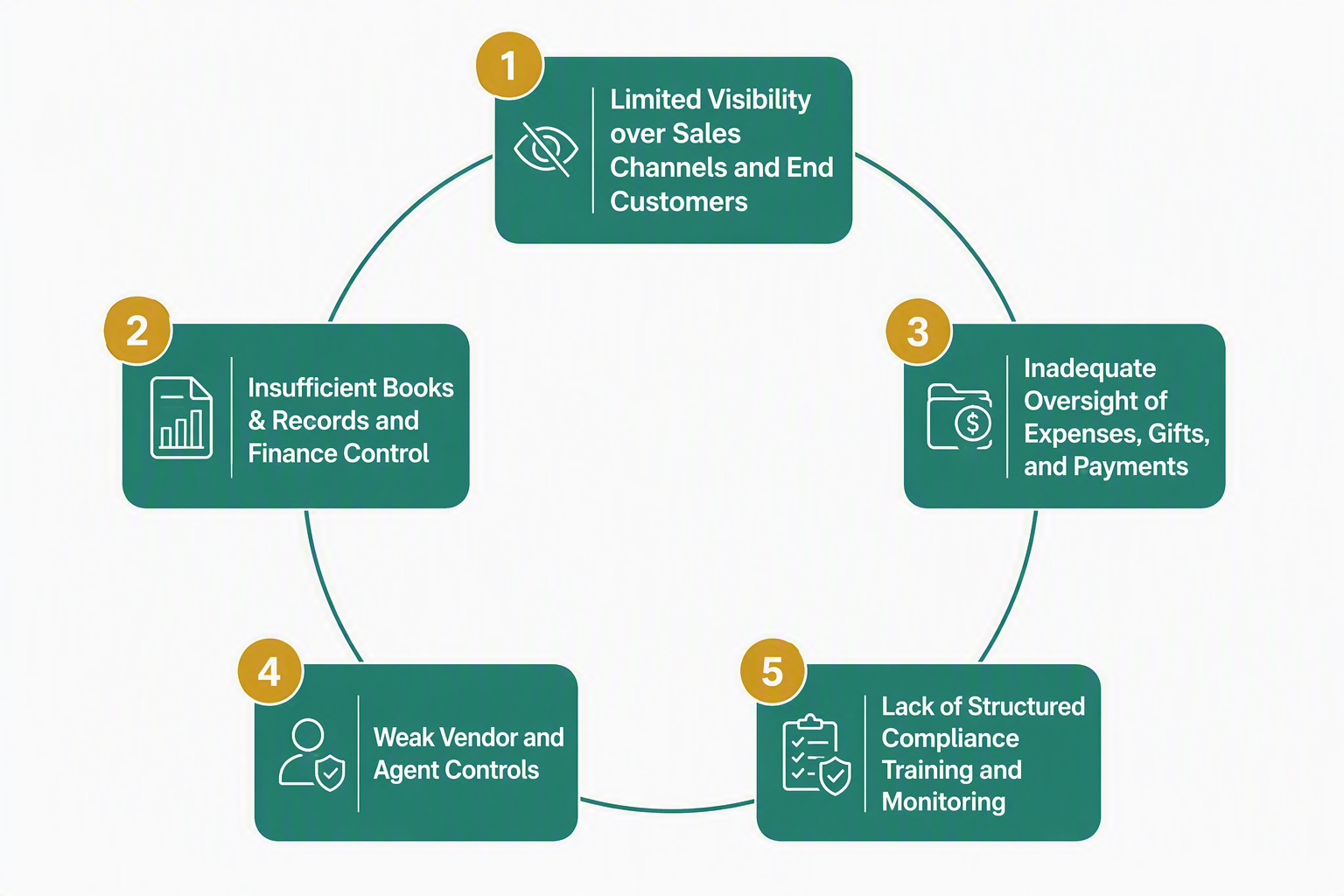
5 Core Risk Areas in Distributor Compliance Reviews
Third-party distributor compliance risks can fall into the following five distinct areas. These areas should be assessed holistically, recognising that weaknesses in one area often compound risks elsewhere. While the specific risk profile may vary by jurisdiction, product type, and distribution model, these themes consistently emerge across distributor oversight reviews.
Moving From Periodic Reviews to Continuous Risk Management
For manufacturers operating through global distribution networks, distributor-related risks are not static. Left unchecked, weaknesses can compound over time, exposing manufacturers to legal, financial, and reputational harm. Regulatory expectations continue to evolve, particularly in relation to ABC enforcement, trade sanctions and export controls, and country-specific enforcement priorities and expectations.
At the same time, distributor operating models frequently change, including ownership and management turnover, shifts in sales channels, customer profiles and vendor relationships, expansion into higher‑risk markets, increased exposure to regulated customers, and changing country‑specific or regional market dynamics.
A successful distributor compliance review should include, but is not limited to, the following key elements:
- Pre‑site visit data analytics, including reconciliation of sales, rebate and expense data between manufacturer’s and distributor’s records, and identification of higher‑risk or anomalous transactions, which can help highlight potential control gaps and inform a more efficient on‑site testing strategy;
- On site reviews of books and records, conducted with the necessary language capabilities and interpersonal skills, are critical to understand how distributors actually operate.Validation of actual practices against documented policies helps identify gaps between intention and execution; and
- Management and sales personnel interviews frequently surface issues that are not documented on paper.
Independence is also critical. Distributors are often more willing to engage openly in a review process conducted by an independent third party, rather than disclosing sensitive commercial and financial information directly to the manufacturer. Independent reviewers provide knowledgeable, objective, and unbiased assessments, particularly where internal resources are constrained or focused on competing commercial priorities.
Adopting a Risk-Based Approach
To strengthen distributor oversight in a sustainable manner, manufacturers should benchmark their distributor compliance against the five core risk areas outlined above. In doing so, manufacturers should establish a clear baseline of their risk appetite and the distributors’ risk exposure.
Reviews should be conducted on a risk‑based approach, taking into account distributor’s risk profile, commercial significance, and regulatory exposure, for example:
- Lower‑risk distributors may be reviewed through desktop due diligence, focused document reviews, and targeted testing; and
- Higher‑risk distributors often require on‑site assessments, management and sales personnel interviews, and enhanced monitoring mechanisms.
Where internal resources, geographic coverage, or independence are limited, engaging external specialists to conduct independent compliance reviews can support a more objective and defensible assessment of distributor‑related risks.
| Case Study Ankura was retained by a U.S. manufacturing organisation to conduct a multi-jurisdictional review of its third-party distributor network. The review included distributor due diligence, management interviews, data analytics, and risk-based testing of sales and expense activity across several countries over a two-year period. The review identified control weaknesses across multiple distributor oversight areas, particularly within higher-risk jurisdictions. Ankura developed practical, risk-based recommendations to strengthen distributor oversight and mitigate bribery, corruption, and sales-diversion risks. The engagement enhanced management’s visibility over distributor activities and supported the client’s broader compliance programme. |
Conclusion
As regulatory expectations continue to rise and distribution models become increasingly complex, distributor oversight is no longer solely a compliance issue. It is a governance, commercial, and reputational imperative. Manufacturers that proactively assess and manage distributor-related risks are better positioned to protect enterprise value, strengthen stakeholder confidence, and support sustainable growth across global markets. In an environment of heightened regulatory scrutiny and growing stakeholder expectations, effective distributor oversight can become a source of competitive advantage, not merely a compliance obligation.
Source
[1] Enforcement release dated 8 July 2025 by The Office of Foreign Assets Control
© Copyright 2026. The views expressed herein are those of the author(s) and not necessarily the views of Ankura Consulting Group, LLC, its management, its subsidiaries, its affiliates, or its other professionals. Ankura is not a law firm and cannot provide legal advice.

