






Walk into any private equity boardroom in the final 18 months of a hold period, and you can feel the temperature shift before the deck is even on the screen. The board is not there to learn the business. They are there to underwrite the exit. Every slide gets read through the same lens: Does this number, this story, this forecast, hold up to the diligence the next buyer will run?
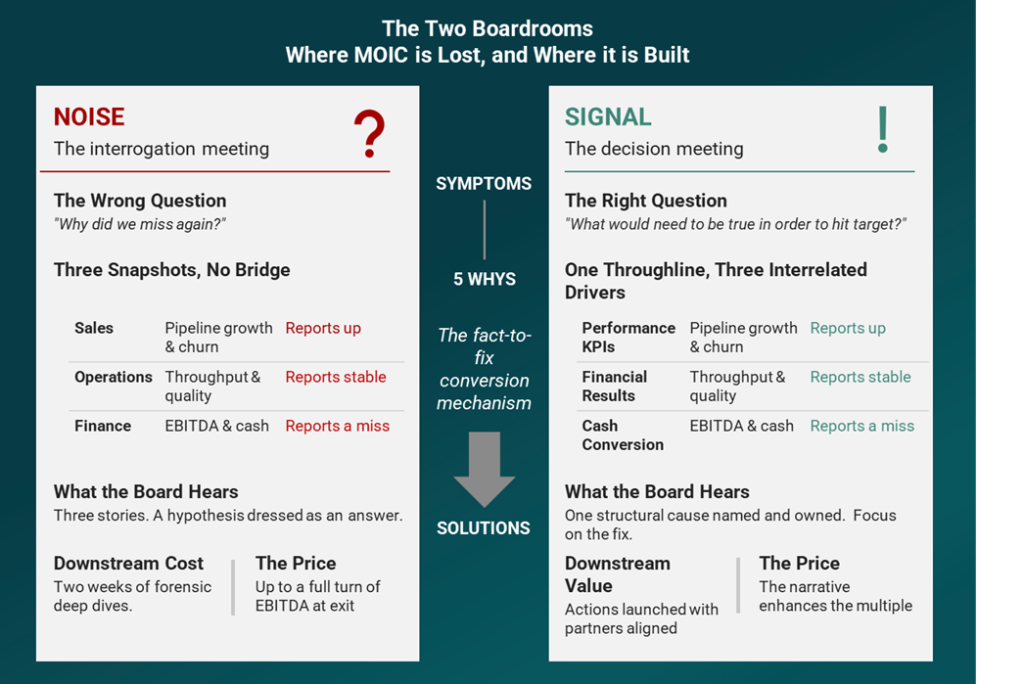
Then the CFO advances to the variance slide, and a director leans forward and asks the question that defines the next 40 minutes of the meeting: “Why did we miss again?”
And just like that, the meeting changes shape. The following 40 minutes are not about the value creation plan. They are about retrospective explanations. The CFO produces context the board will accept as plausible. Some pricing pressure. A slipped order. A competitor’s aggressive bid. Action items get assigned. A follow-up deep dive is scheduled. The CEO promises a written response within the week. Nobody in the room notices what just happened.
The board did not get an answer. They got a hypothesis that they could not verify, dressed up to feel like one. And the management team just inherited two weeks of work that will not move EBITDA one basis point.
This is not a story about a bad board or a weak CFO. This is the most common failure mode in private equity portfolio governance, and it has a structural cause. The narrative connecting operational performance, financial results, and cash has fractured, and nobody is rebuilding it in real time. Until somebody does, every quarter is going to look like the last one.
The discipline that fixes this is what we call separating the noise from the signal. It is not a reporting upgrade. It is not a new dashboard. It is a way of running the conversation between the CFO and the board so that questions point forward, answers carry weight, and management spends its time executing rather than explaining.
The tools to make this achievable in a live portfolio company have arrived. The CFOs who use them will reset the relationship with their boards within a quarter. The ones who do not will spend the back half of their hold period defending variances they should have been preventing.
Why Board Narratives Fracture
The honest answer most CFOs would give, if the room were small enough, is that they have lost the ability to integrate the picture in real time. Sales reports growth in pipeline and churn. Operations reports throughput and quality. Finance reports EBITDA and cash. Three teams, three dashboards, three sets of numbers, and no shared driver tree connecting them. The board hears three separate stories at every meeting and is asked to integrate them on the fly. They cannot, and they know it, so they default to the one question that always works: Where is the gap, and why is it there?
The fracture spreads from there. EBITDA is up but cash is down, and the CFO has 30 seconds to explain why. Without a disciplined Cash-to-EBITDA bridge, the board defaults to skepticism. And skepticism, once it enters the room, does not leave. The forecast says EBITDA is significantly below target, and nobody in the room can articulate what changed, when it changed, or which specific initiative will close the gap. Investment cases for capex or initiatives become difficult to evaluate. The forecast becomes a number to defend rather than a plan to execute. The variance bridge reads price unfavorable, mix unfavorable, volume favorable, and the board can recite the labels back word for word, but the underlying why is missing. In each of these instances, we hear the noise but fail to see the signal.
Each of these gaps is survivable on its own. Together they create a board meeting in which management spends more energy explaining the past than executing the future. In the back half of a hold period, energy spent on the past is Multiple on Invested Capital (MOIC) left on the table. The cost is not theoretical. Every quarter spent in forensics is a quarter not spent on price discipline, commercial mix, working capital release, or the operational moves that compound into the exit multiple. Twelve months of board meetings spent looking backward can quietly cost a portfolio company a full turn of exit multiple. The math is not subtle.
The deeper problem is that the wrong question is getting asked first. “Why did we miss?” points the team backward. “What would need to be true to hit?” points the team forward. The first question generates explanations. The second generates a plan. Most board meetings open with explaining the past, and most management teams spend the rest of the meeting trying to recover.
Asking the Right Question First
There is an operational discipline borrowed from the Toyota Production System that solves this, and it has been hiding in plain sight for 50 years. It is called the Five Whys, and it was developed by Sakichi Toyoda as the core diagnostic tool of root-cause analysis. The premise is simple: When something goes wrong, the first explanation you reach is almost always a symptom and never the actual cause. Ask why again, and you find a second, more deeply rooted symptom. Keep asking why until you arrive at something that is structurally fixable, not just observationally true.
Most boards never get past the first why. The CFO gets asked why EBITDA missed, says “price was unfavorable,” the board nods, and the meeting moves on. The actual cause, the thing that would need to change for next quarter to look different, is still buried four whys down. By skipping the discipline, the board has guaranteed the same conversation will happen again at the next meeting.
Consider a hypothetical mid-market portfolio company called AnyCorp Components, a precision widget distributor doing $475 million in revenue. This company is 4.5 years into its hold period with EBITDA stuck at 6.7% against a thesis that demanded 11%. The market views AnyCorp’s product as a commodity. Pricing pressure is constant and the exit window is 12-18 months out. At the most recent board meeting, the lead director asks the inevitable question: Why did we miss EBITDA again?
The CFO’s first answer is the one most CFOs give. Pricing was unfavorable in the quarter, by roughly 140 bps of margin. True, but not useful. Ask why again. Pricing was unfavorable because the sales team conceded discounts on three large accounts that came up for renewal. Ask why again. Discounts were conceded because the sales team did not have visibility into the actual cost-to-serve on those accounts and assumed the business was profitable at the quoted price. Ask why again. They did not have cost-to-serve visibility because the operations team and the finance team measure margin differently, and the system of record for product-level profitability has not been reconciled in 18 months. Ask why one more time. The reconciliation has not happened because nobody owns the linkage between the operational driver tree and the financial reporting model. It is not on anyone’s scorecard and therefore is not being used to drive the correct behaviors and decisions.
That last answer is the one the board needed. “Pricing was unfavorable” is a description. “Nobody owns the linkage between operational drivers and financial reporting” is a structural finding with a fixable owner, a defined scope, and a measurable outcome. The first answer generates a follow-up deep dive, while the fifth answer generates a value creation initiative. The first answer protects the past, while the fifth answer protects the multiple at exit.
The wrong question does not just waste a meeting. It quietly reroutes management toward the wrong work for the next 90 days.
This is the cost most boards never see. “Why did we miss?” pulls the management team into a backward-looking forensic exercise that consumes the controller, the FP&A lead, and a meaningful share of the operations team’s analytical capacity for the next two to three weeks. By the time the deep dive deck is ready, the next month is half over, and the team is now behind on the forward-looking work that would actually have closed next quarter’s gap. The board got a surface-level explanation, but the thesis lost a month.
The fix is not to ban the question. The board is going to ask it. The fix is for the CFO to walk into the meeting having already done the Five Whys, with the structural finding ready to go, so that the conversation can move in one breath from “why did we miss” to “here is what we found, here is what we are doing about it, and here is what would need to be true for next quarter to look different.” That conversion, from defensive to forward, is the difference between a CFO the board challenges and a CFO the board trusts.
The Linkage Architecture: KPIs, Financials, and Cash
The Five Whys works only if the underlying data architecture supports it. Most do not. In a typical mid-market portfolio company, operational KPIs live in one system, financial results live in another, and cash sits in a third. The three are reconciled monthly, in a manual exercise that consumes the first two weeks of every close cycle and produces a number nobody fully trusts. When the board asks why EBITDA missed, the CFO is reaching across three disconnected systems and trying to assemble a story in the moment. It is no wonder the answer comes out as a hypothesis.
The architecture that fixes this is straightforward to describe and disciplined to build. At the top sit the operational KPIs that actually drive the business, no more than 10 or 12, each one tied to a specific revenue or cost lever. Below them sits the financial model, structured so that every line in the P&L can be traced back to one or more of those operational drivers. Below that sits the cash model, anchored by a rolling 13-week forecast and a cash-to-EBITDA bridge that explains, every period, where the conversion is happening and where it is not. The three layers are reconciled continuously, not monthly, because the value of the architecture is in real-time coherence, not month-end accuracy.
When the architecture is in place, the board meeting transforms. The CFO opens the variance slide already knowing which operational driver moved, which financial line it landed in, and what the cash implication was. The board asks “why did we miss?” and the answer comes back in one sentence, with the structural cause named, the fix in flight, and the forward implication explained. The meeting ends 30 minutes early. The action items list is short, forward-looking, and owned. The deep dive nobody needed gets cancelled. Management goes back to executing the value creation plan instead of investigating it.
This is what we mean by signal. Signal is not better data. It is data assembled into a coherent story that lets the board make a decision in the meeting rather than schedule one for later. Noise is everything else. Most portfolio companies are drowning in data and starving for signal, and the CFO is the only person in the building positioned to fix it.
Signal is not more data. It is data assembled into a coherent story that lets the board make a decision in the meeting, not schedule one for later.
Journey-Mapping the Move From Noise to Signal
Building this architecture inside a live portfolio company in the final stretch of a hold period is not a one-time project. It is a journey, and like every transformation worth doing, it has predictable phases. The CFOs who attempt it underestimate how long the first phase takes and overestimate how quickly the third phase compounds.
Phase I: Understanding the Disconnect
Before any architecture gets built, the CFO needs an honest map of where the narrative is fracturing. That means walking the recent board decks to identify questions that were not answered adequately, action items that produced a follow-up rather than a decision, and variances that were described but not understood. The pattern that emerges is the pattern that needs to be fixed. Most CFOs skip this phase because it feels like introspection rather than execution. It is the most important phase because it is the only one that produces clarity about which fractures matter most.
Phase II: Architecture
With the diagnosis in hand, the CFO designs the linkage between operational KPIs, financial results, and cash. This is the work where most transformations fail, because it requires saying no to the temptation to instrument everything. The discipline is to pick the 10 or 12 KPIs that actually move the EBITDA needle, build the financial bridge that traces them, and stand up the cash model that closes the loop. Done well, this phase produces a single page that any board member can quickly read and understand the business. Done poorly, it produces another dashboard that joins the pile.
Phase III: Operating Cadence
The architecture creates value only if the management team uses it the same way every period. That means a weekly standing review where the operating drivers are walked alongside the financial and cash implications. It means a monthly close that produces a narrative that orients management and the board. Traditional MD&A does not suffice. It means a board prep cycle where the CFO walks into the meeting having already done the Five Whys on each critical variance, with the structural finding and the forward action both ready.
Phase IV: Compounding
Once the architecture is operating, the value builds in two directions. Internally, management starts making better decisions because the integrated view surfaces opportunities the siloed view concealed. Externally, the board’s confidence in management compounds with every meeting that ends with a decision rather than a deep dive. By the time the exit process begins, the diligence narrative is not something the CFO has to construct under pressure. It is something the CFO has been building, quarter by quarter. The exit deck writes itself.
Owning the Narrative
The four-phase journey this article has described, from diagnosis to architecture to cadence to compounding, is not new. What is new is that the standard it represents is now both feasible and required to maximize value. The CFO who can hold operational drivers, financial results, and cash conversion in one integrated story, and pressure-test that story against the Five Whys before the board meeting, is operating at the bar. The board feels the difference within a meeting, and the next buyer’s diligence team will feel it within a week.
Most CFOs reading this have already thought easier said than done. That objection used to be correct. Producing a coherent KPI-to-cash narrative every period, walking every variance to a structural cause, was not realistic against the cadence of a portfolio company. What has changed is not the discipline itself, but rather the cognitive leverage required to run it cleanly is now available to the CFO with their AI thought partner.
The first place AI helps is on the Five Whys. Working alone, the CFO often stops asking after the second or third why — not because the answer is right but because the deck is due in the morning. A thought partner that does not get tired and has no stake in the answer keeps pressing until the cause is understood and there is an answer someone can own and fix. A skill built well will not let the questioning end at a symptom.
AI does not replace the Five Whys. It enforces them.
The second place is the coherence of the board narrative, and the line here must be drawn cleanly. The CFO owns the story and the numbers that go with it. That ownership is not delegable. AI is the fresh eye the CFO no longer has after the 12th read-through, surfacing the places where the argument does not close. The CFO writes the answer and takes ownership in guiding both management and the board toward actions that drive the most value.
This is the new floor, not the new ceiling. The CFOs who install this discipline now will operate at a standard their peers have not yet reached. The CFOs who wait will find the floor has risen underneath them, in the diligence rooms of every transaction that closes in the meantime. The window is open to step forward.
AI did not replace the CFO’s judgment. It eliminated the bottleneck that used to make better judgment impractical inside a portfolio company’s actual operating cadence.
The CFO’s Move
Every portfolio CFO reading this article already knows whether the narrative in their last board meeting was signal or noise. The board knows too. The sponsor knows. The only question is whether the next board meeting is going to be different.
The simplest place to start is with the last board deck. Open it. Find the variance slide. Walk the Five Whys on the largest miss. If the fifth answer points to a structural cause with a fixable owner, the architecture is closer than it feels. If the fifth answer points back to the same vague description that was on the slide, the journey starts there, and it starts now.
Solve the problem. Do not fix the blame. The board is not the enemy. Neither is the variance. The siloed architecture that turns every variance into an interrogation is. Replace it, and the next board meeting becomes a decision instead of a defense. Do that for four quarters in a row, and the buyer walking your data room will know it before they finish the first week.
How Ankura Office of the CFO® Can Help
Ankura Office of the CFO® works with private equity sponsors and portfolio company CFOs to install the linkage architecture and operating cadence described in this article. We do not deliver theoretical frameworks or generic dashboards. We build the integrated KPI-to-cash model that the board can read in 90 seconds, the Five Whys discipline that converts every variance into a forward action, and the AI operating layer that makes the whole system sustainable inside a portfolio company’s actual cadence.
There are three ways to engage with this work, depending on where you are in the journey.
1. Reframing the Narrative: A focused two-week assessment of your last four board decks that produces a structural map of where your narrative is fracturing and a sequenced plan to fix it.
2. The Board Deck Five Whys: A self-assessment any CFO can run on their own deck this week to test whether the answers in the room are signal or noise.
3. Schedule a Discussion: Contact us about AI-enablement in the finance organization.
If your last board meeting felt more like a deposition than a decision, the next one does not have to. Reach out to the Ankura Office of the CFO® team to start the conversation. The exit window does not wait. Neither should the narrative.
© Copyright 2026. The views expressed herein are those of the author(s) and not necessarily the views of Ankura Consulting Group, LLC, its management, its subsidiaries, its affiliates, or its other professionals. Ankura is not a law firm and cannot provide legal advice.

