






Download the Ankura U.S. Bank M&A Tracker dataset.
Key Highlights
Consistent Deal Volume, Lower Aggregate Value: The U.S. bank acquisition market maintained steady momentum in the second quarter of 2026, with 47 transactions announced and $1.8 billion in total deal value.
Large Banks Shift From Expansion to Execution: Following a wave of transformational transactions in late 2025 / early 2026, large-cap acquirers largely paused new acquisitions in Q2 to focus on integration, balance-sheet alignment, and post-merger execution.
Smaller Strategic Transactions Carried the Market: With mega-deals largely absent, Q2 activity was led by community and lower-middle-market combinations focused on geographic expansion, localized market density, scale efficiencies, and targeted capability acquisition.

Notable Q2 Transactions
Q2 2026 has seen some significant transactions announced, including:
| Deal Overview |
| Hancock Whitney Corporation entered into a definitive agreement to acquire OFB Bancshares, Inc. in an all-cash transaction valued at approximately $355 million. This acquisition is designed to expand Hancock Whitney’s Florida banking footprint and client base by merging One Florida Bank into its existing operations, accelerating the corporation’s growth in highly attractive, fast-growing Florida markets. |
| Bank First Corporation signed a definitive agreement to acquire PSB Holdings, Inc. for approximately $203 million in an all-stock transaction. This strategic partnership expands Bank First’s footprint into North Central Wisconsin and the greater Milwaukee area, increasing the combined asset size to over $7.6 billion to unlock enhanced lending capacity, resources, and advanced technology for its community banking customers. |
| Banner Corporation entered into a definitive agreement to acquire Pacific Financial Corporation for approximately $177 million. This merger combines Pacific Financial’s subsidiary, Bank of the Pacific, into Banner Bank, creating a stronger, larger collective presence across Western Washington and Western Oregon while offering clients a broader suite of product capabilities and higher commercial lending limits. |
| Colony Bankcorp, Inc. agreed to acquire First Reliance Bancshares, Inc. in a stock-and-cash transaction valued at approximately $163.9 million. This transformational merger unites Colony Bank and First Reliance Bank to create a premier Southeast franchise with roughly $5 billion in assets, establishing immediate operational scale and extending Colony’s footprint across Georgia, Alabama, Florida, and South Carolina. |
Key Themes
Digesting the Surge: Big Banks Hit Pause on Acquisitions
The headline metrics for the second quarter of 2026 present a clear shift in market behavior. Deal activity experienced a notable volume increase, with 47 announced transactions in Q2 compared to 37 in Q1 2026 and 39 in Q2 2025. Yet, aggregate deal value dropped significantly. Total transaction value came in at just $1.8 billion for the quarter, a sharp decline from the $15.7 billion we saw in Q1 2026, and well below the $6 billion recorded in the same quarter last year.
This pivot is tightly tethered to shifting macroeconomic conditions. The ongoing escalation of conflict in the Middle East has injected volatility into global markets. With oil prices experiencing dramatic spikes and inflationary pressures reigniting, the Federal Reserve has been forced to pause the rate cuts that were widely anticipated at the turn of the year. For large-cap acquirers, this unpredictable interest rate environment makes modeling and pricing large scale, multi-billion-dollar deals exceptionally risky, prompting a step back from transactions until macro indicators stabilize.
Consequently, the pattern for the top end of the market has become one of execution rather than expansion. Following a period of capital-intensive, transformational mega-deals, anchored by combinations like Santander’s $12.3 billion acquisition of Webster Financial in early 2026, large-cap acquirers have largely hit pause on new purchases. Instead of chasing raw scale, these institutions are now focused on execution. They are prioritizing integration, balance-sheet alignment, and the operational heavy lifting required to digest their recent additions.
Capability-Driven Deals Remain Selective but Important
While most large banks sat on the sidelines in Q2 to focus on integration, the quarter demonstrated that well-capitalized acquirers will still act when a target fulfills a specific strategic need. Capability-driven deals remain highly attractive, particularly when a target offers core deposits, specialty lending, strong commercial relationships, wealth management, payments infrastructure, or market access that cannot be built quickly or organically.
The Bank of Nova Scotia’s (Scotiabank) acquisition of Maple Financial Holdings, the parent company of MapleMark Bank, is a perfect example of this selective strategy. MapleMark is a Dallas-based commercial bank with approximately $1 billion in assets and an additional branch in Tulsa, Oklahoma. Unlike the community and regional deals that dominate this quarter’s list, this acquisition is not primarily about scale. The deal gives Scotiabank an FDIC-insured charter and deposit base to support its global banking and markets business, enabling it to offer FDIC-insured deposit products to clients while strengthening its mortgage capital markets and warehouse lending operations in the U.S. The transaction also advances Scotiabank’s broader strategy of building out its North American corridor, giving the bank an established foothold and specialized capabilities in one of the fastest-growing markets in the country.
Smaller Deals Carry the Market
Without multi-billion-dollar transactions dominating the figures, Q2 reveals the baseline reality of the current market: Consolidation is now happening almost entirely at the community and lower-middle-market level. The quarter was defined by targeted, strategic acquisitions, with the largest deal of the period being Hancock Whitney Corporation’s $355.1 million acquisition of Florida-based OFB Bancshares, Inc., followed by Bank First Corporation’s $202.7 million acquisition of PSB Holdings, Inc.
The organizations that are executing M&A right now are doing so to solve specific operational challenges. Community institutions, facing persistent margin pressures and the rising costs of localized deposit retention, are steadily seeking out well-capitalized partners to share the overhead burden. For acquirers, these partnerships provide an efficient mechanism to gain market share in highly desirable new geographies, evidenced by Hancock Whitney’s targeted expansion into the Orlando, Florida market.
This current landscape provides a clear window to execute smaller, highly precise geographic bolt-ons that build market density without fundamentally altering risk profiles. This drop in deal value is not a cyclical freeze; it is a strategic breather. The underlying momentum for industry consolidation remains fully intact, driven by the practical need for scale and efficiency.
Completed Deals
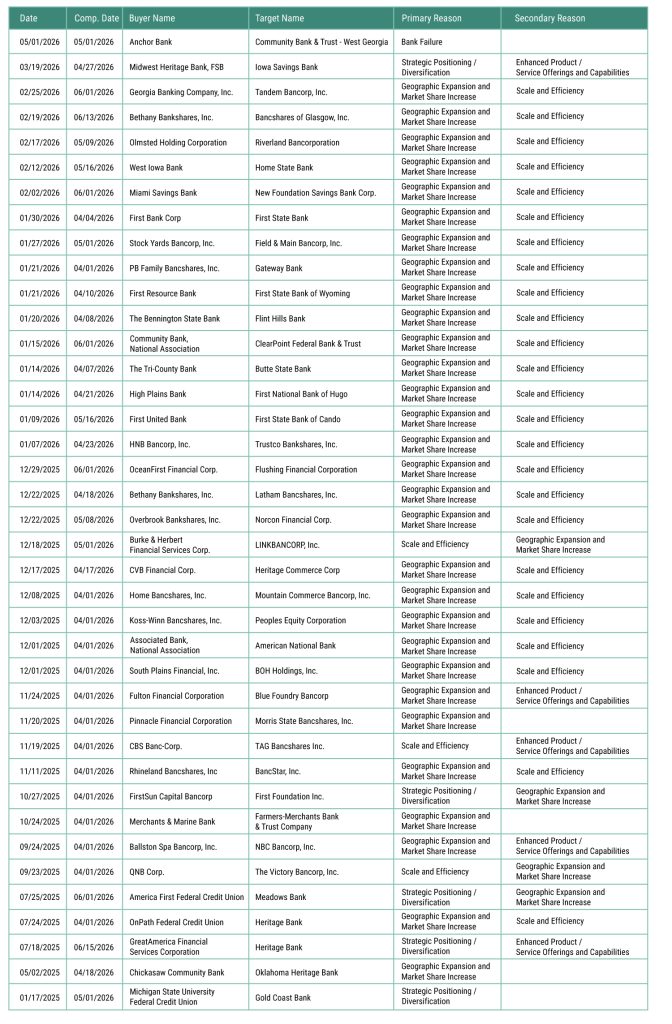
Thirty-nine deals closed in Q2. A detailed list of these deals, along with primary and secondary reasons, is provided below:
Looking Ahead
The mid-year shift in deal dynamics underscores a banking sector that is prioritizing tactical density and operational execution over raw asset accumulation. As the market enters the back half of 2026, the structural drivers propelling industry consolidation remain highly compelling: the need to mitigate localized deposit pressures, spread escalating technology and compliance costs, and defend market share against non-bank competitors. While the pause in transformational mega-deals has naturally brought down aggregate transaction values, the steady volume of community and middle-market combinations demonstrates a healthy, ongoing appetite for strategic growth.
Looking forward, the remainder of the year will likely be defined by a focus on deal sequencing and rapid integration. Acquirers will need to carefully balance the pursuit of geographic expansion against the costs of crossing key regulatory thresholds, while deal teams continue to favor front-loaded execution to maximize the current environment of predictable regulatory timelines. Ultimately, success in the upcoming quarters will belong to those institutions that can efficiently digest recent acquisitions, optimize their post-merger balance sheets, and secure their strategic footing before the broader political and economic landscape evolves into 2027.
How Ankura Can Help
Ankura plays a crucial role in this process by providing expert guidance and tailored solutions throughout the M&A lifecycle. With deep industry knowledge and experience, our experts assist banks in identifying strategic opportunities, conducting thorough due diligence, and managing post-merger integrations. Our comprehensive approach ensures that banks can maximize synergies, mitigate risks, and achieve desired outcomes, ultimately driving successful M&A transactions that align with their long-term strategic objectives.
Related Insights
Banking Industry Outlook: U.S. Banking M&A Builds Momentum into 2026
Banking Industry Outlook: U.S. Banking M&A Caps Off a Historic 2025
Banking Industry Outlook: U.S. Banking M&A Surge Arrives in Q3
Banking Industry Outlook: U.S. Banking M&A Activity Mid-Year Review
Methodology/Data Sources
The M&A transaction data presented in this report is compiled through extensive research of publicly available information. Our dataset includes transactions where either: 1) Banks are acquiring other banks; or 2) Banks are being acquired by non-bank financial institutions.
Our primary data sources for identifying and verifying these transactions include:
- Public Announcements and Press Releases: We monitor news wires and company-specific press releases for official announcements of merger and acquisition agreements.
- Regulatory Filings: Key regulatory bodies provide valuable public information. This includes, but is not limited to, filings with the Securities and Exchange Commission (SEC) for public companies. For financial institutions, we also consult filings with the FDIC, the Federal Reserve, and other relevant state and federal banking regulators.
- Financial News Outlets and Industry Publications: Reputable financial news services and banking industry-specific publications are monitored for reported transactions and market intelligence, which are then cross-referenced with official sources.
- Proprietary Databases and Aggregators: While the core data is derived from public sources, we also leverage and cross-reference information from commercial M&A databases and data aggregators that synthesize publicly available financial and transaction data to ensure comprehensive coverage and accuracy.
Each identified transaction is carefully reviewed to confirm its nature, deal value, participants, and announcement/completion dates, ensuring the integrity of our M&A transaction dataset.
© Copyright 2026. The views expressed herein are those of the author(s) and not necessarily the views of Ankura Consulting Group, LLC, its management, its subsidiaries, its affiliates, or its other professionals. Ankura is not a law firm and cannot provide legal advice.

