


How should I structure my JV deal? Our approach uses the “deal wheel” to drive five core analyses and develop a robust set of options backed by case examples, templates, and checklists.
| Roughly 75% of serious joint venture (JV) negotiations fail to reach a deal, often because deal teams commit to a single structure too early. Dealmakers can avoid this by developing, testing, and refining several deal options after the basic deal logic is in place, but before detailed negotiations and legal drafting begin. This article describes a five-step process for developing deal options, centered on the “deal wheel,” which covers key analyses such as sources of value, company and partner needs, and external constraints. Examples from biomaterials, hospitality, and mining ventures show how alternative structures can bridge conflicting partner objectives. Key Takeaways – Premature commitment kills viable deals. Deal teams should keep at least three options in play, including non-JV alternatives. – Good deal options are partially developed concepts that define the JV’s scope, contributions, transaction structure, and governance without the full detail of a term sheet. – Partner needs matter as much as your own. Deal teams should separate real walk-away requirements from preferences, for both their own company and their counterparty. – Options should be judged against consistent criteria. These include value creation, fit with each partner’s needs, deal feasibility, and post-deal manageability. – Developing options rarely takes more than a month or two and it speeds the path to a “quick no” or a “good yes.” That is a good investment compared with negotiations that can run six to 24 months. |
George, the CEO of a large industrial company, was wondering what went wrong. A major JV had fallen through at the eleventh hour, after months of intense negotiations. Worse, the European counterparty had just announced that it would consolidate its business into a JV with George’s direct competitor, creating a major threat to future competitiveness and growth plans.
Many executives pursuing JVs have felt George’s pain. Roughly 75% of serious JV negotiations fail to reach a deal. Sometimes that is a good thing. Partners may be incompatible, or due diligence may reveal flaws in the value-creation logic. But all too often, as in George’s case, JV negotiations fail for the wrong reasons.
The real problem is that JV deal teams often decide too quickly on a deal setup. That decision is triggered by a missing link in the JV deal process: the phase of developing a robust set of deal options. This crucial, but often poorly executed, step should occur after the basic idea of the deal is in place, but before detailed negotiations and drafting of the JV contract documents begin (Exhibit 1).
Exhibit 1: The Missing Link — Where Deal Option Development Fits in the Process

This article outlines how Ankura’s Joint Ventures & Partnerships practice approaches the deal-option phase of the dealmaking process, including what a good set of deal options looks like, and how to develop them.
The Deal Option Phase: A Sweet Spot in Time
The phase of developing deal options is a critical moment for potential partners to collect deal inputs and to shape, pressure-test, and refine a set of potential deal options, before delving into the myriad terms, provisions, and other details that will need to be worked out to close the deal. Doing this work early can avoid getting to a disappointing “no” late in the deal process — or worse, entering into a JV that fails to deliver on expectations or evolves into a public break-up because of deal-structure flaws.
Return to George’s situation. His company was the number three player in a major industrial components business. The counterparty was the number five player, with a strong position in Europe. The deal team believed there were substantial synergies available through cross-selling complementary products, spreading R&D costs across a larger base of business, and pursuing Asian growth markets together.
Yet the deal team was under pressure from the CEOs to get a deal done fast, and it quickly focused on a JV construct that created a single global company owned by the two parents. This was, to be fair, the most value-creating concept. However, after the concept had been heavily negotiated and a draft agreement prepared by the lawyers, an exchange of financial data implied a valuation that would give 60% ownership of the JV to George’s company. The European company — the largest employer in its small town and strongly committed to maintaining employment — was unable to fund an equalization payment. Unwilling to cede majority ownership, it withdrew from the discussions.
Hindsight is 20-20, of course. But the deal could have been done, and should have been done, if only the deal team had generated a viable alternative to an integrated JV structure early in the process and maintained it as a fallback. In this case, a “twin JV” setup, with differing ownership structures in the two regions, would have allowed the deal to go forward.
Bridging the Gap: What Do Deal Options Look Like?
Like a partly developed picture, deal options do not include a full set of terms, which come into clarity only once the deal is fully developed. A good deal option should answer six questions:
- Where will the JV play — i.e., what is the product, market, and value-chain scope of the venture?
- What will the partners contribute to the JV?
- How will the JV be governed (one partner in control versus shared control) and how much independence will the JV management team have?
- Who will own the JV and what shares of profit or output will the owners receive from it?
- What will the transaction structure be — a single JV or several JV entities?
- What associated commercial agreements will be required, such as brand or technology licenses, off-take, and supply agreements?
When building a set of good deal options, a deal team should not be confined to JV deal forms. Other viable strategy vehicles, such as contractual alliances and acquisitions, should also be considered. It is important to have at least three options at the outset, which preserves the flexibility to incorporate deal constraints that get uncovered during the process of fleshing out the options. Consider two cases in point.
Case 1: A Biomaterials Venture
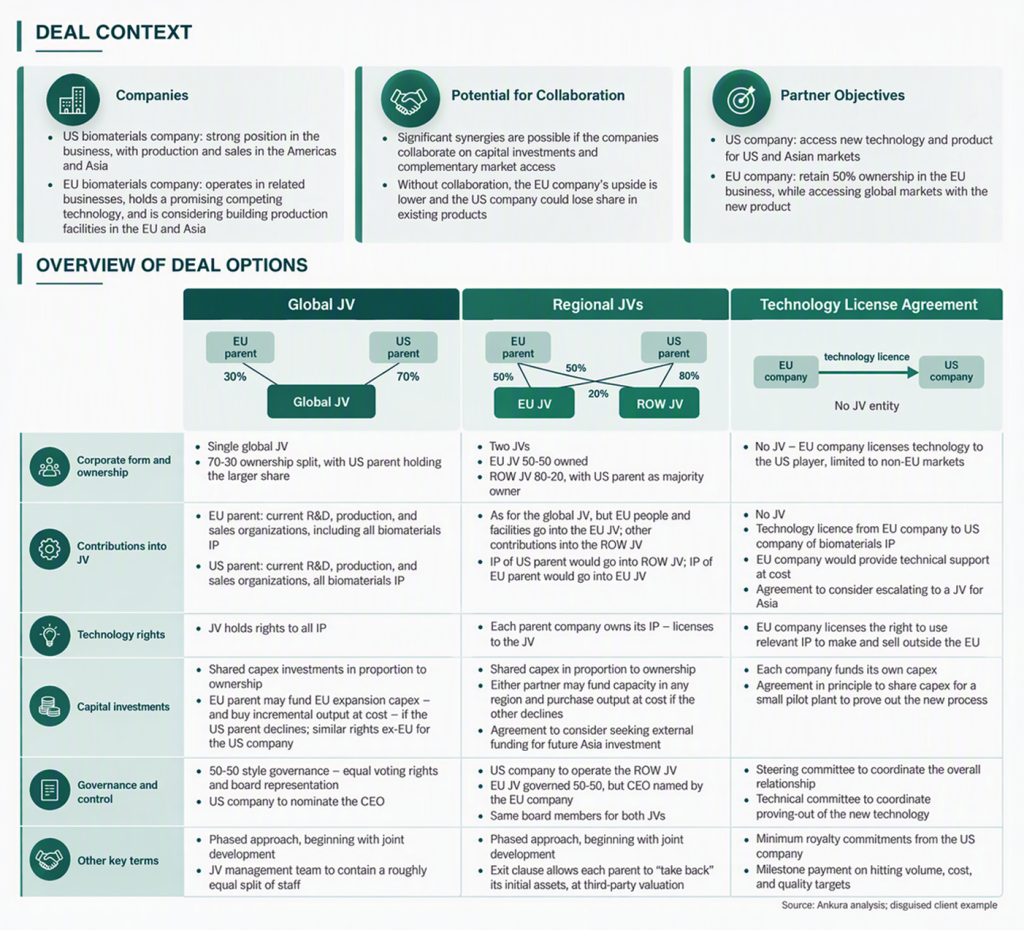
A biomaterials company needed to sort out how to handle the opportunity, and the threat, created by a European company that had developed a potentially attractive and competing technology. The CEO asked his team to come up with a set of deal options for a potential relationship, whether it took the form of a JV, another contractual alliance, or an acquisition. The company wanted control of any JV but needed to find ways to accommodate the European company’s felt need for at least 50% ownership in Europe, its main market. Based on this situation, the deal team developed several options: a single global JV, several regional JVs with differing ownership shares, or a simpler contractual supply agreement (Exhibit 2). An acquisition was ruled out in early talks, when the European partner indicated that any buyout would be prohibitively expensive.
Exhibit 2: Biomaterials Venture — Snapshot of Transactional Options
Case 2: A Hotel Venture in a High-Growth Market
The deal team of a global hotel company was considering whether and how to enter a large but unfamiliar market. Its key desires were to capitalize on a fast-growing market while protecting its brand image and limiting its real-estate exposure. The team developed three competing options: a limited JV excluding ownership of real estate, a full business JV including real estate ownership, and a management services agreement under which the global hotel company would provide the brand, training, back-office, and other services to a local partner. For each of these options, it developed a rich but not overly detailed snapshot of the deal, including which parts of the business would be “in” the venture versus provided by the company or the partner through service agreements (Exhibit 3).
Exhibit 3: Hotel Venture — Snapshot of One Deal Option

These two cases illustrate the two most common dimensions that drive deal-option thinking: geographic scope, in the biomaterials venture, and value-chain contributions into the JV, in the hotel venture. But each situation is unique, and deal options can be driven by a range of other factors, including governance models, tiers of partners, or the overall economic model of the venture — for-profit versus production-sharing, for example.
| Related Insight “Structuring JV Deals to Manage Commercial Conflicts” explains how shareholder commercial interfaces — such as service, license or, supply agreements — can lead to future conflicts, and which JV deal terms and policies help prevent them. |
How to Develop JV Deal Options
How might deal teams create a robust set of deal options? We have found that a simple five-step process is worth following: ensure the needed pre-work is in place; develop a set of “starter” deal options; generate a refined set of options; screen and evaluate those options; and advance negotiations towards a single, agreed option.
Sometimes the work of shaping a slate of deal options is done with the counterparty. That makes sense when there are no conflicting interests, and when the partners know each other and have a high degree of trust. More often, it is appropriate to do this work internally, either to create a basis to suggest a deal to a potential counterparty, or to make sure that joint discussions do not go in directions that are unacceptable internally. Even in that case, there are usually ongoing interactions with the counterparty that can be factored into the thinking, so that the options created are likely to be acceptable.
Workshops — with or without the counterparty — can be very efficient ways to get the brunt of the work done (see Box 1).
| Box 1 Getting the Work Done Efficiently Via Deal Workshops The option-generation phase of deal work is often done with little time to prepare for impending counterparty discussions or internal deal reviews. A series of well-structured working sessions is a highly effective way to get the needed people and perspectives into one room, and to develop robust options quickly. Sessions work best when decision-makers, negotiators, and creative dealmakers are in the room, with a common understanding of the discussions to date and the deal objectives. Pre-work should be farmed out — e.g., legal advisors bring a listing of constraints, business leaders bring options on scope and contributions, R&D staff prepare a brief on IP considerations — and an effective facilitator should be engaged to lead. A good session yields a rich set of deal options and reveals the open issues that frame the team’s work afterwards. Sessions run from three hours to two days, depending on the complexity of the deal.  |
Step 1: Ensure Needed Pre-Work Is in Place
Before deal options can be developed, the deal team needs to answer some simple questions. How do we define success for this business — capturing share, meeting a certain hurdle rate, providing secure long-term supply of a crucial input? Why do we need to use a JV? What are the implications of partner discussions for deal structure? And what do we need from a partner, and how do the partner candidates stack up against each other?
It seems obvious that a deal team should be able to articulate the strategic reasons for a deal, the logic for choosing a JV over simpler transaction alternatives, and the compelling case for choosing one partner from a range of other candidates. But this basic preparation is often poorly executed, leaving a shaky foundation for developing deal options and deal terms.
Step 2: Develop a Set of ‘Starter’ Deal Options
Once the pre-work is in place, the team should quickly develop a starter slate of deal concepts. The focus here should be on getting a list of ideas on the table, not on challenging or refining them.
The team should get creative and write down a half-dozen or more ways the company and its partner could go after the prize at hand. There are three main sources on which the team can draw: ideas from inside the team, partner proposals, and analogs. Inside ideas can be generated by thinking about permutations of scope, level of commitment, value-chain elements to include, and the economic model for the venture. To draw out potential deal options the partner has suggested or might favor, the team should review the notes from early partner discussions and interview people who have had face-to-face contact with the counterparty.
A scan of analogous deals can be done relatively quickly to add to the starter slate of potential options. The analogs need not be from the same industry, but should share characteristics specific to the situation: deals to establish production and sales in a target growth market; shared back-office utilities; natural-resources ventures with multiple partners and no single operator; or deals between smaller technology providers and larger energy companies.
Step 3: Generate a Refined Set of Deal Options
This is the heart of the deal-option development process. The work revolves around five questions and their underlying analyses, depicted in what we call the “deal wheel” (Exhibit 4). The first three analyses should always be done by the deal team; the remaining two may not be needed in some situations.
Exhibit 4: The ‘Deal Wheel’ — 5 Core Analyses to Drive Deal Option Development

Question 1: What are the combinations of assets and capabilities that partners could contribute to the deal — and what value will these different combinations create?
An analysis of the “building blocks of value” can be strikingly simple and powerful. To do this, the deal team should list out the potential contributions of each partner — e.g., R&D, production assets, customer relationships, sales forces — and link each contribution to specific sources of value. After developing and refining these initial lists of potential contributions, different bundles of contributions can be assembled into a set of deal options, which typically range from narrow JVs that are limited in scope to broad JVs that have greater scope and more contributions from each partner.
Consider the building blocks of value identified by the deal team of the biomaterials company in our earlier case (Exhibit 5). Each of the building blocks translated clearly into opportunities to create value by accelerating product development, reducing investment or operating costs, and increasing penetration into growth markets.
Exhibit 5: Building Blocks of Value — Biomaterials Venture

| Related Insight “Joint Venture Valuation: 4 Steps to Handling Hard-to-Value Contributions” shows how to run a JV valuation process that accounts for both tangible and intangible contributions and provides advice for taking valuation disputes off the table. |
Question 2: What external constraints and considerations need to be taken into account, and how should these be reflected in specific deal terms?
Deal options and terms are often shaped by external considerations such as antitrust or other regulatory requirements, limitations on foreign ownership, the tax and accounting impacts of different deal structures, and industry-specific requirements. The deal team should identify the key external factors that limit the shape of the deal, and reshape the slate of deal options to accommodate, or creatively work around, these limits.
Question 3: What are the wants versus the needs of the parent companies?
The desires and concerns that JV partners bring to the negotiating table are strikingly varied, and since the partners will need to live together after the deal, it is critical for the deal team to understand them. Needs can relate to control, financial considerations, limits on the scope and the contributions of each company, and often-unspoken views about how the JV should evolve over time (Exhibit 6).
The exercise needs to clarify true needs versus desires. The deal team may want 51% ownership and full control, for example, but it needs to understand whether this is truly a walk-away requirement, or whether there is an acceptable alternative, such as final approval on all uses of the company’s brand.
It is equally important to anticipate the partner’s needs and to find ways to bridge areas of conflict. In cross-border JVs, or those between different types of companies (e.g., publicly listed, state-owned, or family-owned) the desires are often starkly different.
Take, for example, negotiations between a global metals and mining company and a family-owned industrial company. For the family company, it was more important to ensure a steady dividend flow to family members than to debate the value of the production asset it was contributing to the deal, and whether it would end up with 50% of the JV. This led to a creative deal structure in which the global player was able to take majority ownership, while the family-owned company received preferred shares entitling it to a minimum annual dividend stream.
Exhibit 6: Potential Wants and Needs — Sample Template

Question 4: Should other industry players, customers, or suppliers play a role in the venture?
In many negotiations, it is clear that there are two or three equity partners, and no other participants are needed or wanted. But in certain types of JVs, success requires adoption or commitments by a broader group of industry players, and considering how to structure the deal to win their support is an important step in developing deal options. Examples include global airline alliances, industry-wide research and development consortia, and multi-partner platform ventures that aggregate content or capacity from across a sector.
In these types of situations, the deal team should consider which additional partners or members might be wanted, the conditions of membership, and whether to create tiers of owners, members, or users with differing equity ownership, governance rights, or pricing terms.
Question 5: What are the risks and asymmetric exposures that the deal needs to mitigate?
The financial and strategic exposures of the owners are usually different, even when the ownership shares are equal. Partners typically face different risks related to brand exposure, existing customer or government relationships, or impacts on related businesses. The ability of each partner to withstand a downside scenario may also differ. These risks are highly deal-specific. The team should spend time identifying transactional risks, especially asymmetric ones, and then develop approaches to mitigate or shift those risks, through the financial arrangements, governance, exit provisions, or other deal terms (Exhibit 7).
Exhibit 7: Transaction Risks Checklist — Sample Template

Having gone around the deal wheel and completed this set of analyses, the team should summarize the implications of the work for deal terms, in preparation for creating a refined set of deal options that can be tested with senior management and then used to advance the negotiations, assuming a deal is still viewed as attractive.
Step 4: Screen and Evaluate the Deal Options
The next step is to incorporate the various inputs into a refined set of deal options, each of which is supported by a term sheet that lays out the key aspects of the deal. To the extent that the team has uncovered good analogs, these should be reviewed and used to inform the terms. Generally, the core team — typically the business lead, the transaction process leader, legal counsel, and one or two functional leads — should sit and work through the list of terms to ensure that the various considerations are integrated. It is also important at this point to resist the temptation to write each option as a perfect deal in which the partner gives in on all key dimensions; always consider the analysis of partner needs.
The resulting options should then be evaluated against a set of criteria (Exhibit 8). Typically, the criteria include five main dimensions, each of which has a couple of aspects that dealmakers might consider:
• Value creation: Will the deal create value in the market? Is the concept and planned structure one that will be competitive? What synergies will be captured by each deal option?
• Fit with our own needs: Does the deal option fit with our own strategy? Are the main concerns and risks addressed?
• Fit with partner needs: Will this deal option be acceptable to the counterparty, or would presenting it be an unpleasant and counterproductive discussion? How does each option address the anticipated needs and concerns of the counterparty? Does it fit with their publicly stated strategy? What about investor expectations for the counterparty?
• Deal feasibility: Will the deal be accepted by regulators? Is it financially feasible, especially if it requires external financing or approval from a broader set of shareholders and stakeholders? Are there union or labor issues that could cause problems? Are there important tax issues that affect the feasibility of the deal?
• Post-deal manageability: Assuming the deal gets done, will it be manageable by a JV CEO and by the board? Is the governance construct one that will allow quick decision making, as needed to be competitive? Does the deal concept allow room for the JV to grow, if that is important? How will the market and the venture evolve over time, and are some options better long-term bets than others?
Exhibit 8: Evaluating Deal Options — Biomaterials Venture

With this assessment in hand, the team should refine the options. The evaluation almost always highlights some ways in which all of the deal options can be improved, by incorporating the best aspects of one option into the others. Sometimes the team will want to winnow down to a single option, which may be a hybrid of the best aspects of several. The screening process should include input from the senior executives who will ultimately approve the deal.
Step 5: Advance Negotiations Toward a Single, Agreed Option
As we mentioned earlier, the process of creating deal options is sometimes done collaboratively with the counterparty. More often, though, it is appropriate to do this work internally, to reach agreement on the option, or options, that should be pitched or tested with the counterparty. Assuming that is the case, after the team has evaluated and refined the options, the last step in this phase of work is to prepare for partner negotiations.
| Related Insight “Seven Practical Tips for Negotiating Joint Venture Deals,” co-written with Hogan Lovells, gives practical guidance for the negotiation phase that follows, starting with keeping the deal team focused on the sources of value. |
JV negotiations often take six to 24 months to reach closure. The steps outlined here rarely take more than a month or two, and they can dramatically shorten the time needed to reach either a quick “no” — and stop the negotiations — or a good “yes”: a deal structure that can meet the test of time. Given the time and money at stake, we think it is a good investment.
© Copyright 2026. The views expressed herein are those of the author(s) and not necessarily the views of Ankura Consulting Group, LLC, its management, its subsidiaries, its affiliates, or its other professionals. Ankura is not a law firm and cannot provide legal advice.

