


Healthcare Services Transactions Update – Q3 2026
Ankura is pleased to share its review of U.S. healthcare services transactions announced or completed during Q3 2026. Deal volume rebounded 15.1% from the second quarter, when activity fell 23.7%. Volume also finished 1.6% above Q3 2025 levels.
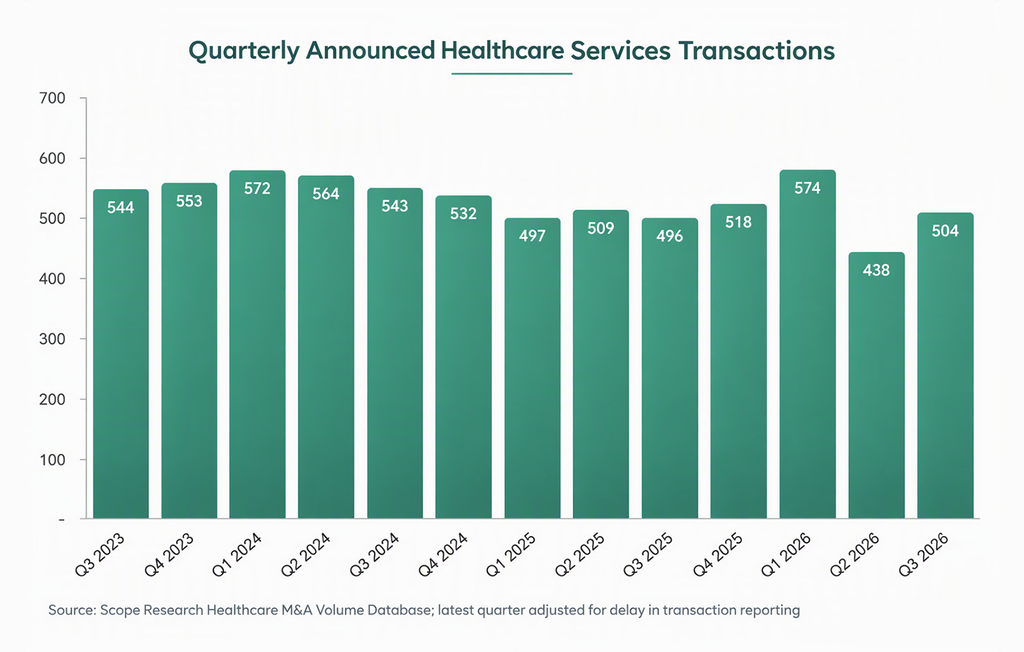
Source: Scope Research Healthcare M&A Volume Database
Notable Transactions Announced or Closed in Q3[1]
- Ambulatory Partner Holdings agreed on August 27, 2026, to acquire a 60% interest in Atlas Surgery Center for approximately $54 million. The transaction implies an enterprise value of approximately $94.5 million, or 3.6x revenue and 13.1x EBITDA. The business operates a New York-based ambulatory surgery center specializing in neurosurgery. It generated approximately $26.0 million of FY 2025 revenue and $7.2 million of FY 2025 EBITDA.
- Addus HomeCare Corporation announced on Sept. 14, 2026, that it would acquire AccentCare’s Personal Care Division for approximately $275 million. The purchase price represents 1.0x revenue and 10.8x EBITDA, before synergies and a $33 million tax benefit. The business provides home-based personal care services across 10 states in the U.S. LTM revenue was approximately $280 million, with implied EBITDA of approximately $25.5 million.
- Intermountain Health announced on July 24, 2026, that it would acquire the ownership interests previously held by Surgery Partners in two Idaho hospitals, Mountain View Hospital and Idaho Falls Community Hospital,along with affiliated clinics. The purchase price implies an enterprise value of approximately $1.15 billion, including physician interests, equal to 1.6x revenue and 9.5x EBITDA. The hospitals provide multi-specialty surgical and hospital services. They reported FY 2025 revenue of approximately $736.0 million and EBITDA of approximately $121.0 million. Their EBITDA margin was approximately 16.4%.
- QCF/I, Inc. agreed on July 29, 2026, to acquire Advantage Behavioral Health and Wellness for approximately $550.9 million. The valuation represents 3.2x revenue and 7.1x EBITDA. The New Jersey-based business provides outpatient mental health and addiction services. Estimated 2026 revenue was approximately $170 million, with adjusted EBITDA of approximately $78 million. This equates to an adjusted EBITDA margin of approximately 45.9%. The transaction is expected to be financed by a bond issuance through the New Jersey Economic Development Authority. Following the transaction, the seller will provide management services, and its executive team will continue to run day-to-day operations.
- Ascension announced on July 9, 2026, that it would acquire Williamson Health System for approximately $700 million, with additional capital commitments of $200 million over the next 10 years. The transaction implies an enterprise value of approximately 2.0x revenue and 13.7x EBITDA. Williamson Health System is a Tennessee-based general acute care hospital system. It reported FY 2025 revenue of approximately $343.1 million and EBITDA of approximately $51.2 million. Its EBITDA margin was approximately 14.9%.
Key Observations
Healthcare services transaction activity regained momentum in Q3 2026. Volume rose 15.1% from the prior quarter and 1.6% year-over-year. Buyers nevertheless remained cautious. Interest rates and financing costs were still key considerations for investors, alongside inflation, reimbursement trends, and broader economic uncertainty.
Regulatory scrutiny also remained high, particularly for physician practice roll-ups and private equity-sponsored transactions. The FTC Healthcare Task Force, launched in March 2026, underscored the federal government’s coordinated focus on competition and consumer protection. Its mandate also includes enforcement and emerging issues across the sector.
Oversight continued to broaden at the state level as well with state regulators paying close attention to private equity-backed transactions and management service organization structures. The continued scrutiny leads to added complexity surrounding healthcare transactions and transaction timeline extensions.
Recent healthcare acquisitions remain concentrated in three sectors: Professional Services, Physician Groups, and Outsourced Services. Together, they represented 62.0% of adjusted transaction volume in Q3 2026. Professional Services led with 27.8% of announced transactions. Physician Groups accounted for 20.9%, while Outsourced Services represented 13.3%.

Professional Services remained the most active category, accounting for 27.8% of adjusted transaction volume. Transaction activity was dominated by dentistry, with over 90 transactions for the quarter. Much of this activity was driven by dental service organizations such as MB2 Dental.
Physician Groups ranked second at 20.9% of adjusted transactions, reflecting continued buyer interest in physician practice management and specialty provider platforms. Most of these transactions for the quarter are centered around surgical specialties and primary care practices.
Outsourced Services ranked third at 13.3%. Together, the three leading sectors accounted for more than three-fifths of activity, highlighting sustained demand for scalable professional and physician-based practices.
Across healthcare services, transaction activity increased 15.1% from Q2 2026 and 1.6% from Q3 2025. The annualized quarterly average was 505 announced transactions in 2026, in line with 2025 and below the 2024 average of 553.
The third quarter rebound suggests buyers reengaged after a softer Q2, but the flat annual average versus 2025 points to a market that remains measured. Financing costs and uncertainty around interest-rate cuts continued to weigh on decisions. Reimbursement pressure, labor inflation, and margin compression also shaped underwriting. Heightened regulatory review reinforced a selective approach to capital deployment.
Future Outlook
Healthcare transaction activity should improve modestly in Q4 2026 as companies look to finalize deals before year-end. Strategic buyers and private equity sponsors are also expected to put capital to work in higher-conviction opportunities; however, a broad rebound in transaction volume is unlikely. Buyers will remain selective and favor scalable businesses that generate cash and present accretive value.
Interest should remain strongest in physician, dental, and specialty provider platforms. Investors will continue to be selective regarding platform acquisitions as bolt-on acquisitions will likely remain most common. Strategic combinations and other structured transactions will be favored to limit the integration risks presented by larger deals.
Technology will likely play a larger role in healthcare investment decisions through year-end and into Q1 2027. Buyers are assessing data infrastructure and AI-enabled workflows as potential sources of value. Clinical automation, administrative automation, and digital care delivery are also drawing attention. Strong valuations, however, will depend on proven operating results, compliance readiness, and growth capacity.
Reimbursement pressures and regulatory oversight will continue to present challenges to transaction activity. Healthcare organizations still face pressure from labor and supply costs amid rising inflation rates. Federal and state review may lengthen diligence and closing timelines, particularly for provider consolidation and physician practice transactions involving private equity. In response to these uncertainties, earnouts and other risk-sharing structures may become more common.
Healthcare M&A appears positioned to close 2026 with improving but disciplined momentum. The pipeline entering Q1 2027 could strengthen if financing conditions stabilize and inflation begins to cool. Businesses with scalable operations and high growth potential should continue to draw competition among buyers. However, buyers will most likely continue to be selective and strategic in their investment decisions.
About Ankura Healthcare Transaction Advisory Services
Healthcare transactions are inherently complex. With deep industry experience, Ankura delivers insights to make informed investment decisions in mergers, acquisitions, and partnerships.
Ankura’s Healthcare Transaction Advisory team is deeply rooted in the healthcare sector, leveraging extensive industry knowledge and expertise to anticipate critical financial accounting aspects of transactions while also understanding the operational drivers. This enables us to proactively address critical financial accounting aspects and operational drivers of transactions.
What sets us apart is the collaboration between our financial accounting due diligence experts and Ankura’s specialized teams in healthcare valuation, healthcare operations, tax, information technology, commercial strategies, and human capital. This collaboration ensures a seamless, integrated reporting process to you, combining diverse expertise to provide a holistic view of every transaction. Our approach guarantees that you receive nuanced, actionable insights in a unified and strategic manner.
With senior deal professionals engaged in every transaction phase, we provide immediate updates on significant deal factors and a dedicated analysis of any critical issues, ensuring a thorough understanding and resolution of underlying concerns.
Connect with one of our Healthcare Transaction Advisory experts to navigate the complexities of healthcare with confidence. Reach out to us for more information.
Sources
[1] Scope Research Healthcare M&A Volume Database, published by Scope Research; Capital IQ
© Copyright 2026. The views expressed herein are those of the author(s) and not necessarily the views of Ankura Consulting Group, LLC, its management, its subsidiaries, its affiliates, or its other professionals. Ankura is not a law firm and cannot provide legal advice.

