






This is the next installment of a multi-part series that takes a look at the Private Attorney General Act (PAGA) filing trends.
A Quick Recap of PAGA
PAGA is a unique law in California.[1] It allows employees, typically through private practice attorneys, to sue on behalf of the state of California’s attorney general. These types of actions can be combined with lawsuits seeking other remedies, such as the recovery of unpaid wages.[2]
This series examines trends in PAGA-related filings and how trends are changing. The goal of this series of articles is to explore the data and documents gathered by the state of california and see what has happened year-over-year.
Recap From Last Time
In our first installment,[3] we discussed the general changes to PAGA that took effect in June 2024. We noted that these changes lowered penalties and allowed companies a longer horizon to remediate. In addition to a spike in filings before June 2024, the overall trend appears to show a continued increase in PAGA filings. This installment will focus on the past year and what is happening by industry classification.
Latest Trends
An analysis of California Labor and Workforce Development Agency (LWDA) case filings shows 8,762 distinct PAGA cases noticed in the 12 months ended June 2026, compared to 8,971 in the prior 12 months and 9,437 in the 12 months immediately preceding the June 2024 reform. The pace works out to about 34 new PAGA notices per workday for the past year. There was an approximate 2.3% decrease over last year, and an approximate 7.2% decrease since the 2024 reforms. Although this seems like a steady decline, the data shows that the huge spike in PAGA notice filings in June 2024 makes it appear that a significant decline occurs in the following year. However, an industry-by-industry review shows that certain industries are being hit harder than others.
Industry Breakdown[4]
By Industry Share of PAGA Notices Filed Between June 2025 and May 2026

As a percentage of all PAGA notices filed, Healthcare & Medical Services, Restaurants, and Retail are in the top three positions. However, the bigger story is in how PAGA notice filings have changed within an industry since the 2024 reforms.
Industries With Declining Trends
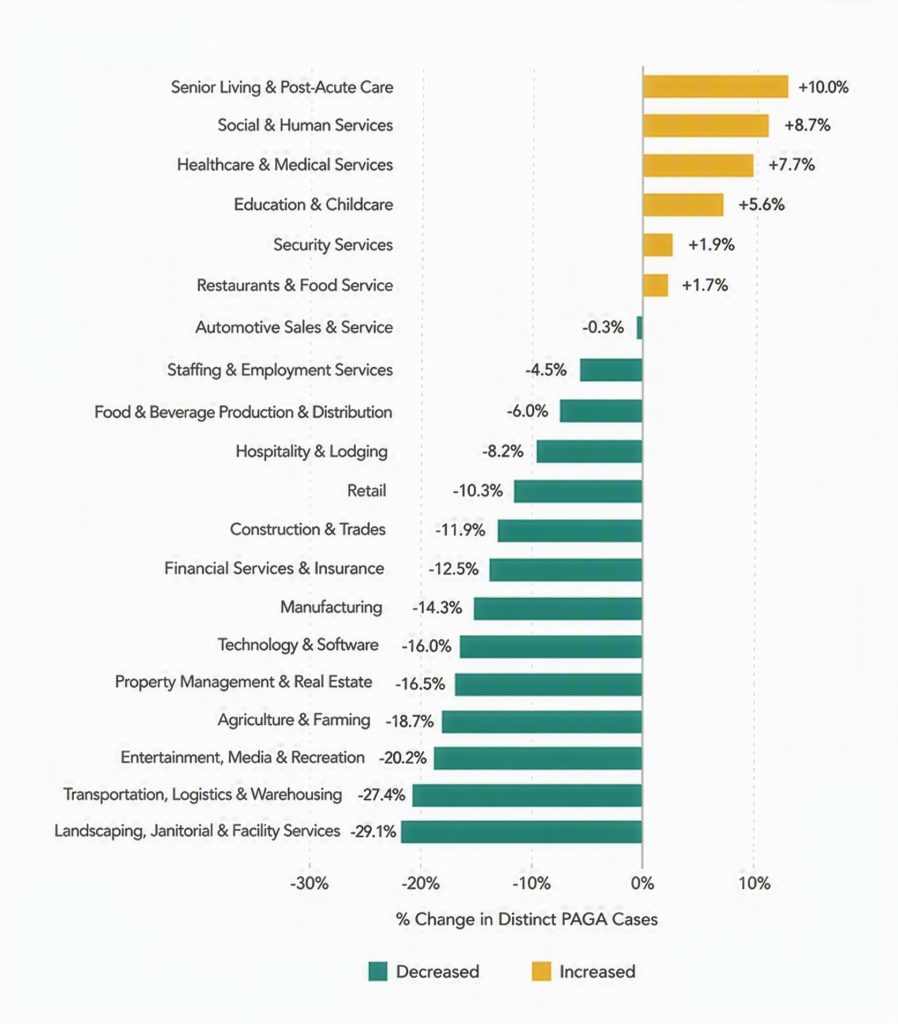
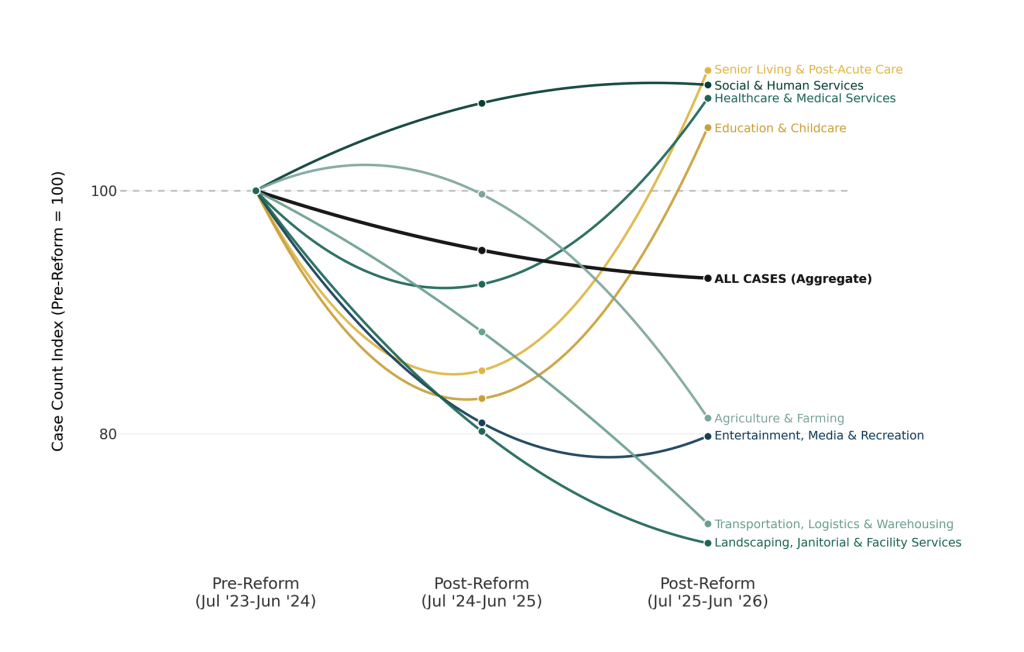
Five of the largest industries posted year-two case counts below their pre-reform baselines. Transportation, Logistics, and Warehousing fell 27.4% versus pre-reform and 18.5% year-over-year, the steepest sustained pullback of any major sector. Landscaping, Janitorial, and Facility Services dropped 29.1% versus pre-reform and 11.6% year-over-year. Entertainment, Media, and Recreation fell 20.6% versus pre-reform and 1.6% year-over-year.
By Industry Change in PAGA Notices From Pre-Reform to Period Ending May 2026
Industries with Increasing Trends
The other side tells a different story. Senior Living and Post-Acute Care case counts rose 10% versus pre-reform and 28.4% year-over-year, the most aggressive trajectory for the past year. Healthcare and Medical Services grew 7.7% versus pre-reform and 16.6% year-over-year. Education & Childcare rose 5.6% versus pre-reform and 27.1%. For employers in these sectors, the trend is not flat. Generally, healthcare-related industries are absorbing a disproportionate and accelerating share of statewide PAGA case activity.
Industries With the Most Significant Change Since Pre-Reform to Period Ending May 2026
Reconciling the Practitioner Narrative
In November and December of 2025, a coalition of California employment defense firms released a report characterizing the 2024 PAGA reforms as “already delivering positive results,”[5] with reported gains including faster settlements, more narrowly focused lawsuits, increased employer compliance investment, and reduced average penalties. California restaurant industry publications endorsed the assessment, framing the reforms as a structural improvement for both employers and employees.[6]
However, the case-level filing data suggests that the practitioner narrative captures one part of a larger picture. Aggregate PAGA notice volume has declined since reform took effect, but it is because of the huge spike in filings that occurred right before the reform took effect. That spike occurred because plaintiffs wanted to retain cases with the pre-reform rules. Additionally, in our previous discussion,[7] based on Ankura’s proprietary settlement database, a random sample of settlement values taken from before and after the reform suggests that settlement values have remained flat.
Other Interesting Items to Note
Another interesting pattern has emerged as it relates to the plaintiffs’ bar. In the 12 months ending May 2026, 396 firms filed at least one PAGA case in California, but 20 firms accounted for 50% of the filings, and five firms accounted for around one quarter of all filings in California. Certain plaintiff firms have increased the number of filings over previous years in a dramatic way, with some firms increasing their number of filings from single digits to hundreds every year.
The Regulator’s Own Data Confirms the Concentration
The concentration is not just visible in third-party analyses. In February 2026, the California LWDA issued its first-ever Notice of Proposed Rulemaking under PAGA, accompanied by data showing 8,846 PAGA notices filed during fiscal year 2024-2025 and approximately 24% of those filings concentrated among five plaintiff firms.[8] The agency described filings as continuing “to rely on generalized allegations and limited factual detail” and noted instances where individual attorneys submitted several hundred notices in a single year. The proposed regulations include a formal “high-frequency filer” framework, defined as any individual claimant, attorney, or firm filing 200 or more PAGA notices within 12 months. Several firms identified in our ranking would meet that threshold. The LWDA’s view, taken as a whole, is that filing practices have not materially shifted following the 2024 amendments. The case-level data reaches the same conclusion through a different route.
Conclusion
Some industry commentary has characterized the 2024 PAGA reforms as already delivering positive results. However, the PAGA notice data support a more nuanced read. As the LWDA moves toward its first formal regulations in the statute’s 20-year history, the next year of filings will show whether the reform’s uneven trajectory begins to even out, or whether the gap between the industries that got relief and the industries that did not continues to widen.
References
[1] https://www.dir.ca.gov/Private-Attorneys-General-Act/Private-Attorneys-General-Act.html
[2] https://www.labor.ca.gov/resources/paga/paga-faqs/
[3] https://ankura.com/insights/a-new-day-in-the-life-of-a-paga-action-1-year-after-the-change-in-californias-private-attorney-generals-act-what-if-anything-has-changed
[4] Ankura used a proprietary process to link the company, as found on the PAGA Notice to an industry sector focused on the type of work that the company performs. For example, many PAGA Notices are filed against the holding company, so Ankura’s process identifies the holding company and the scope of business that the holding company conducts and classifies the entity based on the type of work, not the company name.
[5] https://hrwatchdog.calchamber.com/2025/12/paga-reforms-already-delivering-positive-results/ and https://advocacy.calchamber.com/wp-content/uploads/2025/11/PAGA-Reforms-Successes-2025.pdf
[6] https://www.calrest.org/news/paga-reform-2024-early-evidence-suggests-positive-impacts-employees-and-employers
[7]
[8] https://www.labor.ca.gov/wp-content/uploads/sites/338/2026/02/2026-2-6-ISOR_LWDA_PAGA_w_Appendices-Z2026-0121-03.pdf
© Copyright 2026. The views expressed herein are those of the author(s) and not necessarily the views of Ankura Consulting Group, LLC, its management, its subsidiaries, its affiliates, or its other professionals. Ankura is not a law firm and cannot provide legal advice.

