






Choosing the Right Measure of Debt in the Bridge From Enterprise Value to Equity Value
The Question
Moving from enterprise value to equity value appears simple: Value the business, subtract debt, and the remaining value belongs to shareholders. However, the debt figure is often taken directly from the balance sheet without checking whether it reflects fair value. This shortcut may work if there has been neither a change in the credit profile of the company nor a significant change in interest rates. However, if there is a change in the credit profile of the company or change in interest rates, deducting the book value of debt can materially impact the equity value.
2 Measures, 2 Market Participants
The fair value of debt is the price at which the instrument would change hands between debt investors. The value of debt for the purpose of valuing equity is the amount an equity buyer would deduct from enterprise value in pricing that equity. The mechanics are the same, expected cash flows to the lender discounted at a market yield, but the investors’ point of view differs. Debt investors price the instrument on its own terms and on the information available to them. Equity buyers price the same liability through their own holding period, their own exit assumptions, and information the lenders may not have. Because the perspectives differ, the two values can differ, and the equity bridge should reflect the equity buyer’s view. If the debt is traded, the market price is the best starting point, because it reflects what debt investors are paying. An equity buyer would adjust that price for their own assumptions. Where no publicly available price for the debt exists, a discounted cash flow method serves the same purpose.
This also depends on how the enterprise value itself was estimated. Where enterprise value is derived using a cost of capital that reflects the company’s actual capital structure and current credit profile, subtracting the fair value of the debt is internally consistent. Where enterprise value is instead derived using a normalized or industry capital structure, as is common in practice, the discount rate does not capture the company’s specific leverage, and subtracting fair value alone may not produce an appropriate equity value. Because the enterprise value assumed normalized leverage, the equity value should be adjusted for the difference between the company’s actual and normalized capital structure.
Setting the Upper and Lower Bounds
Generally, analysts valuing equity interests may use the fair value or payoff amount as a proxy for measuring the value of debt for the purpose of valuing equity. These proxies provide a lower and upper bound on the value of equity. Specifically, the equity value measured based on the enterprise value less the contractual payoff amount may be regarded as a lower bound on the value of equity because the equity holders could redeem the debt for this price at any given point. The contractual payoff amount may represent the maximum liability because it includes accrued interest, any make-whole premium, and other applicable prepayment charges. The equity value measured based on the enterprise value less the fair value of debt may be regarded as an upper bound on the value of equity because the equity holders would recognize the value of any below-market terms over the holding period. Judgment is required to estimate the value of debt for the purpose of valuing equity within this range, considering the facts and circumstances.
Market participants transacting in the equity might consider a value of equity closer to the upper bound if the debt has a below-market coupon and the time horizon for the investment is relatively long, so that equity holders would expect to be able to realize value from the below market coupon over a period of time. Market participants transacting in the equity might consider a value of equity closer to the lower bound if they expect that the business would be sold in a short period of time, and the debt has a change of control provision that would prevent them from realizing value from any below-market coupon.
In practice, if a company is close to bankruptcy or in covenant default, the equity holders may have little ability to negotiate with the debt holders, and the time horizon over which the equity holders may benefit from the below market terms of the debt would be limited. When the company has a longer liquidity runway or the investors have better negotiating leverage, the equity holders may have the ability to repurchase debt below the payoff value, negotiate a favorable exit, or realize value from the below-market debt coupon over the time horizon for the investment.
Generally, the fair value of debt will not be higher than the payoff amount because debt investors would assume that the company would pay off the debt, rather than pay an above market coupon for an extended period of time by refinancing.
When Book Value / Contractual Payoff Is a Reasonable Proxy
The following conditions favor the use of contractual payoff:
- The debt was recently issued at market-based terms, and neither benchmark rates nor the company’s credit spread have moved materially since.
- The remaining time to maturity is short, so any coupon differential results in minimal value due to the off-market coupon.
- The debt is prepayable at or near par without a significant penalty, which caps how far the liability can sit above the payoff amount.
- The debt is at a floating rate, and the spread remains consistent with the company’s current credit profile.
- The book value, the payoff amount, and the fair value are close to one another.
When Fair Value Is the Better Measure
The following conditions favor the use of fair value:
- A fixed coupon rate with a long time to maturity, struck at a coupon materially different from the current market yield.
- A change in the company’s own credit quality since issuance.
- Distressed situations, where the debt trades well below par and the equity behaves more like an option on the enterprise than a residual claim.
- Debt that is not prepayable or is prepayable only at a penalty that effectively locks in an above market rate.
- A long-expected holding period, giving the equity time to realize the benefit of a below market coupon.
Illustration
An investor buys all of the equity of a company in December 2023 at an enterprise value of $100 million, funded with $40 million of equity and $60 million of debt. The debt has a five-year maturity and includes a change-of-control provision requiring repayment at 105% of par in year one, 104% in year two, and 103% in year three, with the repayment amount stepping down to par by year five. After two years of acquisition in December 2025, the company has underperformed relative to expected performance. Enterprise value is $70 million and the contractual payoff amount for debt is $61.8 million (including a prepayment premium of 3%); the fair value of the debt is $48 million.
The measure selected now swings the equity conclusion across a $13.8 million range:
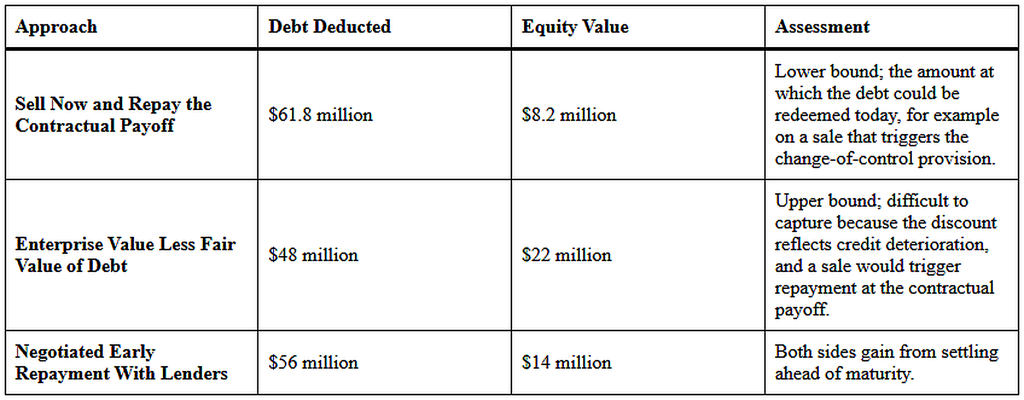
The illustration shows that if the enterprise value is $70 million, the equity value is $8.2 million assuming the contractual payoff of $61.8 million is deducted, or $22 million if the $48 million fair value of the debt is used instead. An assumed negotiated settlement of the debt of $56 million results in an equity value of $14 million, which falls between the previously referenced values.
It is worth noting that what drives the $48 million fair value of debt in this example is the discount to par due to credit deterioration, rather than a below-market coupon. The distinction matters because the two discounts are captured in entirely different ways. Where the debt is priced below par because its coupon is below current market rates, the equity holders benefit simply by continuing to service the loan on its existing terms; the company pays less interest each year than it would on new debt, and that saving accrues to the shareholders automatically over the remaining term. Where the debt is priced below par because the borrower’s credit has deteriorated, no saving exists and the full contractual amount remains payable. The equity holders realize value only if the debt can actually be repurchased, restructured, or settled below its contractual amount, and a company under credit stress is generally least able to fund such a transaction. Deducting the fair value of debt therefore has a very different justification in each case, although the arithmetic looks the same. Debt holders may be unwilling to settle at fair value if they expect to recover more than fair value. Conversely, equity holders may prefer to keep the debt outstanding rather than repay the debt at the contractual payoff amount. A rational equity investor may get involved in the negotiation with lenders and pay off the debt at a level which is agreeable to both sides.
Conclusion
Subtracting debt on the way from enterprise value to equity value is a judgment, not a routine balance sheet step. The right figure depends on the terms of the debt and the company’s operational position. Factors to be considered include the term to maturity, how the debt’s coupon compares with what the borrower would pay today, and prepayment or change of control terms.
A supportable conclusion requires the valuation professional to establish a reasonable range, assess which debt related benefits or costs are available to the equity holder, align the exit assumptions with those underlying the enterprise value. That discipline ensures the resulting equity value reflects the economics of the capital structure rather than a simple accounting convention.
© Copyright 2026. The views expressed herein are those of the author(s) and not necessarily the views of Ankura Consulting Group, LLC, its management, its subsidiaries, its affiliates, or its other professionals. Ankura is not a law firm and cannot provide legal advice.

