






Digital and AI Leaders Are Pulling Ahead
A growing body of independent academic research points to an increasingly consequential performance divide. Organizations with mature digital and AI capabilities tend to outperform less digitally mature companies across revenue growth, profitability, productivity, innovation, asset performance, and enterprise value. The strongest performers use technology and data to change how the enterprise makes decisions, serves customers, operates processes, and allocates resources.
The advantage compounds.
Technology platforms, trusted data, integration, governance, talent, and operating experience developed for one initiative can be reused across the enterprise. Each successful use case therefore produces an immediate result while strengthening the organization’s capacity to pursue the next opportunity more quickly and effectively.
Digital and AI leadership is the ability to repeatedly convert technology, data, and AI into better decisions, more effective operations, and measurable financial results.
Independent Research Shows Stronger Performance
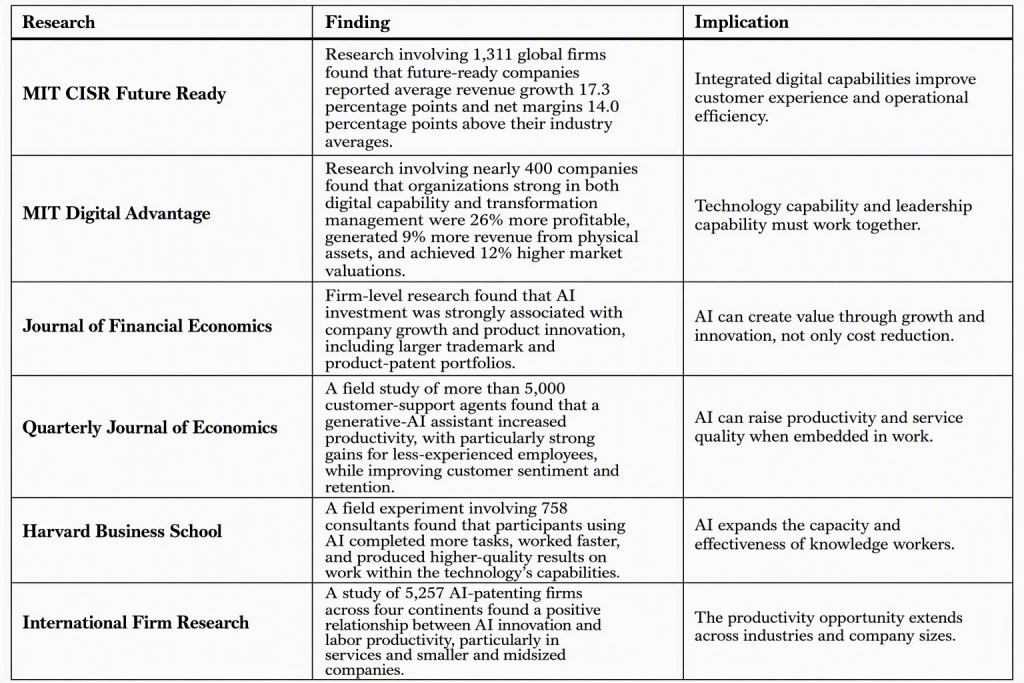
Taken together, these findings suggest that digital and AI can contribute to performance through several channels. These include growth, innovation, productivity, customer value, asset utilization, and more effective operations.
Technology investment, however, does not automatically produce these outcomes. The strongest results emerge when technology capabilities are combined with effective transformation management, business expertise, trusted data, redesigned workflows, adoption, and financial discipline.
What Digital and AI Leaders Do Differently
Digital and AI leaders do more than adopt new tools. They develop the organizational ability to focus investment on important business outcomes, establish modern technology and trusted data foundations, embed intelligence in decisions and workflows, redesign work, incorporate external information, scale successful solutions, and measure the resulting operational and financial performance.
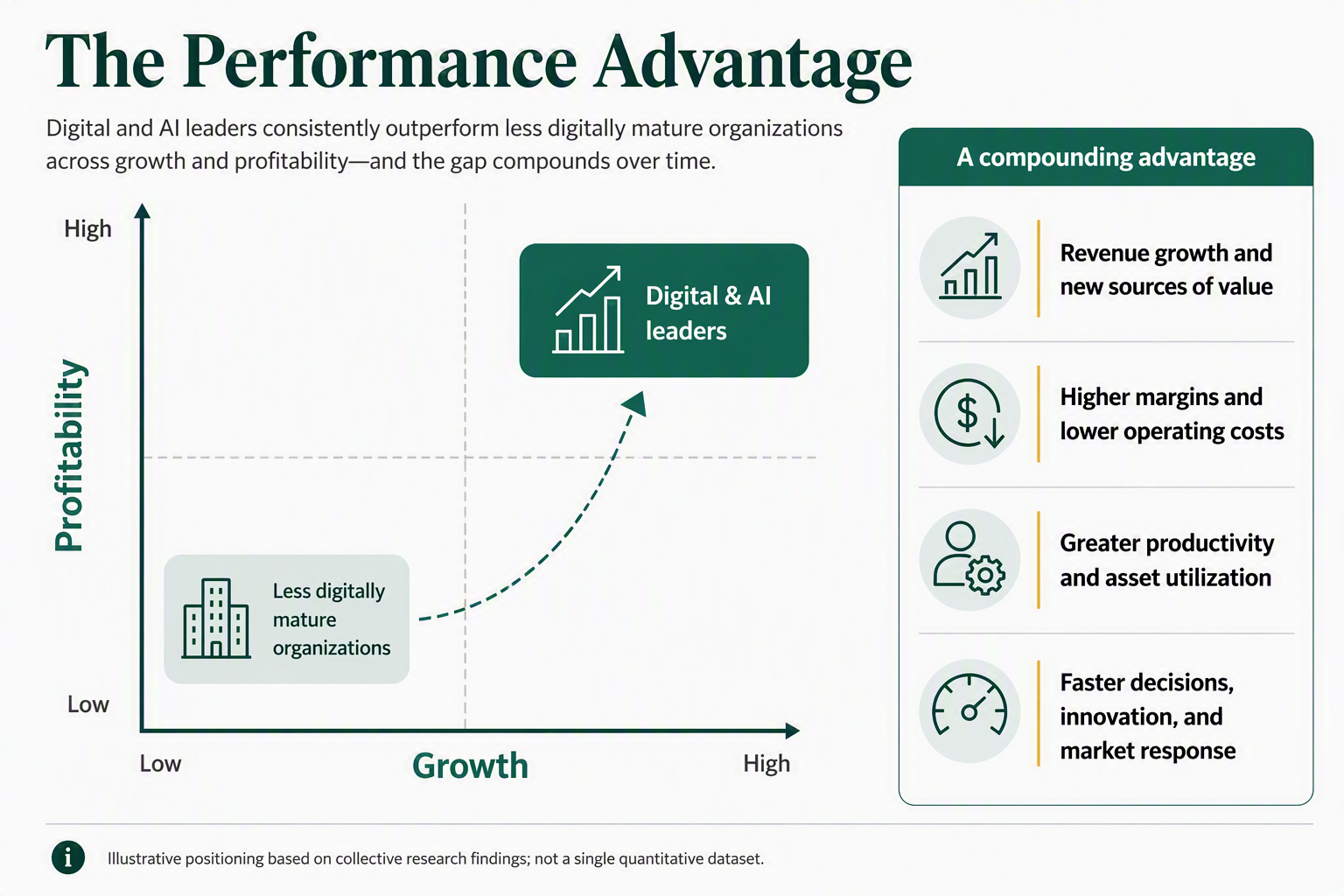
Research consistently associates digital and AI maturity with stronger financial performance. Leaders build this advantage through interconnected capabilities that allow them to convert technology and data into better decisions, more efficient processes, stronger commercial performance, and increasingly intelligent operations. The Digital Capabilities Model described below provides a practical framework for understanding these capabilities.
As these capabilities become more mature, organizations can:
- Focus digital and AI investment on high-value business outcomes.
- Build modern, secure technology and comprehensive, trusted data foundations.
- Embed intelligence and automation into decisions, workflows, and operations.
- Scale successful solutions across functions, processes, and business units.
- Reuse data, integration, governance, technology components, and expertise.
- Measure realized financial and operational results and continuously improve.
Digital and AI leadership is the ability to repeatedly convert technology, data, and AI into better decisions, more effective operations, and measurable financial results.
How Digital and AI Improve Financial Performance
Digital transformation can affect multiple parts of the financial model at the same time.
Better demand intelligence, for example, can help an organization increase revenue, improve pricing, reduce inventory, strengthen margins, and use assets more effectively. Process automation can reduce manual effort while improving speed, quality, capacity, and control.
The principal pathways to value include:
| Financial Pathway | How Digital and AI Contribute |
| Revenue Growth | Customer targeting, personalization, digital channels, new products, retention, pricing, and faster market response. |
| Gross Margin | Pricing optimization, promotion effectiveness, product and customer mix, sourcing intelligence, and lower product costs. |
| Labor and Productivity | Process automation, copilots, workflow redesign, fewer errors, increased capacity, and faster execution. |
| Working Capital | Demand forecasting, inventory optimization, improved collections, and payment management. |
| Asset Atilization | Predictive maintenance, routing, scheduling, capacity management, and reduced downtime. |
| Decision Quality | Timely information, forecasting, scenario modeling, recommendations, and natural-language access to intelligence. |
| Risk Reduction | Stronger controls, anomaly detection, cybersecurity, compliance monitoring, and earlier identification of problems. |
Business, Technology, and Financial Perspectives Must Work Together
No single function can convert digital and AI investment into enterprise value on its own.
Business and industry expertise identifies the customer needs, operating requirements, performance levers, and opportunities that matter most.
Technology, data, and AI expertise determines what is possible and builds the capabilities required to deliver solutions securely, reliably, and at scale.
Financial and economic expertise quantifies the opportunity, evaluates investment requirements, prioritizes initiatives, and measures realized returns.
Business priorities determine where to focus. Technology capabilities determine what can be achieved. Financial discipline guides investment and measures results. Joint ownership helps ensure solutions are implemented, adopted, sustained, and scaled.
6 Connected Capabilities Convert Investment Into Performance
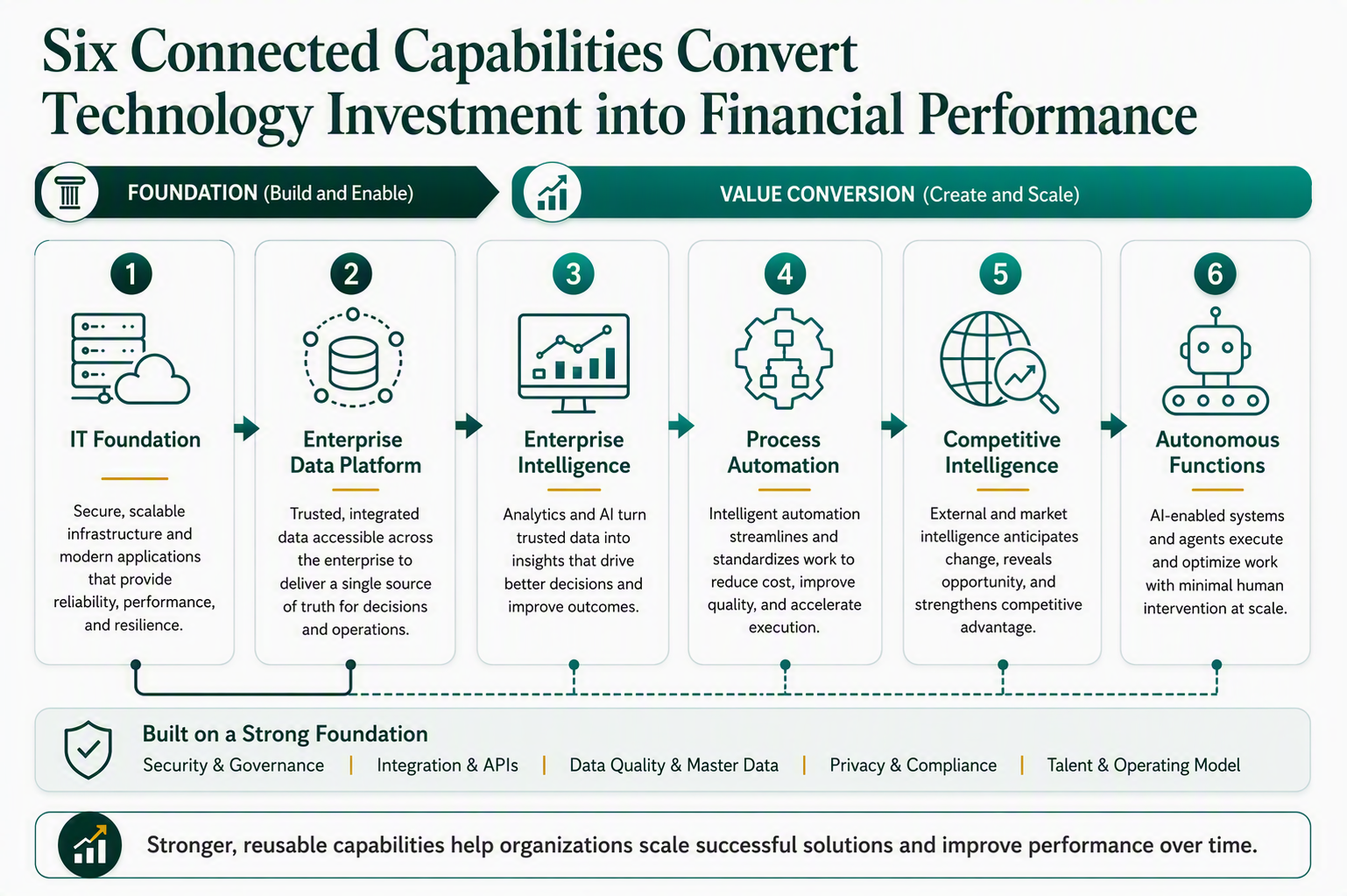
The Digital Capabilities Model organizes the capabilities organizations need to move from technology investment to measurable financial results.
The first two capabilities establish the foundation. The remaining four use that foundation to improve intelligence, efficiency, commercial performance, and increasingly autonomous operations.
How Ankura Can Help
Ankura combines business and industry experience, digital and AI capabilities, and financial and economic discipline to help organizations translate technology investment into measurable business performance.
Our approach helps organizations:
- Identify the Value
Define priority business outcomes, performance levers, and financial potential. - Design the Capabilities
Translate business requirements into practical technology, data, automation, analytics, and AI capabilities. - Build and Implement
Develop the platforms, intelligence, workflows, applications, models, and agents required to deliver the solution. - Realize the Results
Support adoption, measure value, strengthen governance, and scale successful solutions.
Ankura connects performance improvement insight with digital execution to help organizations deliver measurable value.
References
1. Woerner, S. L., Weill, P., and Sebastian, I. M. Future Ready: The Four Pathways to Capturing Digital Value. Harvard Business Review Press, 2022.
2. Westerman, G., Bonnet, D., and McAfee, A. The Digital Advantage: How Digital Leaders Outperform Their Peers in Every Industry. MIT Center for Digital Business and Capgemini Consulting, 2012.
3. Babina, T., Fedyk, A., He, A., and Hodson, J. “Artificial Intelligence, Firm Growth, and Product Innovation.” Journal of Financial Economics, 2024.
4. Brynjolfsson, E., Li, D., and Raymond, L. R. “Generative AI at Work.” Quarterly Journal of Economics, 2025.
5. Dell’Acqua, F., et al. “Navigating the Jagged Technological Frontier.” Harvard Business School Working Paper, 2023.
6. Damioli, G., Van Roy, V., and Vertesy, D. “The Impact of Artificial Intelligence on Labor Productivity.” Eurasian Business Review, 2021.
© Copyright 2026. The views expressed herein are those of the author(s) and not necessarily the views of Ankura Consulting Group, LLC, its management, its subsidiaries, its affiliates, or its other professionals. Ankura is not a law firm and cannot provide legal advice.

