






Tracker Introduction
Ankura actively monitors insurance-related acquisitions and divestitures across the market to identify emerging themes, track the most active participants, and surface insights for insurers and investors. The tracker is intended to provide a concise view into the United States and Canadian market activity using publicly available information, S&P Capital IQ data, and Ankura analysis of Q2 2026 deals classified by announced date. Ankura also produces a similar report for banking, and our first wealth management report will be coming shortly.
Q2 2026 Overview
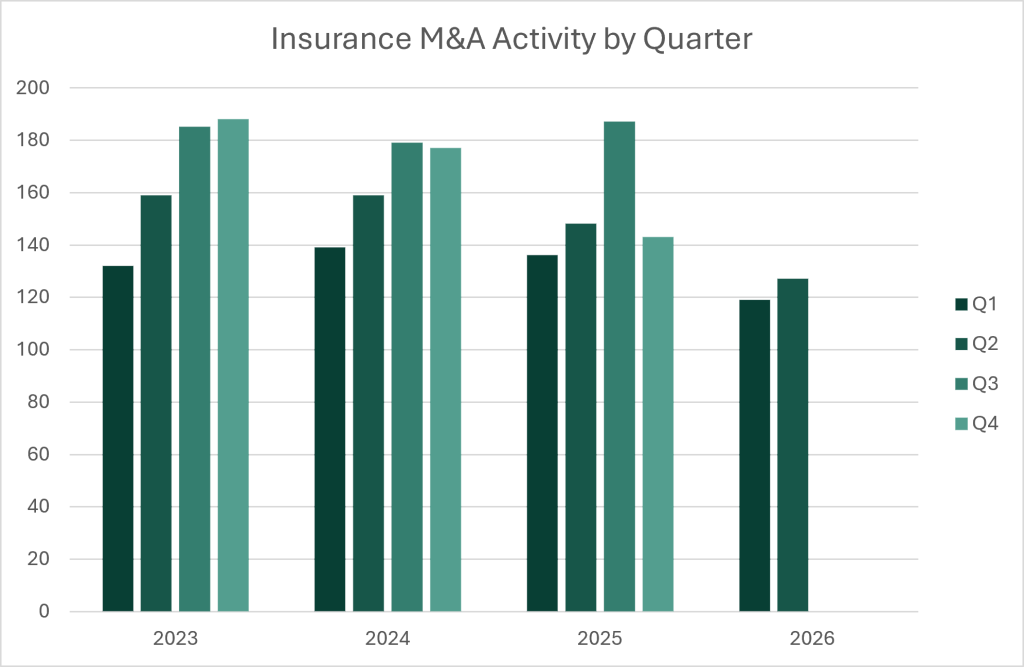
Insurance M&A activity improved modestly in Q2 2026, with tracked deal volume increasing to 127 transactions, up from 119 in Q1, though still 21 deals below Q2 2025 and below the three-year trailing quarterly average of approximately 160 deals. The quarter continued to reflect a disciplined transaction environment.
Private equity (PE)-backed activity increased by five deals from Q1 and was slightly above Q2 2025 levels, suggesting that sponsors and their portfolio companies remain active even as broader deal volume remains below historical averages.
As noted in Ankura’s Q2 Banking tracker, insurance M&A activity has followed a similar pattern: Consolidation is concentrated at the small-company segment. Buyers have continued to target strategic acquisitions, with smaller deal values being the norm.
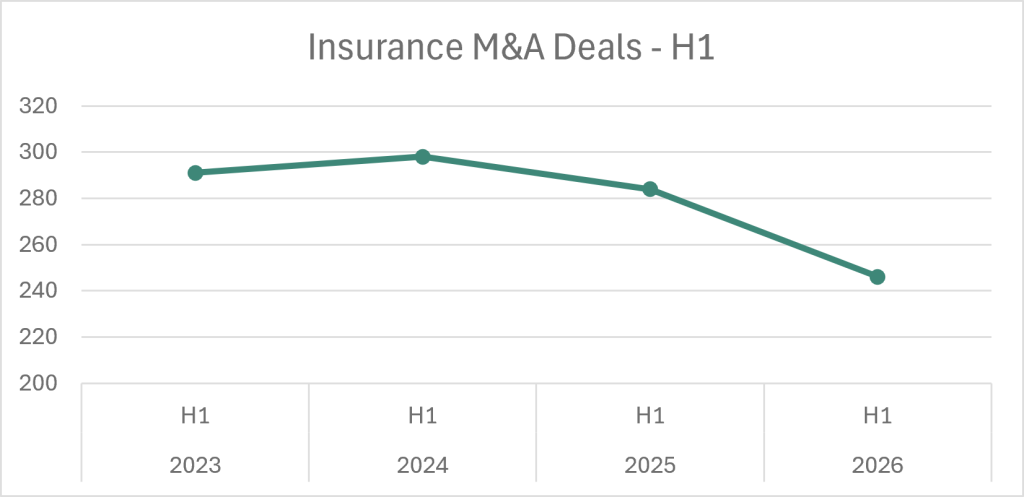
The first half of 2026 saw slower insurance M&A activity relative to recent years, with 246 total deals compared to 284 in the first half of 2025 and 298 in the first half of 2024. However, deal activity has historically accelerated in the second half of the year, creating the potential for a modest rebound if financing conditions and buyer confidence improve.
PE Continues to Focus on Brokerage Roll-Ups
The activity continues to be highly concentrated in the brokerage space, with 97% of PE-backed insurance deals involving brokerages, compared with a three-year trailing average of approximately 88%. Of deals without PE involvement, 86% of acquirees were brokerages. The concentration suggests that sponsors continue to favor distribution-oriented businesses over more capital-intensive or heavily regulated parts of the insurance value chain.
The rationale appears to be targeting platforms that can often scale through repeatable acquisitions of smaller agencies, adding local producer relationships and regional density without assuming the balance sheet complexity of risk-bearing insurance carriers. Smaller agencies may also face technology investment needs and increasing pressure to compete with larger platforms. These dynamics create a continued supply of acquisition targets for PE-backed buyers with established integration capabilities.
Inszone and Alkeme Remain Highly Acquisitive
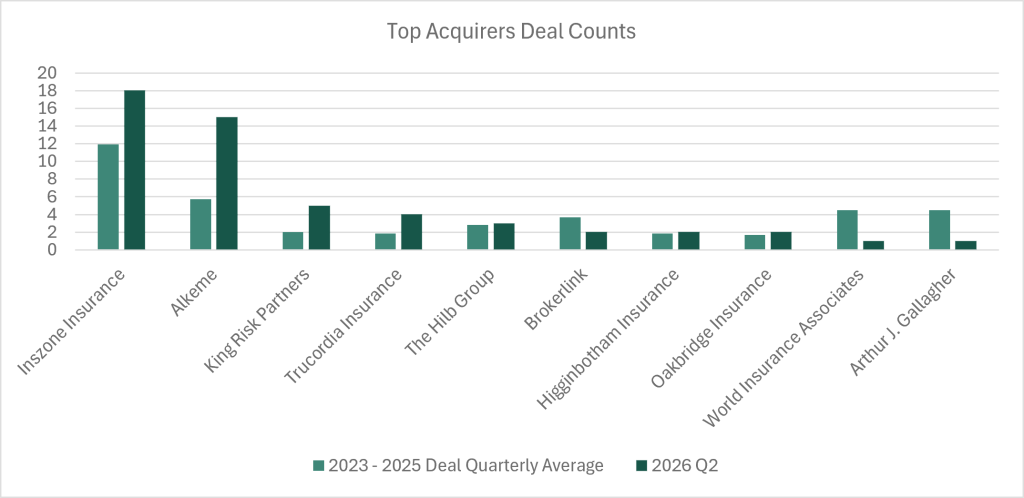
The most active acquirers in Q2 further support the PE theme. Inszone Insurance Services led the quarter with 18 transactions, while Alkeme rebounded from a slower Q1 with 15 transactions. Together, the two PE-backed platforms account for over a quarter of total tracked transactions.
Inszone’s continued acquisitiveness demonstrates the durability of the brokerage roll-up model among sponsor-backed platforms. The company has consistently used M&A to expand its footprint, add capabilities, and deepen regional density. In the past 3 years, Inszone has completed 148 acquisitions in the U.S. insurance space, with 146 of them being brokerages.
Other active acquirers included King Risk Partners and Trucordia, further illustrating that the quarter’s activity was driven by a relatively concentrated set of repeat acquirers. This pattern suggests that the market is not experiencing a broad, indiscriminate rebound. Instead, it is being led by platforms with established acquisition engines and strong integration playbooks.
What to Watch for H2 2026
Looking ahead, interest rate expectations, uncertainty around economic growth, and sponsor appetite will continue to influence how aggressively PE-backed platforms pursue additional acquisitions. At the time of publishing, Polymarket priced a 55% “Yes” probability on interest rate hikes, signaling that markets expect higher rates by year-end. If interest rates increase, higher borrowing costs could drive greater selectivity for leveraged buyers, reinforcing the preference for smaller add-ons that are easier to finance and quicker to integrate.
For insurance M&A, a softer growth backdrop tends to weigh on organic premium growth and seller valuations, which can widen bid-ask spreads and extend deal timelines. Should growth prove more durable than expected, however, the same conditions that supported Q2 activity, ample sponsor dry powder and a deep pipeline of smaller agencies, would likely sustain deal flow through year-end.
Closing
For PE sponsors and portfolio companies, value creation is increasingly dependent on what happens after closing a deal. Acquisition volume alone is not enough. Sponsors need disciplined integration planning, clear governance, synergy tracking, operating model alignment, technology enablement, and performance management to ensure that acquired brokerages contribute to the broader investment thesis.
Ankura supports PE sponsors and their portfolio companies across the M&A lifecycle, with a particular focus on turning acquisition strategies into executable value creation programs. Ankura helps PE-backed businesses evaluate integration priorities, align operating models, identify and track synergies, improve performance, and execute transformation initiatives that protect deal value and accelerate returns. As PE-backed insurance platforms continue to acquire and integrate smaller brokerages, Ankura’s hands-on execution model can help sponsors move from deal thesis to realized value.
Ankura will continue to monitor developments across the insurance M&A market and provide periodic updates throughout 2026. With PE activity, financing conditions, and economic uncertainty shaping the market, we encourage readers to stay tuned for next quarter’s update and see Ankura’s banking and wealth trackers.
© Copyright 2026. The views expressed herein are those of the author(s) and not necessarily the views of Ankura Consulting Group, LLC, its management, its subsidiaries, its affiliates, or its other professionals. Ankura is not a law firm and cannot provide legal advice.

