






Algorithmic pricing uses data, automated models, and AI to set prices, discounts, and offers. For retailers, it is no longer just a back-office revenue-management tool; it is becoming a visible part of the customer experience. The opportunity is meaningful, but so is the risk: The same technology that makes offers more relevant can also make customers feel watched, singled out, or penalized for their loyalty. The retailers that win will not simply have the most sophisticated pricing engines. They will use personalization in ways customers understand, regulators can defend, and loyal shoppers experience as fair.
The Executive Rule of Thumb:
- High Risk / Defensibility Exposure: Individualized base-price surcharges dictated by private consumer attributes (e.g., location, cart abandonment, device telemetry, or browsing velocity).
- Low Risk / Durable Value: Transparent, uniform public reference prices paired with visible, personalized benefit mechanics (e.g., loyalty discounts, curated bundles, basket-threshold rewards).
The Core Distinction: Market-Driven vs. Individualized Dynamic Pricing
Dynamic pricing is not inherently problematic. Consumers have long accepted price fluctuations dictated by macro market conditions: perishable grocery markdowns at closing, off-season clearance, surge pricing during severe transit supply deficits, or seasonal airfares. In these contexts, pricing adjustments apply uniformly across the market based on supply, demand, inventory aging, and timing.
The boundary is breached when retailers pivot from macro market signals to private consumer telemetry. Setting a unique, elevated base price based on an individual’s inferred willingness to pay, that is derived from browsing history, zip code, or past purchase frequency for instance, transforms pricing from an open economic function into covert price discrimination. Macro dynamic pricing remains legally sound; opaque individual price targeting invites direct regulatory enforcement and catastrophic loyalty churn.
Customers Want Better Deals, Not the Feeling They Are Being Watched
Customers draw a clear line between a benefit and a penalty. A personalized discount, relevant bundle, or loyalty perk feels like recognition. A higher price based on shopping habits, location, or device data feels like the retailer used confidential information against them. The customer reaction is straightforward: Personalization should save time or money, not reveal how much more the retailer thinks a person will pay.
That reaction has commercial consequences. A hidden surcharge may produce a short-term gain, but it can also increase complaints, weaken loyalty, discourage data sharing, and push customers to comparison shop. For a retailer, the short-term margin captured through opaque personalization can be outweighed by longer-term damage to loyalty, word of mouth, app adoption, and willingness to share data.
Regulators Are Focusing on Disclosure and Fairness
The FTC’s proposed August 2026 policy says businesses may violate Section 5 when they use personal data to set individualized prices without clear disclosure in markets where customers expect a common price. The proposal calls for businesses to disclose that a price is personalized, explain the basis, and identify the types of data used.[1] New York already requires a specific notice when a price is set by an algorithm using a customer’s personal data.[2] Retailers should assume that “the algorithm did it” will not be a sufficient defense if customers are not told how personal data affects the price or offer they receive.
State rules are also moving quickly. Maryland’s 2026 law restricts covered food retailers and third-party delivery services from using personal data to set higher food prices.[3] Connecticut’s 2026 law adds disclosure requirements for online personalized price increases and limits certain in-store uses beginning Oct. 1, 2026.[4] Congress has opened inquiries, and 16 state attorneys general urged the FTC to address pricing practices in online food delivery.[5] Retailers should expect a patchwork of disclosure, privacy, and sector-specific rules rather than one national standard.
2 Examples: Hidden Surcharges and Visible Discounts
Two customers can pay different amounts for the same product with very different legal and trust implications. The key questions are which data set the price, whether the base price changed, and what the customer was told.
Example 1: Unlawful or High-Risk Personalized Base Pricing
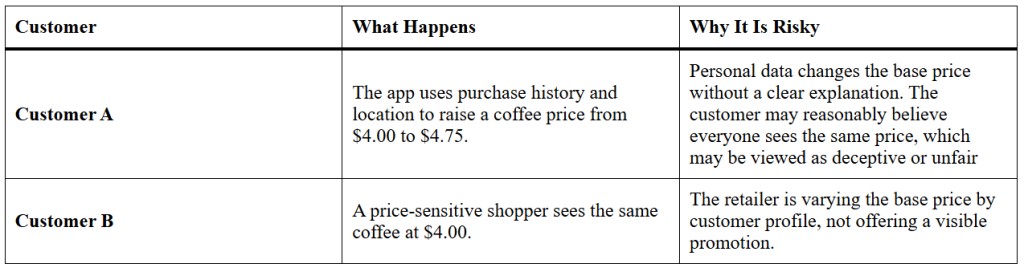
What Matters: Different final prices are not automatically the problem. The higher-risk practice is changing a customer’s base price with undisclosed personal data. A safer design keeps a common reference price and makes any personal benefit visible.
Example 2: Legal, But Potentially Trust-Damaging
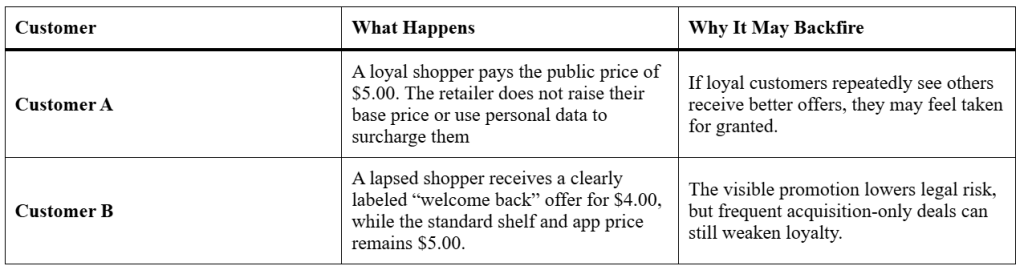
What Matters: Compliance is the floor. Even a compliant promotion can erode goodwill if it repeatedly rewards disloyalty more visibly than loyalty. Retailers should balance acquisition offers with visible rewards for existing customers, so loyalty does not feel like a disadvantage.
A Safer Approach: Keep Prices Public and Personalize the Discount
Keep the base price public and consistent. A retailer can still optimize margin, move inventory, and increase basket size, but it should do so through transparent mechanisms customers recognize as value. Use customer data for benefits around that price: member discounts, coupons, bundles, free items, threshold rewards, and clearly labeled markdowns. This preserves room to manage margin and inventory without quietly charging one shopper more.
| Principle | Retailer Action | Why It Helps |
| Use a Public Reference Price | Keep shelf, app, website, and checkout prices aligned. | Gives customers a clear basis for comparison. |
| Personalize Benefits | Use data for discounts, bundles, and perks — not hidden surcharges. | Makes personalization feel useful instead of punitive. |
| Disclose the Logic in Plain English | Use labels such as “member price,” “loyalty offer,” or “inventory markdown.” | Supports disclosure and improves perceived fairness. |
| Govern the Data Inputs | Review sensitive attributes, location, device data, proxies, and vendor inputs. | Reduces privacy, discrimination, and reputational risk. |
| Measure the Customer Response | Track complaints, opt-ins, trust, retention, and margin. | Shows whether the program creates durable value. |
Recommendations for Retailers
- Establish a pricing-use policy before scaling the technology. Define which use cases are acceptable, which require disclosure, and which are prohibited. Treat individualized base-price increases driven by personal data as a Tier-1 compliance exposure requiring legal, privacy, compliance, and business review.
- Separate market-based dynamic pricing from personalized algorithmic pricing. Maintain different governance paths for broad demand, supply, and inventory pricing versus customer-specific pricing or offers. The compliance burden is materially higher when personal data influences what an individual sees.
- Build disclosure into the user experience, not the fine print. Disclosures should appear near the price or offer and explain the basis in language a customer can understand. If the price or promotion is personalized, say so directly.
- Design personalization as hospitality. Use algorithms to remember preferences, simplify choices, reward repeat behavior, and make offers more relevant. Avoid mechanics that make loyal customers feel captive, rushed, or exploited. Personalization must never feel like surveillance; it should function as a digital concierge.
- Audit the model and the vendor ecosystem. Pricing intermediaries, personalization platforms, loyalty vendors, and ad-tech partners may introduce data inputs or optimization logic the retailer did not fully intend. Retailers should require documentation, testing, and contractual controls.
- Measure trust as a commercial KPI. Margin lift should be evaluated alongside customer complaints, fairness perception, opt-in rates, churn, loyalty engagement, and social sentiment. A pricing model that improves gross margin, but damages trust is not creating durable value.
How Retailers Can Reduce Risk
Retailers can use advanced pricing without creating avoidable legal risk. Start by inventorying every system that changes a price, fee, discount, or offer. Then trace the data inputs, identify where personal information affects the result, document the business rule, and test for unfair or discriminatory outcomes. Legal, privacy, pricing, data science, and operations teams should review the same facts.
Given that FTC penalties, state enforcement actions, and civil litigation can escalate into substantial fines and settlements, proactive review is easier than rebuilding a pricing program during an investigation. It also gives retailers time to address different state rules, update disclosures, and preserve customer trust.
Bottom Line
Algorithmic pricing will be judged by both results and fairness. Retailers do not need to abandon personalization. They do need to use it transparently, keep customer expectations in view, and avoid using private data to find the highest price one person will pay. The best programs make value easier to see and risk easier to defend. In an environment where regulators are scrutinizing pricing practices and consumers are increasingly sensitive to how their data is used, trust may become the most important pricing variable of all.
How Ankura Helps Retailers Build Defensible, Trust-Centered Pricing Programs
Algorithmic pricing combines consumer protection, privacy, model risk, economics, and retail operations. Ankura brings those disciplines together to help retailers identify where personal data affects price, redesign high-risk practices, test models, improve disclosures, and respond to investigations or litigation.
| Concern | Ankura Service Offering | Deliverable(s) |
| “We do not know every system that changes a customer’s price or offer.” | Performance Improvement Practice: Pricing-Algorithm Risk Assessment | A complete inventory of pricing systems, decision rules, and personal data inputs, with the highest-risk uses clearly identified. |
| “Customer data, not market conditions, is changing our base prices.” | Performance Improvement Practice: Pricing and Promotion Tool | A pricing model that ties public prices to cost, inventory, and margin — and moves personalization into visible discounts and loyalty offers. |
| “We lose track of customer data when vendors and platforms use it.” | Performance Improvement Practice: Dataflow and Privacy Review | A map of where customer data goes, how it is used, and which sensitive, unnecessary, or poorly disclosed inputs should be removed. |
| “We know the disclosure rule, but we do not know how to apply it.” | Performance Improvement Practice: Disclosure and Control Design | Clear operating standards for when disclosures appear, what they say, and how the company proves customers received them. |
| “Can we explain and defend the model to a regulator?” | AI Security & Privacy Advisory: AI governance frameworks, model risk review, and bias/disparate-impact testing | An independent assessment of model fairness, proxy variables, human review, and the evidence needed for an audit or inquiry. |
| “Customers see the disclosure only in the fine print.” | Compliance & Ethics: Program design, policy and procedure implementation, and controls testing | A pricing policy that defines allowed and prohibited uses, state-specific notice requirements, and proof that customers were informed. |
| “How will a compliant approach affect margin and customer value?” | Economics & Statistics: Econometric modeling, price elasticity, and conjoint analysis | A quantified view of the margin, basket-size, and lifetime-value impact of using visible discounts, bundles, and loyalty offers. |
| “We are already facing a regulatory inquiry, lawsuit, or antitrust matter.” | Disputes, Forensics & Investigations, and eDiscovery: Damages, class certification, and testifying experts | End-to-end support for data preservation, document review, algorithm analysis, damages, and expert testimony. |
Appendix
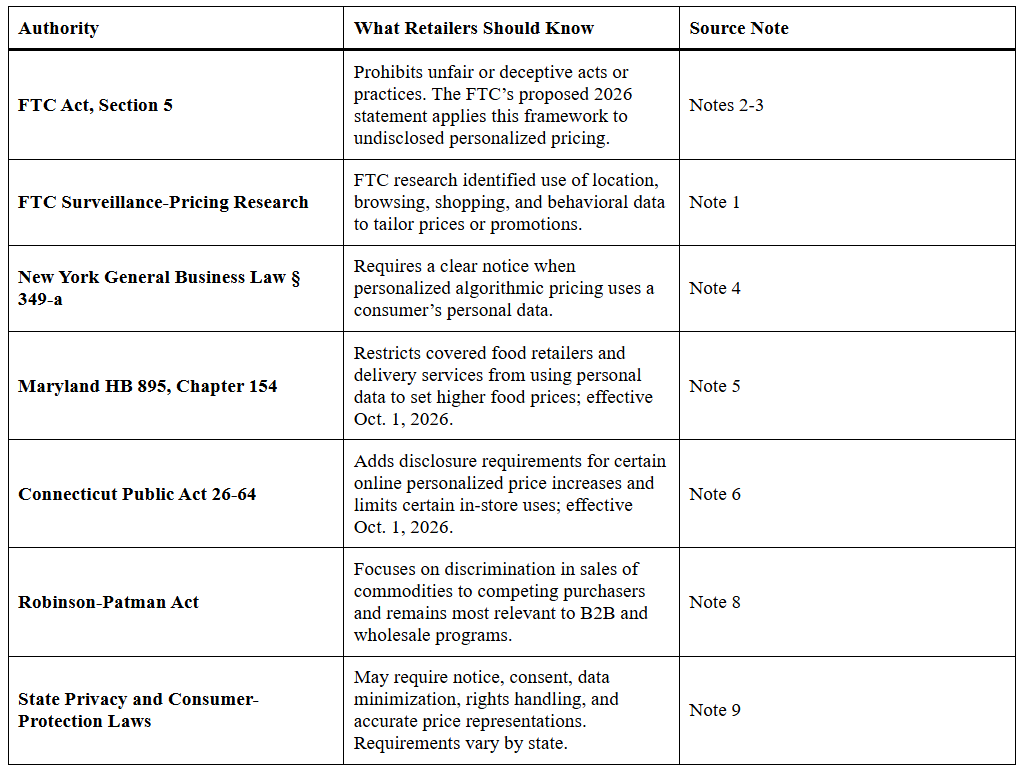
Legal and Regulatory Reference
This appendix summarizes the main authorities discussed in the paper. It is not an exhaustive legal analysis. Applicability depends on jurisdiction, product, channel, data inputs, and the specific pricing practice.
References
[1] FTC August 19, 2026 proposed enforcement policy statement. https://www.ftc.gov/news-events/news/press-releases/2026/08/ftc-seeks-comment-enforcement-policy-statement-regarding-personalized-pricing
[2] New York General Business Law § 349-a. https://newyork.public.law/laws/n.y._general_business_law_section_349-a
[3] Maryland HB 895, Chapter 154. https://mgaleg.maryland.gov/mgawebsite/Legislation/Details/hb0895?ys=2026rs
[4] Connecticut Public Act 26-64. https://www.cga.ct.gov/2026/act/pa/pdf/2026PA-00064-R00SB-00004-PA.pdf
[5] Source 7: U.S. House Committee on Oversight and Government Reform, March 5, 2026; Duane Morris, June 1, 2026 (no URLs listed in Appendix Sources).
Sources
- Federal Trade Commission, “Surveillance Pricing,” including the July 2024 study orders and January 2025 staff findings: https://www.ftc.gov/news-events/features/surveillance-pricing
- 15 U.S.C. § 45, Federal Trade Commission Act, Section 5: https://www.ftc.gov/legal-library/browse/statutes/federal-trade-commission-act
- Federal Trade Commission, “FTC Seeks Comment on Enforcement Policy Statement Regarding Personalized Pricing,” August 19, 2026: https://www.ftc.gov/news-events/news/press-releases/2026/08/ftc-seeks-comment-enforcement-policy-statement-regarding-personalized-pricing
- New York General Business Law § 349-a, Algorithmic Pricing Disclosure: https://newyork.public.law/laws/n.y._general_business_law_section_349-a
- Maryland General Assembly, HB 895, Chapter 154, Protection From Predatory Pricing Act: https://mgaleg.maryland.gov/mgawebsite/Legislation/Details/hb0895?ys=2026rs
- Connecticut General Assembly, Public Act 26-64, An Act Concerning Consumer Privacy and Protection: https://www.cga.ct.gov/2026/act/pa/pdf/2026PA-00064-R00SB-00004-PA.pdf
- U.S. House Committee on Oversight and Government Reform, “Comer Investigates Use of Artificial Intelligence to Set Prices for Consumers,” March 5, 2026; and Duane Morris, “State Attorneys General Urge FTC to Regulate Pricing Practices by Online Food Delivery Services,” June 1, 2026.
- Federal Trade Commission, “Price Discrimination: Robinson-Patman Violations”: https://www.ftc.gov/advice-guidance/competition-guidance/guide-antitrust-laws/price-discrimination-robinson-patman-violations
- MultiState, “20 State Privacy Laws in Effect in 2026: Key Dates and Changes,” February 4, 2026: https://www.multistate.us/insider/2026/2/4/all-of-the-comprehensive-privacy-laws-that-take-effect-in-2026
© Copyright 2026. The views expressed herein are those of the author(s) and not necessarily the views of Ankura Consulting Group, LLC, its management, its subsidiaries, its affiliates, or its other professionals. Ankura is not a law firm and cannot provide legal advice.

