






Back-to-school is no longer just a retail event. It is a behavioral reset, a budget test, and an early signal of how consumers may approach the second half of the year.
Overview
Back-to-school has long been one of retail’s most dependable seasons, and its significance extends beyond classrooms and supply lists. It marks a behavioral reset as families re-establish routines, students prepare for new environments, and consumers shift from the flexibility of summer to the structure of fall. In 2026, that transition feels particularly meaningful.
Households are approaching the season with greater intentionality. Rather than simply purchasing what is required, consumers are weighing needs, budgets, and priorities for the months ahead. For retailers and brands, this creates both opportunity and responsibility. Success will come not from treating the season as a transaction-driven event, but from recognizing the role these companies play in helping consumers prepare for a fresh start.
The Economic Backdrop: A Two-Speed Consumer
The U.S. economy continues to show resilience. GDP increased at an annual rate of 1.5% in Q2 2026, signaling continued albeit slugging growth amid a more uneven economic backdrop. July 2026 retail sales remained positive with year-over-year (YOY) growth of 4.8%, and manufacturing activity continues to expand. Read on its own, that picture would suggest a straightforward season.
The household picture is more complicated. Inflation remained elevated at 3.4% in July 2026, household debt has climbed to a record $18.8 trillion, and July 2026 personal savings rate was at 3.0%, down from 4.5% the same time last year. Wage growth and inflation have largely converged, limiting further gains in purchasing power despite a relatively healthy labor market. Consumers are participating in the market with caution rather than optimism, and that gap between a healthy topline and a stretched household is the defining tension of the season.
Exhibit 1. A Resilient Economy and a Stretched Household

Source: See Data Sources
Note: Institute for Supply Management Manufacturing Purchasing Managers’ Index above 50 reads manufacturing is expanding
What Is Different This Year?
The traditional image of back-to-school shopping centers on a last-minute rush through crowded stores. Increasingly, consumers are approaching the season as an extended planning exercise. Parents are evaluating not only what their children need for school, but how those purchases fit into broader household priorities. Students are considering functionality alongside self-expression. Teachers are often purchasing classroom necessities themselves. College students are preparing for entirely new living and learning environments.
Consumers are not broadly pulling back. Rather, spending is becoming increasingly selective. Households continue to spend in categories that support daily life, productivity, and experiences, while becoming more deliberate about discretionary purchases. This shift helps explain why overall retail sales remain resilient even as sentiment remains weak and household financial pressure continues to build.
The season is also starting earlier, reflecting the same intentionality that is shaping spending decisions more broadly. The National Retail Federation reported that 62% of back-to-school shoppers began shopping by early July, confirming that the buying window is no longer concentrated in a short burst before the first day of school. Yet starting earlier does not necessarily mean finishing earlier. For many households it reflects a deliberate effort to monitor prices, spread spending across paychecks, and wait for value.
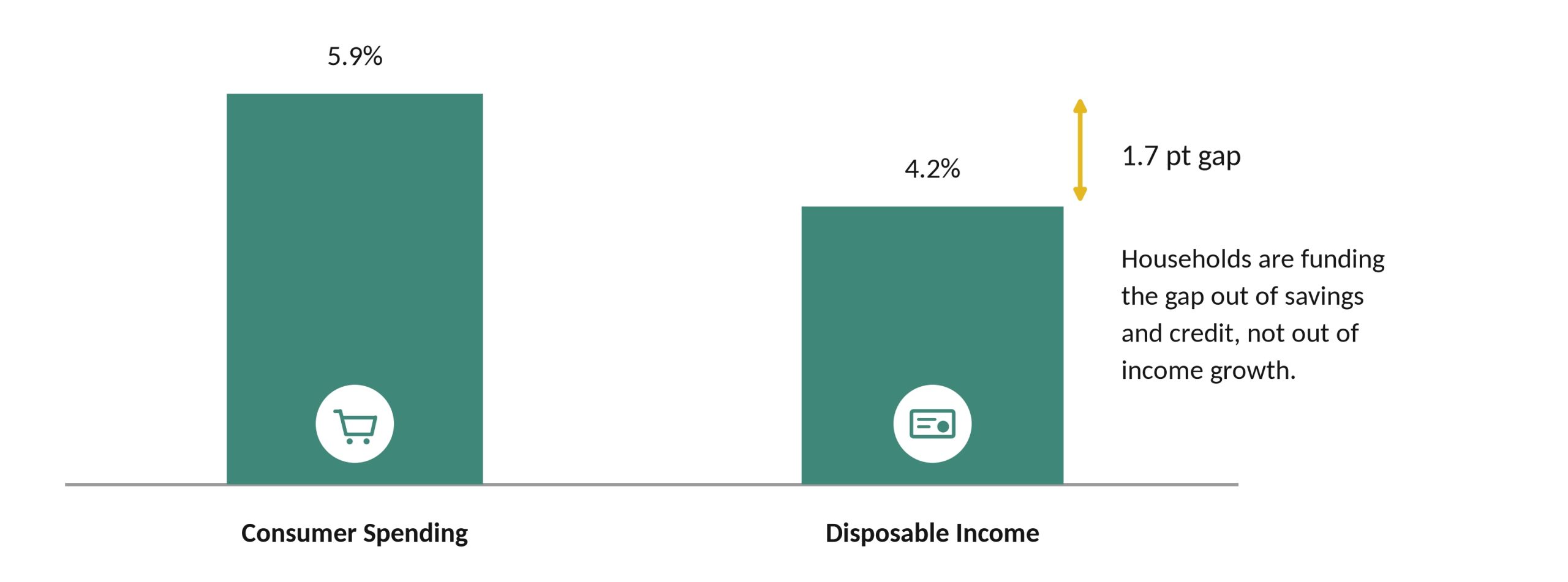
Consumer spending continues to outpace income growth, with July 2026 expenditures rising 5.9% YOY versus 4.2% growth in disposable income. That gap suggests many households are preserving spending by drawing down savings, relying more heavily on credit, or becoming increasingly selective about where they allocate their dollars. July 2026 fuel prices remain roughly 25% above prior-year levels, transportation costs continue to rise, and student loan repayment obligations are placing additional pressure on household budgets. The result is a season that touches nearly every consumer segment, but for very different reasons.
Exhibit 2. Spending Is Outpacing Disposable Income
Source: See Data Sources
5 Themes Retailers Should Watch
1. Consumers Are Seeking Readiness, Not Just Products
Back-to-school purchases are ultimately about preparedness. Whether it is a backpack, a laptop, a pair of sneakers, or a dorm room accessory, consumers are looking for tools that help them feel equipped for what comes next. That desire for readiness is occurring at a time when many households feel financially constrained. Sentiment remains well below historical averages, savings rates are low, and financial stress indicators remain elevated. Consumers are willing to spend, but they want confidence that every purchase has value and purpose.
This creates an opportunity for brands to shift messaging away from products and toward outcomes. The most compelling retailers will focus on how they help families feel organized, confident, and ready for the year ahead. The conversation is less about what consumers buy and more about what those purchases enable.
2. The Definition of Back-to-School Is Expanding
The season increasingly reaches consumers beyond traditional K-12 families. College students remain a significant spending driver, but back-to-school also influences young professionals entering new roles, parents adjusting household routines, and educators preparing classrooms. In many ways, it has evolved into a broader back-to-routine season.
That broader audience matters because spending growth is increasingly concentrated in select categories. July 2026 sporting goods, hobby, book, and music store sales are up more than 10% YOY, non-store retail has increased over 7%, and home improvement continues to outperform other categories like electronics. Companies that recognize the expanded audience can uncover new opportunities for relevance, particularly in categories that support productivity, organization, wellness, and personal development.
Exhibit 3. Retail Growth Spans Multiple Categories

YOY sales growth by category against total retail sales. Source: See Data Sources
Home Improvement includes Building Materials, Garden Equipment, Supplies Dealers
3. Confidence Is Becoming a Key Purchase Driver
Consumers today have more choices than ever, and that abundance can make decision-making feel overwhelming. The brands that simplify the process will build trust. Clear assortments, practical recommendations, thoughtful merchandising, and solution-oriented messaging remove friction at a time when families are managing dozens of competing priorities. This matters even more when sentiment sits near multi-year lows despite continued spending activity. In an environment saturated with options, clarity becomes a competitive advantage, and retailers should treat confidence as part of the value proposition rather than a byproduct of the shopping experience.
4. Students Continue to Influence More Decisions
Back-to-school remains one of the first major shopping moments of the year where younger consumers hold meaningful influence over spending decisions. Students arrive with strong opinions shaped by social media, peer groups, athletics, gaming communities, and digital creators. Parents may control the budget, but students often shape preferences. That dynamic creates a balancing act: Products must satisfy practical considerations while also resonating culturally. The categories seeing the strongest momentum, including sporting goods, electronics, and digital commerce, sit precisely at that intersection of functionality, technology, and identity.
5. Preparation Has Become Emotional
At its core, back-to-school is not simply a retail event. It is a life transition. For a kindergarten parent, it may represent a major milestone. For a high school senior, it may signal the beginning of a chapter closing. For a college freshman, it often marks a significant step toward independence.
That emotional significance is amplified by financial realities. Student loan balances remain above $1.6 trillion nationally, household debt has reached record levels, and many families are balancing future aspirations against present-day budget constraints. The most effective brands understand that these purchases carry emotional weight. Retailers that acknowledge the significance of these moments can create deeper connections than those focused solely on product and price.
Exhibit 4. Back-to-School Has Become Back-to-Routine

Source: Ankura Performance Improvement analysis
What Retail Leaders Should Be Thinking About
The strongest strategies will focus on reducing complexity, providing guidance, and creating confidence. Merchandising should reflect real-world consumer needs. Marketing should emphasize solutions rather than promotions. Operations should prioritize convenience, reliability, and availability during a period when time is often in short supply.
Leaders should also keep the broader economic climate at the forefront. Elevated fuel prices, rising transportation costs, and continued logistics expenses remain among the most persistent sources of pressure on household budgets and consumer-facing sectors. The organizations best prepared for back-to-school success will be those that balance value, availability, and affordability simultaneously. A low price attracts attention, but confidence, clarity, and trust are what turn interest into conversion. Perhaps most importantly, back-to-school is often a consumer’s first major engagement with brands in the second half of the year, and the impressions formed during this season can influence purchasing behavior well into the holiday period.
How Ankura Helps
Ankura’s Performance Improvement team helps retailers and brand owners convert this view of the season into operating decisions:
- Match assortment to the reset. Use pricing and promotion analytics, category profitability modeling, and merchandise-mix and demand-planning tools to reflect how households are actually budgeting this season rather than how they budgeted last year.
- Plan for a longer, flatter buying window. Adjust inventory, replenishment, and labor scheduling for a season that now begins in early July and spreads across paychecks instead of peaking in a single burst.
- Protect margin as input costs rise. Apply inventory and working-capital optimization, productivity analysis, and AI-enabled forecasting to absorb higher fuel, freight, and tariff costs without surrendering price perception.
- Reduce friction where confidence is won. Simplify assortments and merchandising so the clarity that drives conversion is designed in, not left to chance.
Final Thoughts
Back-to-school remains one of retail’s most important seasons, but its importance has evolved. Today it is less about shopping lists and more about a mindset. Consumers are entering the season looking for structure, confidence, and preparedness. They are not simply buying products; they are investing in the next chapter of their year.
The economic backdrop explains why. Consumers continue to spend, but they are doing so while navigating persistent inflation, rising debt, low savings, and ongoing uncertainty about the months ahead. Retail sales remain resilient, yet confidence remains fragile. What makes this back-to-school season particularly important is that it offers one of the first clear signals of post-summer consumer behavior. The story is not one of retreat, but of selectivity. The companies that succeed will be those that understand the deeper role they play in that transition. By helping consumers navigate change, simplify decisions, and feel ready for what comes next, brands can build relationships that extend far beyond the first day of school.
Data Sources
- Gross domestic product, personal consumption expenditures, disposable personal income, and the personal savings rate: U.S. Bureau of Economic Analysis.
- Retail and food services sales, including category-level detail for sporting goods, home improvement, electronics, and non-store retailers: U.S. Census Bureau, Advance Monthly Sales for Retail and Food Services.
- Consumer Price Index, July 2026, including headline CPI, core CPI, transportation, apparel, education, food-at-home, and food-away-from-home inflation: U.S. Bureau of Labor Statistics.
- Household debt, consumer credit, and student loan balances: Federal Reserve Bank of New York, Quarterly Report on Household Debt and Credit.
- Consumer sentiment: University of Michigan Surveys of Consumers.
- Manufacturing activity, industrial production, and durable goods orders: Institute for Supply Management; Federal Reserve Board Industrial Production Index; U.S. Census Bureau Durable Goods Orders.
- Retail gasoline prices and diesel fuel prices: U.S. Energy Information Administration.
- Back-to-school shopper timing and season outlook: National Retail Federation, 2026 back-to-school consumer survey.
- Wage growth and earnings data: U.S. Bureau of Labor Statistics, Employment Situation and Average Hourly Earnings releases
- Transportation and travel cost indicators, including airfare inflation: U.S. Bureau of Labor Statistics and U.S. Transportation Security Administration
© Copyright 2026. The views expressed herein are those of the author(s) and not necessarily the views of Ankura Consulting Group, LLC, its management, its subsidiaries, its affiliates, or its other professionals. Ankura is not a law firm and cannot provide legal advice.

