






Introduction
Many companies rely on spreadsheets, email, shared drives, and disconnected legacy systems to perform work that is too important to remain manual. These tools often become the operational backbone for planning, reporting, approvals, scheduling, purchasing, and exception management — even when they were never designed to support enterprise workflows.
The conventional response is frequently to purchase a large software platform or expand an existing enterprise system. While those solutions can be appropriate, they may also require significant license fees, lengthy implementations, extensive configuration, and substantial process changes. Even after implementation, users may still rely on spreadsheets and manual workarounds because the software does not reflect how the business actually operates.
A custom digital point solution offers another path. By combining operational expertise, user-centered design, modern data architecture, and accelerated development, companies can address clearly defined business problems in weeks rather than months or years. The result is a practical solution built around the work users need to perform — not around the limitations of an off-the-shelf platform.
The Business Imperative
Operational complexity is increasing across industries. Companies must manage more products, customers, suppliers, locations, data sources, planning variables, and cross-functional dependencies — often without adding resources at the same pace. This creates common pain points.
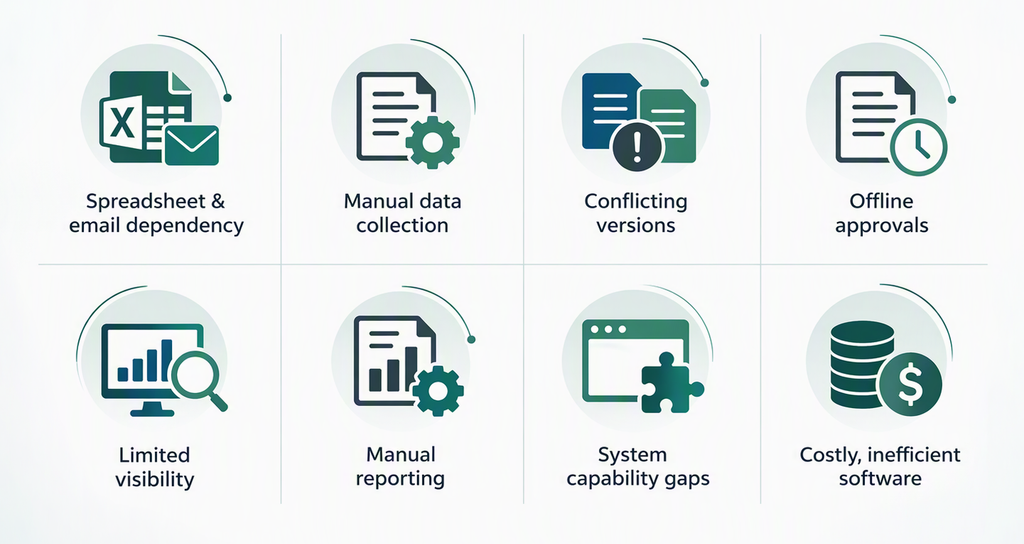
These issues create more than administrative inefficiency. They slow decisions, increase error risk, obscure accountability, reduce organizational capacity, and prevent skilled employees from focusing on higher-value work.
The Opportunity: Fit-for-Purpose Digital Solutions
Many companies have unique processes that third-party software solutions do not adequately accommodate. In these situations, a custom digital solution can often be developed faster, better fit the way the business operates, and cost less to implement and maintain. In many cases, the highest-value solution is a focused application that connects existing data, automates the most burdensome activities, and gives users a shared environment for completing a specific process. Custom point solutions can support a broad range of operational needs.

The objective is not to replicate every capability of an enterprise system. It is to identify the work creating the greatest friction and build the most practical solution that materially improves speed, control, and decision quality.
From Fragmented Work to a Connected Workflow
A well-designed point solution creates a single place for users to access information, complete tasks, collaborate, and understand the implications of their decisions. The result is not simply a better dashboard. It is a more efficient way of working.

Illustrative Custom Solution Applications
Retail – Assortment Planning
A custom assortment planning application can replace disconnected planning files with a shared environment for product information, assumptions, financial targets, approvals, and performance reporting. Users can evaluate product productivity, assortment breadth and depth, pricing, cost, margin, inventory, and other business variables without manually consolidating multiple files.
Potential capabilities include roll-up reporting, bulk changes, scenario modeling, approval controls, supplier information, product images, milestone tracking, and visibility into the financial effect of proposed decisions.
Supply Chain – Purchase Order Flow and Exception Management
A flow-management solution can consolidate purchase-order, shipment, event, milestone, inventory, capacity, and location data into a common view. Instead of manually assembling updates from multiple systems, teams can monitor product flow, identify delayed activities, compare expected, projected, and actual milestone dates, and focus on exceptions requiring action.
Potential capabilities include configurable calendars, projected completion dates, status tracking, drill-down reporting, search and filtering, unit conversions, administrative controls, and exportable data. The solution can also evolve as users identify additional reports, metrics, alerts, and decision requirements.
Manufacturing – Demand, Inventory, and Production Planning
A custom planning and materials application can connect demand forecasts, finished-goods inventory, production requirements, raw-material needs, purchasing plans, production schedules, and manufacturing reporting.
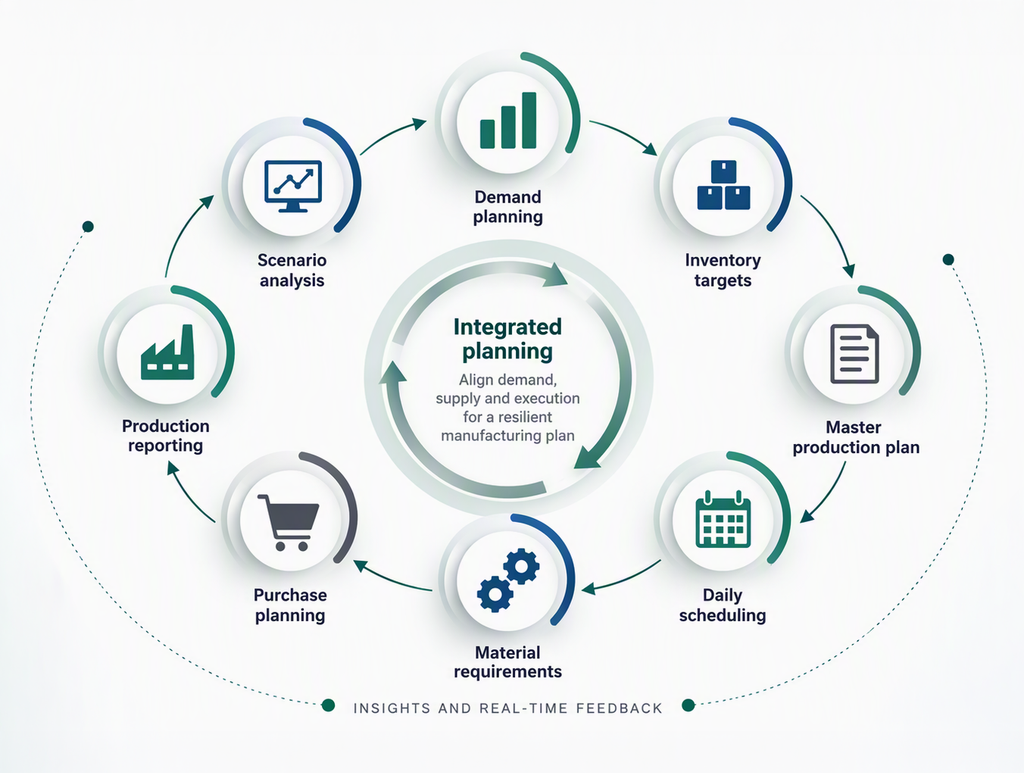
This type of solution can complement an ERP by providing the operational planning and decision support that transactional systems often do not deliver effectively.
Faster Delivery, Lower Risk, and Better Value
Traditional software programs may require lengthy selection, contracting, design, configuration, integration, and deployment cycles. A focused custom solution can move much faster because the scope is tied to a defined operational problem and a prioritized set of user outcomes. An accelerated delivery model typically includes three stages.

Depending on scope and data readiness, an initial solution can often be designed, developed, tested, and deployed in approximately eight to 16 weeks. More focused applications or prototypes may be delivered even faster.
Building an Asset the Client Owns
A custom solution should create a durable client asset — not ongoing dependence on a proprietary software vendor.
The solution can be developed within the client’s approved technology environment and be designed to provide direct data integration, security, lower cost, and greater flexibility.
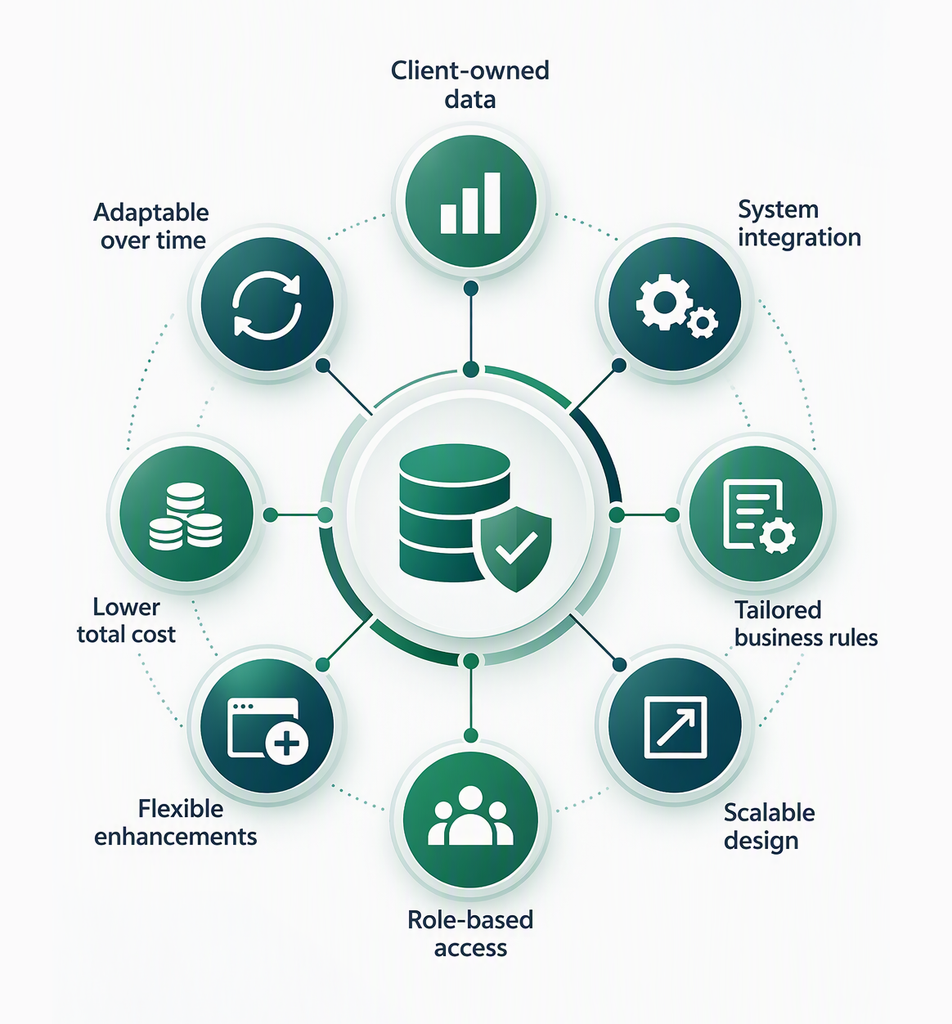
This approach allows the company to invest in capabilities that directly support its operating model rather than paying for a broad feature set that may never be used.
Technical Architecture
A strong technical foundation is essential. Custom does not mean informal, unsecured, or disconnected.

The architecture should be matched to the client’s security standards, technology strategy, data environment, and internal support model.
Where an enterprise data platform is available, custom digital solutions can leverage its integrated data, consistent business definitions, and governance to accelerate development and improve reliability. Multiple applications can then use the same trusted foundation for reporting, planning, and workflow automation. Where a platform is not yet in place, an initial enterprise data platform can often be developed in a few months, depending on scope and data readiness, while custom solutions are built alongside it. A focused solution can also begin with the data it needs and contribute to a broader enterprise data foundation over time.
Practical Value Versus Large Software Implementations
Large software platforms can offer significant capabilities, but they may also require the business to adapt its processes to the software. This can introduce more steps, create duplicate data entry, and leave important work outside the system.
A custom point solution reverses that equation. The technology is designed around the desired workflow and provides distinct advantages.

The appropriate decision is not “custom or enterprise software” in every situation. Custom solutions can fill gaps between systems, improve processes while a broader transformation is underway, extend the value of existing technology, or provide a targeted alternative where a large platform is not justified.
User-Centered Development and Change Management
Successful development requires more than technical delivery. Users must trust the data, understand the workflow, and see how the solution makes their work easier. Our approach embeds users throughout development to improve adoption.
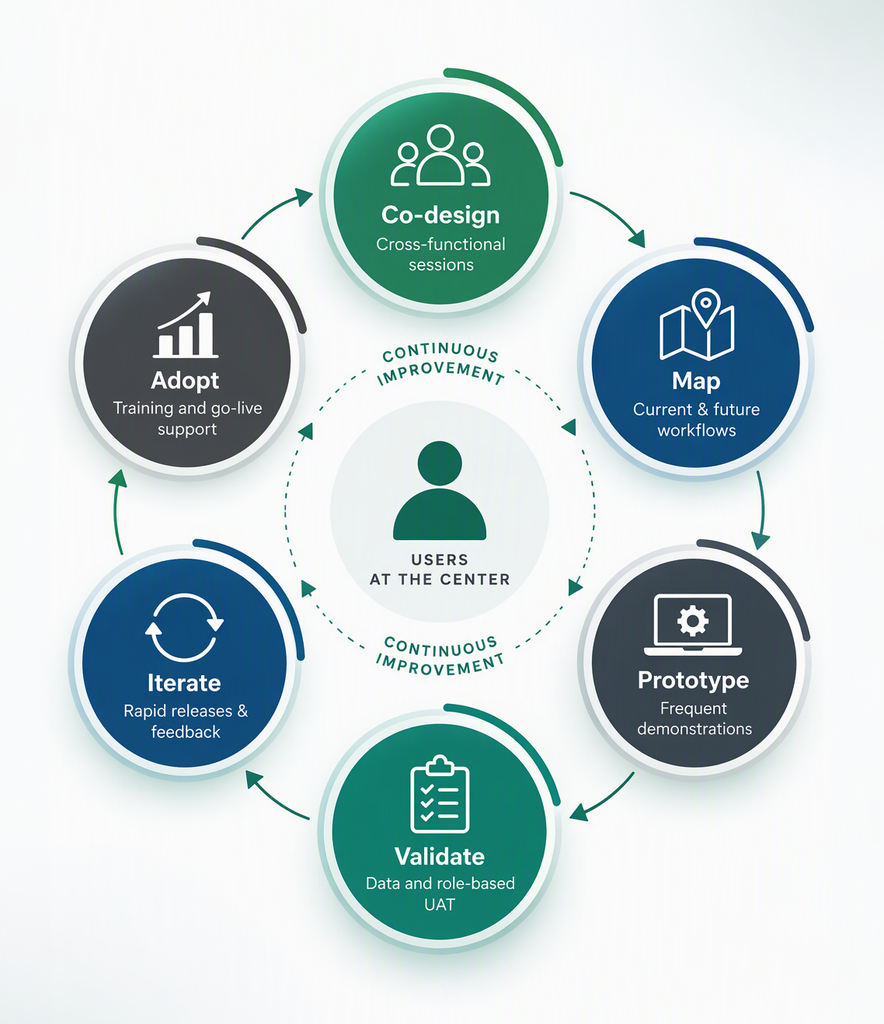
This approach creates stronger adoption because users help shape the solution before it is deployed. It also allows the development team to identify unclear requirements, data issues, and workflow conflicts early — when they are faster and less expensive to resolve.
Measuring the Business Case
Every custom solution should begin with a clear value hypothesis and measurable outcomes. Establishing a baseline before development allows the company to evaluate realized value during rollout and prioritize subsequent enhancements.

How Ankura Can Help
Ankura combines operational, financial, data, and technology expertise to identify high-value opportunities and deliver practical digital solutions.
Our Support Includes
- Operational diagnostics and opportunity identification
- Current and future-state process design
- Functional requirements and solution design
- Data assessment and technical architecture
- Enterprise Data Platforms development or enhancements
- User-interface and user-experience design
- Systems integration and data automation
- Dashboards, reporting, and workflow automation
- Training, change management, and adoption support
- Cloud hosting, maintenance, and technical support
Our teams work side by side with client operators and technology leaders to connect strategy to execution. We focus on solutions that help people complete work faster, improve decision quality, and deliver measurable operational and financial value.
Ankura Performance Improvement Fundamentals
We have a proven track record of executing strategic plans to achieve sustainable performance improvement and targeted operating results aimed at maximizing EBITDA, cash flow, and shareholder value.
We work alongside management and other stakeholders to help companies navigate periods of change, address operational constraints, and accelerate growth and value creation.
Ankura’s Performance Improvement professionals draw on specialized expertise across operations, finance, data, technology, and change management to solve complex problems and produce practical outcomes.
Productivity and Profit Improvement Opportunities
Ankura supports clients in identifying and executing opportunities across:
- Custom technology development, implementation, and cloud hosting
- Process automation and workflow redesign
- Data integration, reporting, and decision support
- Product, assortment, and inventory optimization
- Procurement and supplier collaboration
- Manufacturing capacity, utilization, and efficiency
- Demand planning, inventory management, and production planning
- Supply chain flow, network optimization, and SIOP
- Financial modeling and scenario analysis
- Training, adoption, and continuous improvement
© Copyright 2026. The views expressed herein are those of the author(s) and not necessarily the views of Ankura Consulting Group, LLC, its management, its subsidiaries, its affiliates, or its other professionals. Ankura is not a law firm and cannot provide legal advice.

