



Never Miss an Insight
This article is part of Ankura’s Digital & AI Value Series, exploring how organizations convert technology investment into measurable business performance. New articles are delivered every other week.
Sign up to receive each article directly in your inbox.
If you missed the first article in the series, read it today: “Digital and AI Leaders Perform Better: How Connected Capabilities Convert Technology Investment Into Financial Performance“
A Practical Model for Connecting Business Priorities, Technology Capabilities, and Measurable Financial Returns
| Executive Summary Digital and investments create value when they are organized around business outcomes and supported by connected, reusable enterprise capabilities. The strongest performers align business priorities, technology execution, financial discipline, governance, adoption, and measurement so each use case improves near-term performance while strengthening the foundation for what comes next. Leaders should prioritize the outcomes that matter, identify the capabilities required to produce them, and measure whether implementation changes revenue, margin, productivity, decisions, risk, or enterprise value. |

Digital Capabilities Model for Maximizing Financial Performance
The Performance Question: Where Will Digital Investment Create Value?
The practical question for leaders is not which technology to deploy next. It is where digital, data, automation, and AI can materially improve business performance, and what the enterprise must change to realize that value.
Many organizations recognize the potential of digital technologies and AI but remain uncertain about where to begin, which opportunities to prioritize, and how much to invest. Some underinvest because the path to value is unclear. Others accumulate disconnected platforms, analytics tools, and AI pilots that are only loosely connected to business requirements. Still, others pursue advanced solutions before establishing the technology, data, security, and governance needed to operate them reliably at scale.
The central challenge is rarely technology alone. It is the ability to connect three perspectives that are too often separated:
| Perspective | Contribution |
| Business and Industry | Identify the problems, opportunities, operating requirements, and performance levers that matter most. |
| Technology, Data, and AI | Determine which capabilities can address those requirements securely, responsibly, and at scale. |
| Financial and Economic | Quantify benefits, evaluate investment requirements, prioritize opportunities, and measure realized returns. |
Digital transformation is not defined by how many technologies an organization deploys. It is defined by the enterprise ability to convert technology, data, automation, and AI into better decisions, stronger operations, managed risk, and measurable financial results.
Why Current Approaches Fall Short
Technology creates potential, but connected capabilities create performance. When investments are treated as isolated projects, organizations often reproduce the same barriers across each new use case: fragmented architecture, inconsistent data, disconnected processes, unclear ownership, limited adoption, and weak value measurement.
A technically successful implementation is still incomplete if it does not change performance, capacity, decision-making, or risk. Realized value requires the solution to be implemented, adopted, governed, measured, and improved as part of the operating model.
- Foundational gaps limit trust and scale. Weaknesses in infrastructure, integration, data quality, cybersecurity, or governance make advanced solutions less reliable and more costly to expand.
- Pilots remain disconnected from workflows. A model or tool can perform well in isolation and still fail to influence decisions or day-to-day work.
- Accountability is unclear. Without business ownership, decision rights, and defined performance measures, activity can be mistaken for progress.
- Value is not measured. When expected results are not defined before implementation, leaders cannot compare realized performance with the original business case or redirect investment effectively.
The Connected-Capability View
Organizations need more than a portfolio of technology projects. They need connected, reusable capabilities that allow successful solutions to scale and make subsequent use cases faster, more reliable, and less costly to deliver.
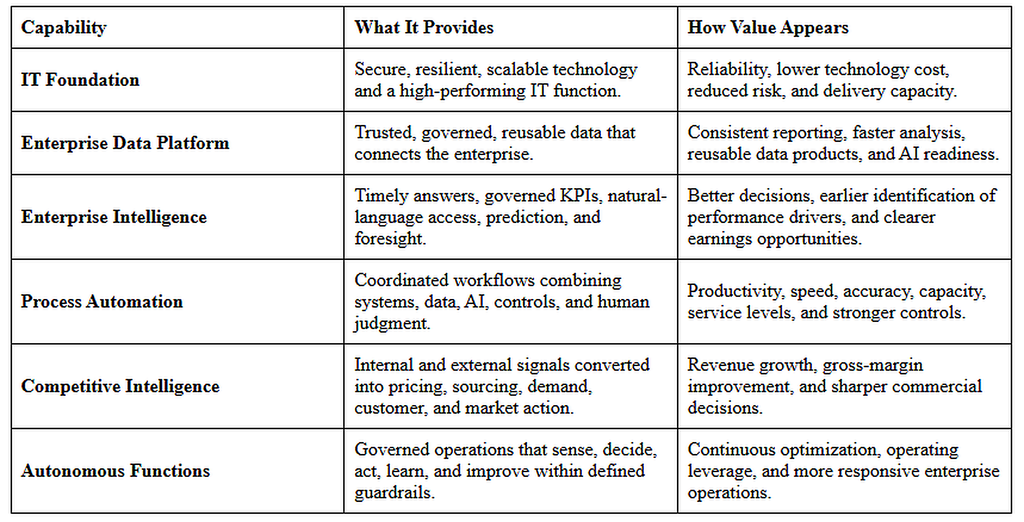
The Digital Capabilities Model organizes six capabilities around the business value they are intended to create. It is a connected framework, not a rigid six-step sequence. The IT Foundation and Enterprise Data Platform provide essential foundations for scale, while organizations can strengthen the remaining capabilities in different combinations based on priorities, readiness, and value opportunities.
How AI Progresses Across the Model
AI is not a separate capability or simply the final stage of the model. Its role becomes more embedded as the organization strengthens its technology, data, intelligence, processes, and controls. Foundations provide governed infrastructure and trusted data. Enterprise intelligence uses AI to interpret information and improve foresight. Automation incorporates copilots, document intelligence, recommendations, and workflow agents. Competitive intelligence applies AI to market sensing and commercial optimization. Autonomous functions coordinate governed decisions and actions within defined guardrails.
The advantage comes from embedding AI in reusable enterprise capabilities, not from multiplying stand-alone pilots.
How the Capabilities Work as an Integrated System
The six capabilities reinforce one another. The IT Foundation provides secure and scalable technology. The Enterprise Data Platform creates trusted internal and external information. Enterprise Intelligence identifies performance problems and value opportunities. Process Automation coordinates the work needed to act on those insights. Competitive Intelligence incorporates market conditions into commercial decisions. Autonomous Functions sense, decide, act, measure, and improve within established guardrails.
Gross-Margin Improvement in Practice
1 Connect. Combine sales, cost, customer, competitor, supplier, and demand information in the Enterprise Data Platform.
2 Understand. Use Enterprise Intelligence to identify underperforming products, customers, locations, or channels and determine the drivers.
3 Streamline. Use Process Automation to coordinate analysis, route recommendations and exceptions, and implement approved actions.
4 Optimize. Use Competitive Intelligence to evaluate pricing, promotion, demand, and sourcing alternatives using internal and external information.
5 Improve. Use Autonomous Functions to adjust defined decisions within approved parameters, measure outcomes, and learn from results.
Organizations do not have to perfect every foundational capability before pursuing valuable use cases. Near-term initiatives can advance while the foundation is strengthened. The key is to ensure that each use case delivers an outcome while also strengthening data, integration, governance, controls, components, and expertise that can be reused.
What Connected Capabilities Look Like in Practice
Building a Trusted Data Foundation
A healthcare organization connected information from hundreds of practices and numerous clinical and administrative systems. A standardized enterprise data platform created a trusted foundation for reporting, analytics, automation, predictive models, and AI-enabled search.
Improving Operational Intelligence
A services company integrated financial and operational information with GPS and employee timekeeping data to examine labor utilization and client profitability. AI-enabled dashboards and natural-language search helped leaders identify inefficient routes, staffing patterns, and performance drivers.
Automating a Critical Process
A rapidly growing company redesigned and automated its financial close, reducing the process from approximately eight weeks to one week. The improvement strengthened reporting and removed a critical operational barrier to completing an initial public offering.
Optimizing Commercial Decisions
A multi-location services company combined internal customer and financial information with competitor prices and market-demand indicators. Predictive models improved pricing, promotions, customer mix, utilization, and profitability decisions.
Advancing Governed Autonomy
An insurance organization codified claims-audit methodologies in a scalable rules and analytics platform that autonomously analyzed claims and prioritized high-value recovery opportunities. The capability increased recoveries and productivity while reducing manual effort.
Practical Implications for Leaders
A value-led approach begins with the business outcome and works backward to the capabilities, operating changes, controls, and investment required. It also creates a repeatable cycle in which results inform the next set of priorities.
1. Define the Outcomes
Identify the revenue, margin, productivity, working-capital, asset-utilization, decision-quality, resilience, or risk outcome that matters. Specify where value should appear and what evidence would show that the investment worked.
2. Identify Capabilities
Determine which combination of technology, data, intelligence, automation, competitive insight, and governed autonomy is required. Treat the model as an integrated capability framework rather than a fixed sequence.
3. Assess the Foundation
Identify gaps in architecture, data, integration, cybersecurity, governance, talent, and operating models that could limit trust, adoption, or reuse.
4. Prioritize Use Cases
Compare opportunities based on expected value, investment, risk, timing, strategic importance, and readiness. Favor initiatives that can produce near-term results while strengthening reusable enterprise capability.
5. Deliver and Reuse
Develop the solution and redesign the surrounding workflow, controls, roles, and decision rights. Preserve human judgment where risk, exceptions, accountability, or material decisions require oversight.
6. Govern and Adopt
Embed the capability into day-to-day work through business ownership, training, change management, performance incentives, and practical enablement.
7. Scale and Improve
Track adoption, operational performance, risk, and financial results against the original business case. Reuse proven data, components, governance, and delivery patterns to accelerate subsequent use cases.
Digital and AI leadership is not a destination. It is the repeatable ability to identify value, design and implement the required capabilities, operationalize and adopt them, measure results, and continuously learn, reuse, and scale.
How Ankura Can Help
Ankura connects performance improvement insight with hands-on digital execution. We combine business and industry expertise, digital and AI capabilities, and financial and economic discipline to help organizations identify where value can be created, build and operationalize the capabilities required to capture it, and measure the results.
| DEFINE THE VALUE | DESIGN THE CAPABILITIES | BUILD THE SOLUTIONS | OPERATIONALIZE RESULTS |
| Identify business outcomes, performance levers, and financial potential. | Translate requirements into a practical technology, data, automation, AI, governance, and adoption roadmap. | Develop platforms, intelligence, workflows, applications, models, and agents. | Drive adoption, measure realized value, strengthen governance, transfer capability, and scale what works. |
The objective is not technology for its own sake. It is a more intelligent, responsive, resilient, and valuable enterprise, supported by connected capabilities that improve performance today and compound advantage over time.
About Ankura
Ankura Consulting Group, LLC is a global consulting and expert advisory firm that partners with organizations at critical inflection points. Ankura combines multidisciplinary judgment with advanced technology and analytics to help clients protect, create, and recover value. For more information, visit ankura.com.
© Copyright 2026. The views expressed herein are those of the author(s) and not necessarily the views of Ankura Consulting Group, LLC, its management, its subsidiaries, its affiliates, or its other professionals. Ankura is not a law firm and cannot provide legal advice.

