






The Governance Trap
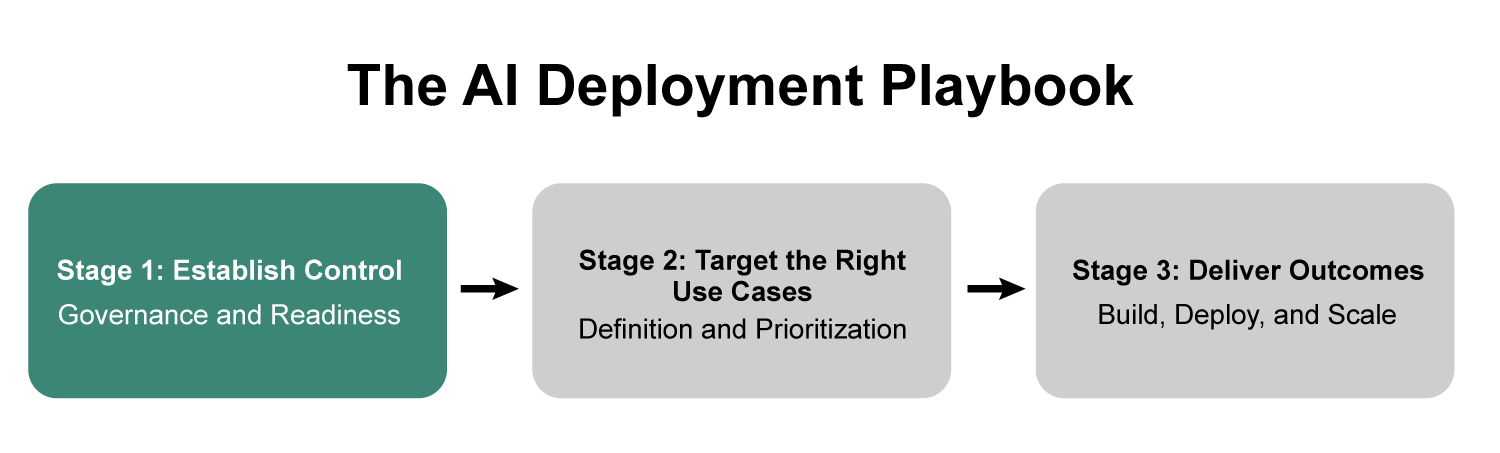
In our AI Deployment Playbook, From Pilot to Production, we made the case that most financial services companies are not held back by AI capability but by AI execution. That execution problem starts at the very first stage, before a single use case is prioritized or an AI system is built. This piece takes a deeper look at that stage: governance and readiness.
The failure pattern is predictable. A team stands up a working prototype, and then everything stalls. No one can say who approves the use case or who is accountable when it produces a wrong answer. No one can see how many other AI projects are already running across the business. Every initiative faces the same scrutiny, whether it is an internal productivity tool or a customer-facing model. And no one has confirmed the data, or the security around it, is ready for AI to touch. These are governance gaps, and until they are closed, nothing is ready to move into production.
The Reframe: Governance as Deployment Infrastructure
Here is the shift that matters. AI governance should not be a defensive policy exercise or a final checkpoint before launch. It should be part of the deployment infrastructure itself, embedded into the way AI is prioritized, approved, built, tested, and monitored. Done well, governance gives financial services companies the structure to deploy AI safely, repeatedly, responsibly, and faster than competitors.
Framed that way, governance becomes what makes innovation repeatable. It is embedded by design, not applied after the fact. It is not about adding process for its own sake; it is about building just enough operational control to put AI into production safely and at scale. Done right, it is what lets you move faster, not slower.
The reason is structural. Without proper governance, every use case is negotiated from scratch: a new approval path, a fresh debate over who signs off, an in-depth review by legal, risk, and security. That work repeats for each initiative, and the delay compounds as the pipeline grows. A governance program makes those decisions once and reuses them. Tiering criteria, approval routes, control requirements, and the evidence a system must produce are settled in advance, so the second use case moves faster than the first, and the 10th moves faster still.
5 Questions Leadership Must Answer
Building that kind of governance starts with a candid self-assessment. Before deploying a single agent or approving a new Agentic workflow or platform, leadership should be able to answer the following five questions. Where the answer is not yet clear, that is exactly where governance needs to focus first.
- Strategic Alignment: Is there a clear thesis for why the organization is investing in AI, whether that is cost reduction, customer experience, competitive defense, risk management, or some mix? Governance cannot right-size itself against a strategy that does not exist. That strategy should also clarify the operating choices governance must support, including whether the organization intends to build, buy, configure, or partner; who is allowed to use AI; and who owns the budget for it.
- Ownership and Accountability: Who owns the AI decisions in practice, not just on paper? Ownership means naming who approves a new use case, who controls data access, and who is accountable when an agent produces a wrong answer. A defined operating model and a standing steering committee provide that clarity, giving AI initiatives clear sponsorship and a defined place where authority sits.
- Policy and Regulatory Fit: How do generative and agentic systems fit into the model risk frameworks you already have? Existing model risk, third-party risk, data governance, privacy, information security, and compliance frameworks should be leveraged where they work, because they are familiar to operators, users, audit, and regulators. But they also need to be extended where AI introduces new requirements for procurement, development, validation, monitoring, and use.
- Data Readiness: Is the operational data an agent would need accessible, or is it locked in legacy core platforms, case management systems, and third-party applications? AI is only as useful as the data, workflows, training, procedures, and controls surrounding it, which makes an honest readiness assessment one of the cheapest ways to prevent an expensive false. Having a centralized Enterprise Data Platform greatly enhances the capabilities and effectiveness of AI platforms and tools.
- Infrastructure, Security, and Privacy: Is your infrastructure ready to integrate with AI, and are the security, privacy, and third-party controls in place to let it operate safely around regulated processes and customer data? It is paramount to validate that your organization is ready for AI, and that you have the effective security controls and infrastructure in place to support AI enablement. Retrofitting these controls after deployment is far more expensive than confirming them up front.
The Components of an AI Governance Program
An AI governance program is more than a policy document. It is a set of working functions that accelerate deployment rather than obstruct it. Together, these components form the foundation of the program.
- Direction: The program sets a clear thesis for why the organization is investing in AI and secures the executive sponsorship to back it, anchored by an AI value and roadmap that ties investment to business priorities.
- Policy and Decision Rights: The program establishes the policies, procedures, and guardrails for how AI is procured, developed, validated, and used, and an operating model and steering committee with clear authority over who approves use cases, who controls data access, and who is accountable for outcomes.
- Central Intake and Inventory: The program maintains a centralized registry of every AI system in use and in development, fed by a consistent intake process for new initiatives.
- Risk Tiering and Proportional Control: The program applies a risk-tiering and scoring framework that classifies each use case by risk and sets the level of scrutiny in proportion to it.
- Execution and Operations: The program sets business and operating guardrails for how AI investments move forward, including use-case prioritization, build-versus-buy considerations, business case expectations, cost-effectiveness, vendor oversight, and total-cost-of-ownership management. It does not define every detail of how AI is built or run, but it ensures those decisions are made consistently and with the appropriate oversight.
- Tools and Enablement: The program defines the controls a system must meet across its life, from model validation, human oversight, bias and fairness testing, and security assessment before launch to continuous operations, monitoring, drift testing, lineage, and logging once it is live, all underpinned by ongoing regulatory compliance.

Getting the Critical Components Right
The components tell you what a governance program contains. Not all of it carries equal weight. A handful of components do the most to determine whether AI actually reaches production, and getting them right comes down to a single principle: match the level of oversight to the level of risk, so a low-stakes tool moves quickly and a high-stakes system gets the scrutiny it deserves.
- Assess Readiness Honestly: Evaluate the program’s current risk profile, data, infrastructure, tools, procedures, controls, monitoring, talent, and training against where you actually stand today, not where you hope to be. Pair that assessment with role-specific training so everyone using these tools understands both their value and their responsibility in using them.
- Tier the Risk: Everything else follows from this. Score each use case by threat, vulnerability, and potential impact, then sort it into a small number of risk tiers. A low-risk internal productivity tool should not face the same approval path as a customer-facing engine. Tiering is what makes proportional oversight possible instead of treating every system the same.
- Set Decision Rights to Match the Tier: Document the guardrails for how AI is procured, validated, and used, then define who approves what and let that authority scale with risk. Low-risk systems can clear a lightweight, delegated approval; high-risk ones escalate to the steering committee. Deciding this up front, rather than after something goes wrong, is what keeps approvals fast where they can be and rigorous where they must be.
- Route Everything Through One Intake and Inventory: Give every initiative a single front door and keep a complete inventory behind it. You cannot tier what you cannot see. A standardized intake feeds a central inventory of every AI system in use or in development, giving the organization one place to spot shadow AI, duplicative spend, and concentration risk before they become audit findings.
Consider two systems. An internal tool that drafts meeting summaries clears a light path: basic access controls, approved data sources, and a quick readiness check before it is live. A broadly deployed tool that reviews customer requests, routes complaints, or supports account maintenance is a different matter. Before it reaches production, the organization may require demonstrated data quality, explainability that can withstand review, human oversight of exception decisions, ongoing performance monitoring, and a complete audit trail showing how decisions were reached. Same organization, same governance program, two very different bars, set by risk.
Done well, right-sizing turns oversight from a flat tax on every project into a dial the organization can turn up or down as the risk requires.
What Must Be True Before Production
Before any AI system reaches production, three things must be true: It must make business sense, it must be responsible, and it must be secure. The higher the risk tier, the more evidence each demands.
The Business Imperative: Is It Worth Doing?
- Prioritization: Score use cases by value, feasibility, and risk before they enter the pipeline, so investment follows opportunity rather than the loudest advocate. The mechanics of that scoring are the focus of our next article in this series.
- Build vs. Buy and Cost: Decide deliberately whether to build, buy, configure, or partner, and track total cost of ownership as usage scales. A single internal agent may require a light path, while a broadly deployed toolset with multiple use cases may require a business case, project team, vendor oversight, and ongoing cost governance.
The Responsible Imperative: Is It Fair and Accountable?
- Human Oversight: Require a person in the loop to review, approve, or override any high-stakes outcome; these decisions cannot run fully autonomously in a regulated environment.
- Fairness: Test for bias in high-impact decisions, whether related to underwriting, claims, fraud, client servicing, or account review, so unfair outcomes are caught before they affect customers or regulated processes.
- Explainability: Require that outputs can be translated into a clear rationale that a customer, an end-user, and a compliance officer can all understand. A decision no one can explain is a decision no one can defend.
- Traceability: Require that every agent action, prompt, data retrieval, and decision path is automatically captured and timestamped, so internal audit, risk, and regulators can reconstruct any decision on demand.
The Security Imperative: Is It Safe?
- Data Protection, Privacy, and Third-Party Controls: Restrict access to least privilege, so an AI system only touches the data its workflow permits, with privacy, consent, and vendor controls built in.
- Validation Quality and Testing: Validate performance before launch, monitor for drift and manipulation after, and maintain the system as data, workflows, regulations, and business conditions change.
- Regulatory Alignment: Map each deployment to the evolving set of state, federal, and global AI mandates, and keep that mapping current.
Clear all three and the system is ready for production. Fall short on any one, and the risk is not that governance slows you down. It is that something reaches your customers before it was ready.
An Agile Governance Implementation Model
Everything above describes what to put in place. Just as important is how you stand it up. The organizations that scale AI successfully do not treat governance as a document to finish before the work begins. They treat it as a discipline that develops alongside the systems it governs.
- Start narrow, then scale the framework. Do not try to govern every AI system across the organization on day one. Stand the framework up around the first few use cases, learn what actually creates friction, and extend it as adoption grows. A program proven on a handful of real systems scales far better than one designed in the abstract for systems that do not exist yet.
- Refine policy alongside production, not before it. Trying to perfect a governance framework in isolation is one of the surest ways to stall the program. Design the foundational guardrails early, then refine them as real systems move through build and testing. Operational friction that only surfaces in practice, an approval step that adds no value, a control that slows the wrong things, is exactly the input that turns a theoretical policy into a workable one. The goal is a framework shaped by how the organization actually deploys AI, not how it imagined it would.
- Measure governance by speed, not just safety. Traditional governance measures success by what it prevents. Effective AI governance measures success by how quickly it lets good ideas reach production safely. That means tracking cycle time from intake to deployment in weeks rather than quarters, while holding to zero audit exceptions and clear regulatory defensibility. When a control adds time without reducing risk, that is a signal to right-size it, not a cost of doing business.
Governance done this way stops being the thing that slows AI down and becomes the thing that lets an organization move quickly with confidence.
Control is not the price of innovation. It is what makes innovation repeatable.
How Ankura Can Help
Ankura helps financial services companies turn AI governance from a policy exercise into an operating capability. Rather than starting from a blank page, we begin with what already exists and build the program up from there, sized to where the organization actually stands.
Working alongside your team, we:
- Assess where you stand, reviewing current AI maturity across strategy, data, technology, governance, and security, benchmarked against regulatory expectations and industry best practices.
- Establish direction and decision rights, from executive sponsorship and a steering committee to the approval authority that determines who decides what.
- Stand up the operating mechanics, including a single intake and inventory, risk tiering, and proportional controls that scale oversight with risk.
- Define what must be true before production and the review cadence that keeps AI moving without creating unmanaged exposure.
To learn more about how our Financial Services Advisory practice can help your organization move from AI experimentation to governed, scalable deployment, visit our dedicated Financial Services Advisory page: Financial Services Advisory – Ankura.com.
© Copyright 2026. The views expressed herein are those of the author(s) and not necessarily the views of Ankura Consulting Group, LLC, its management, its subsidiaries, its affiliates, or its other professionals. Ankura is not a law firm and cannot provide legal advice.

