






There is a question no innovation committee likes to ask out loud: If you and your fiercest competitor installed exactly the same AI tomorrow, what would change between you? The honest answer, almost always, is nothing. And no, that is not bad news. It is where this whole series begins.
For two years, the corporate conversation about AI revolved around the wrong word: adoption, as if the challenge were catching a moving train. But when every passenger holds the same ticket, boarding stops being an achievement. This series is not about how to adopt AI. It is about something more uncomfortable and considerably more profitable: What is left to defend once the tool that promised to set you apart is owned by everyone (or will be, by Tuesday)?
Before we get to auditing the market predictions that move our clients’ plans, which is really the work of the coming installments, it is worth setting the four premises we read everything else through. These are not fashionable opinions. Think of them as the physics of the terrain.
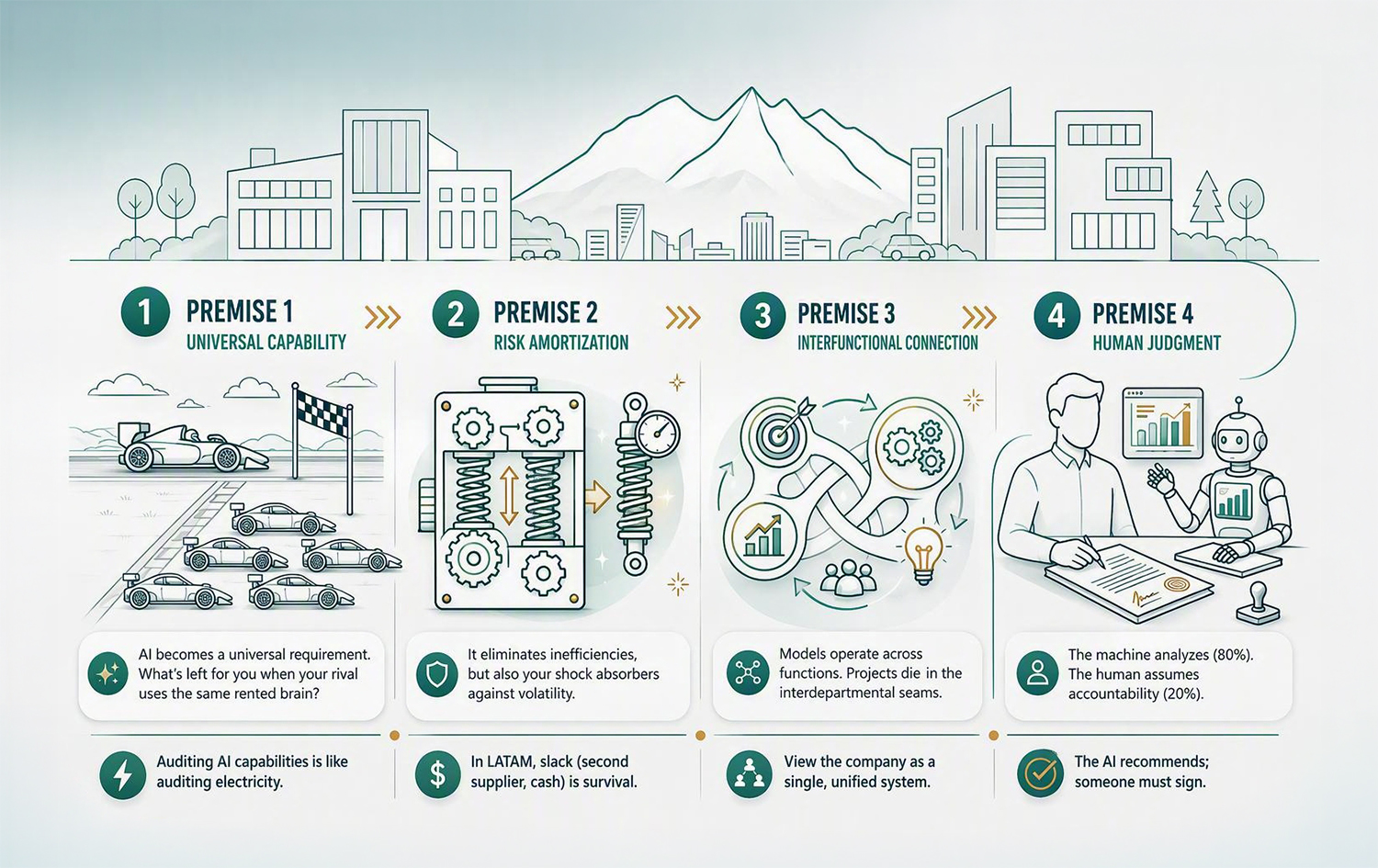
4 Premises Before Any ‘AI Strategy’
1. AI Is an Optimizer, and Optimizers Remove Slack
Here is the heart of the series, the idea most of the rest flows downstream from. An AI does one thing with brutal efficiency: It finds slack and squeezes it. The extra inventory, the redundant supplier, the “unnecessary” step in the process, the week of cushion in the timeline. And there lies both its power and its danger, because much of that slack was not inefficiency: It was your shock absorber. The margin that looked like waste turned out to be the airbag that saved you the last time the exchange rate moved on a Friday afternoon.
In a region that breathes volatility, and let’s be honest, Latin America has turned uncertainty into something of a national sport, this is not a theoretical worry. The Latin American operator survives precisely because of slack: the second supplier, the petty cash, the contact who clears customs. Importing the optimization mindset of a sunny valley where nothing ever goes wrong, unfiltered, is a mistake. It is the equivalent of unbolting the shock absorbers right before the dirt road.
2. It Is the Price of Admission, Not an Edge
Any capability that becomes universal stops differentiating and becomes a simple price of admission. Email was a competitive advantage for about 15 minutes in 1996; nobody brags about having it now. AI runs that curve at an indecent speed. The strategic question was never whether to adopt it. The market settled that one for you. The real question is what you have left once your rival runs on the exact same rented brain. Auditing your “AI capabilities,” at this stage, is about as revealing as auditing whether you have electricity.
3. AI Does Not Respect Your Silos
The model neither knows nor cares which box of the org chart you filed a decision under. To an AI, one choice about a supplier is also a choice about your people and about your strategy, all in the same breath. When the planning algorithm recommends switching suppliers, it is simultaneously rewriting your operating footprint, your talent map, and your competitive position without asking permission from three different VPs.
This is why AI projects rarely die inside a function; they die in the seams between them. And it is why reading them properly means looking at all three disciplines at once: strategy and commercial excellence, supply chain and operations, and people and transformation, as a single system rather than three fiefdoms that meet once a quarter to misunderstand each other. That, and it is no coincidence, is exactly how we ended up building our own practice. The problem left us little choice.
4. When Analysis Is Free, Judgment Is the Scarce Thing
If the machine produces 80% of the analysis at zero marginal cost, value migrates to the 20% it cannot manufacture: accountability, trust, the hard call someone has to sign with their name on it. Analysis gets democratized; judgment does not. An AI can recommend closing a plant with impeccable statistical elegance. What it cannot do is sit in front of the board and answer for the consequences. That seat remains, mercifully, human.
The Uncomfortable Question This Raises
If the four premises are true, it sharpens itself into a single line:
How many of your competitive advantages were, in reality, just advantages in access to analysis, and are therefore, as of now, worth precisely nothing?
The consultant who charged for knowing what the client could not compute. The distributor whose moat was understanding the market better than anyone. The sales team whose magic was the data the competition did not have. They all shared the same invisible asset: a monopoly over a certain kind of analysis. That monopoly has just expired, and it did not have the courtesy to send a renewal notice.
The Playbook: Stop Auditing Your AI, Audit Your Exposure
The practical consequence is a 180-degree turn in the question leadership should be asking. Stop asking “How advanced are we in AI?” — a vanity question if there ever was one — and instead start asking “How exposed are we to commoditization?” Real differentiation, the kind that survives the next model update, can only be built on what the engine cannot replicate:
- Sovereign Human Accountability: The AI offers an opinion, but someone still has to sign their name to the outcome.
- Deliberate Shock Absorbers: Know which slack is waste and which slack is resilience, and protect the second one as fiercely as others cut the first.
- Assets Free Analysis Cannot Touch: The cheaper analysis gets, the more your plant, your certifications, your relationships, and your proprietary data are worth, not less.
The exercise is worth ordering like this:
- Map which current differentiators a mid-sized competitor could replicate with AI in 18 months.
- In each process, separate waste-slack from shock absorber slack.
- Identify where your advantage lives in human judgment, and fortify that judgment rather than automating it for fashion’s sake.
A Conversation Worth Having Early
AI is not an initiative with a budget, a committee and a closing date. It is a silent redesign of the very system your company is already built on, and it is happening whether or not your board approves it. The good news for anyone leading in volatile markets is counterintuitive: On terrain where analysis becomes free, advantage returns to judgment, to relationships, and to the kind of composure under pressure that no model can replicate. Three things that Latin America, for better or worse, has never been short of.
The question that opens this series is the same one it closes with: When everyone has the same engine, what will keep your company hard to copy? If you do not have a comfortable answer, it is probably the most valuable conversation you can have this quarter. And, as it happens, it is precisely the one we most enjoy having.
This Was the Lens. The Targets Come Next
Every premise above is comfortable in the abstract and merciless in the particular. Over the coming pieces we will aim them at the things your own 2026 plan is quietly betting on: the nearshoring boom, the gospel that AI will retire your sales force, the headcount projections that rhyme, suspiciously, with every failed forecast since Keynes. We will name each prediction, run it through the same grid, and ask the one question that tends to ruin a perfectly good board deck: What if the consensus has the direction right and, as always, everything that matters wrong, the size, the timing, and the second-order effect nobody bothered to put on the slide?
So bring your plan. We will bring the knife.
© Copyright 2026. The views expressed herein are those of the author(s) and not necessarily the views of Ankura Consulting Group, LLC., its management, its subsidiaries, its affiliates, or its other professionals. Ankura is not a law firm and cannot provide legal advice.

