


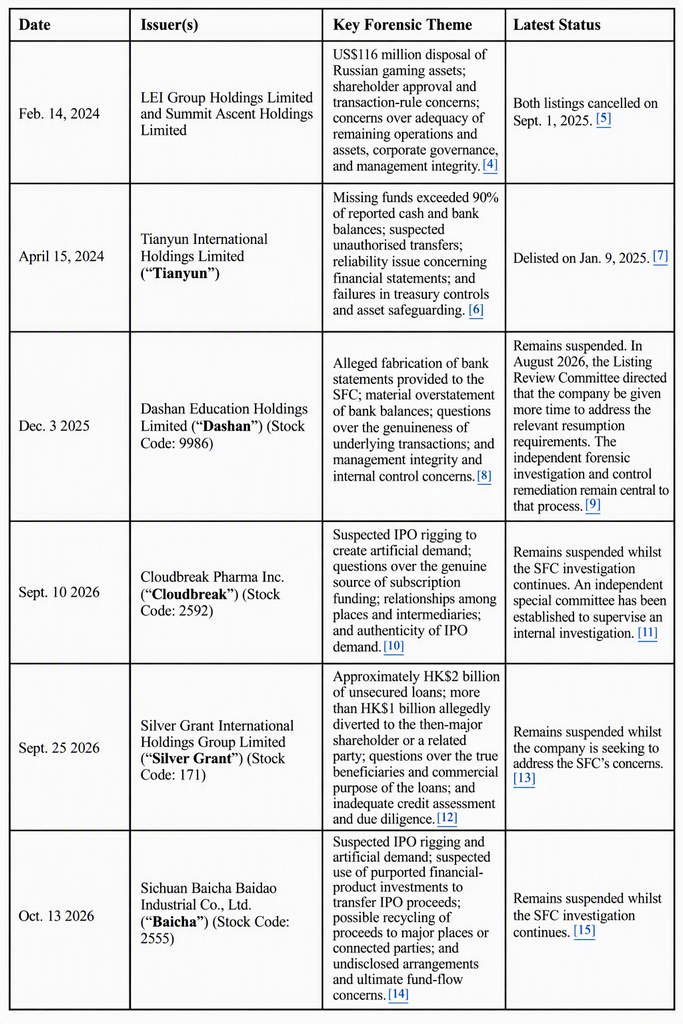
Hong Kong’s approach to trading suspensions in cases of suspected listed-company misconduct is at a turning point. Since 2024, the Securities and Futures Commission (SFC) has directed the Stock Exchange of Hong Kong Limited (SEHK) to suspend trading in at least six cases involving seven listed issuers under section 8(1) of the Securities and Futures Stock Market Listing Rules (SMLR), encompassing issues ranging from a major asset disposal and unreliable financial records to suspicious fund flows and alleged IPO rigging. These cases illustrate the breadth of circumstances in which trading suspensions may be used, spanning different forms of suspected corporate misconduct and market-integrity concern.
While the SFC’s use of trading suspensions has broadened, the regulatory framework is also changing. Amendments expected to take effect in the first quarter of 2027, subject to the legislative process, will allow the SFC to impose post-listing conditions as an alternative to immediate suspension. This may permit identified concerns to be addressed through specified conditions while trading continues, where the SFC considers that approach appropriate, but the issuer will still need to provide reliable evidence and demonstrate compliance with the conditions imposed.[1]
From Suspension to Targeted Conditions
Under section 8(1), the SFC may direct SEHK to suspend trading in a listed company’s shares where, among other circumstances, specified documents contain materially false, incomplete, or misleading information; suspension is necessary or expedient to maintain an orderly and fair market; or suspension is in the public or investor interest. A suspension is a protective intervention, not necessarily a final finding of misconduct.[2]
The forthcoming conditions regime introduces a more graduated response. Conditions may allow deficiencies to be addressed without immediately stopping trading, while streamlined resumption procedures and an independent merits review by the Securities and Futures Appeals Tribunal provide additional safeguards. From a forensic perspective, the practical question will be whether the issuer can produce reliable evidence addressing the regulatory concern.[3]
Recent Suspension Episodes in Hong Kong
What the Trend Suggests
Three observations stand out:
- First, the SFC’s power to direct SEHK to suspend trading in a listed company’s shares is not confined to financial reporting or accounting irregularities. The recent cases span transactional governance, reliability of corporate records, protection of corporate assets, and IPO integrity.
- Second, the two latest cases add an IPO-demand dimension against the backdrop of a stronger Hong Kong primary market. Increased fundraising does not imply misconduct, but it heightens the importance of genuine demand, transparent subscription funding, and controls over allocation and use of proceeds.
- Third, the consequences can extend well beyond temporary loss of liquidity: Three of the seven issuers covered by these suspension episodes were ultimately delisted.[16]
The common forensic thread is substance over form. In Tianyun and Dashan, the common issue was whether independent evidence supported reported cash balances and records. In Silver Grant, it was where the money went and who benefited. In Cloudbreak and Baicha, it was whether apparent IPO demand was genuine and whether fund flows reflected their disclosed purpose.
How Boards Should Respond
Where a suspension or condition potentially relates to suspected corporate misconduct, the board should move quickly from explanation to independent fact-finding. Depending on the nature of the concern, practical steps include establishing an independent investigation committee; engaging forensic, eDiscovery and asset-tracing specialists; preserving communications, accounting and banking evidence; mapping each regulatory concern to specific investigative procedures; and implementing remediation capable of independent verification.
The new conditions regime should not be viewed as a soft alternative. An issuer given an opportunity to remediate will need to show that the underlying risk has been identified, investigated, and controlled. Legal advisers should address the applicable statutory and regulatory requirements. The forensic accountant’s role is to establish what happened, trace the economic substance, and provide an evidence-based platform for remediation and regulatory response.
Conclusion
Hong Kong’s recent SFC-directed trading suspensions show a widening focus, from major transactions and unreliable financial records to fund diversion and alleged IPO manipulation. The 2027 conditions regime may provide a more targeted alternative to immediate suspension, but it will increase the premium on credible evidence. Boards that preserve evidence early, investigate independently, and tie remediation directly to the regulatory concern will be better placed to protect investors, maintain market confidence, and work toward an appropriate regulatory outcome.
References
[1] SFC press release titled “SFC proceeds to strengthen targeted tools to tackle IPO-related and other corporate misconduct”, dated 12 October 2026.
[2] SFC press release titled “SFC suspends dealings in Cloudbreak Pharma Inc. shares over suspected IPO rigging”, dated 10 September 2026.
[3] “Consultation Conclusions on Proposed Amendments to the Securities and Futures (Stock Market Listing) Rules” issued by the SFC, dated 12 October 2026.
[4] SFC press release titled “SFC suspends dealings in the shares of LET Group Holdings Limited and Summit Ascent Holdings Limited”, dated 14 February 2024.
[5] HKEX announcements concerning cancellation of listing of LET Group Holdings Limited and Summit Ascent Holdings Limited, both dated 27 August 2025.
[6] SFC press release titled “SFC suspends dealings in Tianyun International Holdings Limited shares over massive missing corporate funds”, dated 15 April 2024.
[7] HKEX announcement concerning cancellation of listing of Amrita Global Development Limited, formerly Tianyun International Holdings Limited, dated 7 January 2025.
[8] SFC press release titled “SFC suspends dealings in Dashan Education Holdings Limited shares over significant overstatement of corporate bank balances”, dated 3 December 2025.
[9] Dashan’s announcement dated 26 August 2026.
[10] SFC press release titled “SFC suspends dealings in Cloudbreak Pharma Inc. shares over suspected IPO rigging”, dated 10 September 2026.
[11] Cloudbreak’s announcement dated 30 September 2026.
[12] SFC press release titled “SFC suspends dealings in Silver Grant International Holdings Group Limited shares over suspicious diversion of over $1 billion in loan proceeds”, dated 25 September 2026.
[13] Silver Grant’s announcement, dated 30 September 2026.
[14] SFC press release titled “SFC takes action against suspected IPO-rigging syndicates and suspends dealings in Baicha shares”, dated 13 October 2026.
[15] Baicha’s announcement dated 14 October 2026.
[16] Q1 2026 Hong Kong Market Update issued by the HKEX dated 29 April 2026.
© Copyright 2026. The views expressed herein are those of the author(s) and not necessarily the views of Ankura Consulting Group, LLC, its management, its subsidiaries, its affiliates, or its other professionals. Ankura is not a law firm and cannot provide legal advice.

