






The U.S. Department of Health and Human Services (HHS) has launched a department-wide clinical trials reform initiative branded as Operation TrialBlazer.[1] HHS is positioning this as an effort to bring early-stage clinical research back to the U.S., accelerate drug development, and restore American competitiveness. The announcement identifies a real issue in that clinical research sponsors increasingly see other countries as faster, cheaper, and more predictable places to generate early human data. HHS’ proposed remedy is a coordinated set of regulatory, technological, and operational changes across its operating divisions including:
- Food and Drug Administration (FDA),
- National Institutes of Health (NIH),
- Office of the National Coordinator for Health Information Technology (ONC),
- Advanced Research Projects Agency for Health (ARPA-H), and
- HHS Office of Inspector General (OIG).
While this initiative could meaningfully help U.S. clinical research by reducing avoidable administrative burden, the announcement raises unaddressed questions about weakened scientific standards, patient safety, FDA capacity, conflicts of interest, health equity, implementation details, and whether speed is being elevated over evidentiary rigor.
What HHS Is Trying to Fix
HHS frames this initiative as a means to restore U.S. leadership in clinical research, especially in early-stage trials. Clinical trials progress through four primary phases: phase 1, also called first-in-human, trials focus on the safety of the investigational product and any side effects associated with increasing doses; phase 2 trials evaluate the effectiveness of the investigational product in patients with the disease or condition under study; phase 3 trials are larger studies designed to confirm the effectiveness of the product and compare it with existing approved treatments; and finally after regulatory approval, phase 4 or “open label” post-marketing studies monitor long-term safety and efficacy in clinical practice.
HHS argues that lengthy federal review timelines, regulatory uncertainty, redundant review processes, and operational barriers have encouraged sponsors to move first-in-human phase 1 work overseas. The announcement emphasizes faster FDA interactions, clearer early-stage expectations, stronger NIH support for well-powered trials, greater use of artificial intelligence (AI) and real-world data, patient to trial matching using electronic health record (EHR) data, and possible updates to anti-kickback safe harbors related to trial participant compensation.
HHS notes that China has taken many steps to improve its clinical research infrastructure through government funding and streamlined regulatory pathways, to the point that in 2021, “China’s global share of Phase 1 trials surpassed the United States’ share for the first time.”[2] Australia has also prioritized clinical research efficiency through its Clinical Trial Notification System, which “allows trials to begin in fewer than 70 days after a final protocol is submitted… and sites activated within 6 to 12 weeks.”[3] China has similar timeframes. As HHS notes, “too often, the U.S. pathway can be measured in years, while other countries’ pathways are measured in months.”[4]
The available public data and contemporaneous reporting support the direction of the trend HHS highlights: Early-stage clinical trial activity has shifted away from U.S. dominance and toward China and other faster-start jurisdictions. The exact percentages noted below should be treated as directional estimates because public sources differ in whether they count trial registrations, trial starts, country locations, multi-country trials, industry-sponsored drug trials, or all phase 1 studies.
| Estimated Share of Phase 1 Clinical Trials by Country/Region: 2010 vs. Most Recent Available Data[5] | |||
| Country/Region | 2010 Share | Most Recent Share | Direction of Change |
| U.S. | ~45% | ~25% | Declined materially |
| China | ~5% | ~30% | Increased sharply; surpassed U.S. share in 2021 |
| Western Europe / EMEA | ~25% | ~20% | Modest decline |
| Australia | ~5% | ~7% | Increased modestly |
| India | ~2% | ~4% | Increased; India is becoming a more prominent clinical trial jurisdiction. |
| Canada | ~4% | ~3% | Slight decline |
| All Other Countries | ~14% | ~11% | Declined as activity is consolidated in faster-growing jurisdictions. |
The following chart from the World Health Organization (WHO) displays the number of trials listed in the WHO International Clinical Trial Registry Platform (ICTRP) by year and WHO region. The ICTRP comprises both interventional and observational trials and all phases of research, but does clearly demonstrate that the total number of trials in WHO’s Western-Pacific region (gold bar, which includes China and Japan) and the South-East Asia region (green bar, which includes India) have increased at a much higher rate than in other regions.
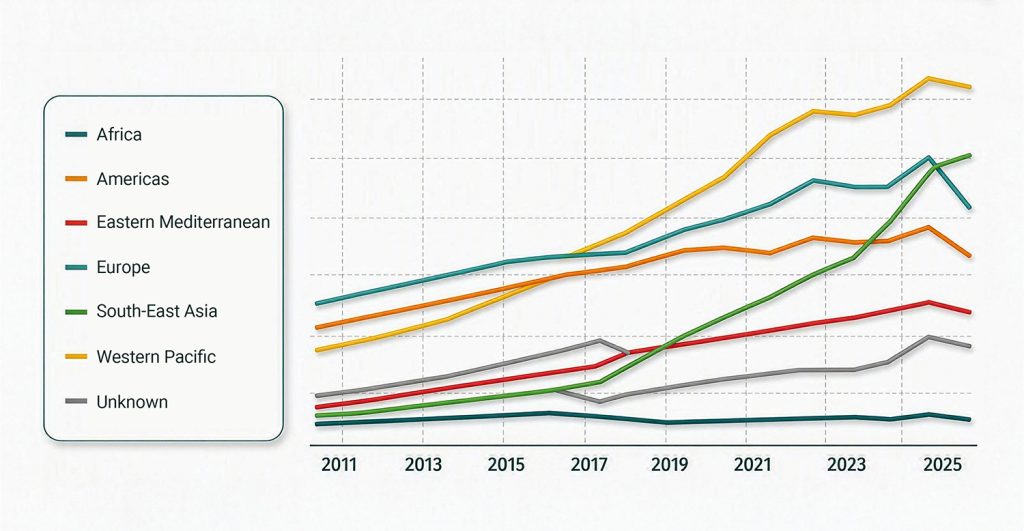
While the initiative does point out areas where administrative burden could be reduced and thus efficiency increased, HHS does not address the fact that it is simply cheaper to conduct research in other countries. It is unclear whether improving timelines to study start-up will be sufficient to motivate sponsors to return phase 1 trials to the U.S. In fact, many sponsors and researchers have an increased distrust in HHS and other U.S. systems, which may also be contributing not only to the migration of research to other countries but continue to serve as a barrier to reshoring phase 1 trials.
How the Initiative May Help the U.S.
- Shorter development timelines. FDA’s proposed early-stage reforms could reduce unnecessary delays before first-in-human trials, particularly for small and mid-sized biotech companies that lack sophisticated regulatory infrastructure.
- More predictable expectations.Clarifying phase-appropriate requirements for chemistry, manufacturing, controls, pharmacology, toxicology, dose selection, and master protocols could reduce over-submission and avoidable clinical holds.
- Greater U.S. competitiveness. If sponsors can begin trials faster in the U.S., the country may retain more research jobs, patient access opportunities, investment, and scientific infrastructure.
- Better patient matching. Integrating clinical trial opportunities into EHRs could make trial identification part of routine care rather than a separate, often inaccessible process.
- More modern trial designs. Support for AI, human cell-based models, real-world data, adaptive designs, decentralized approaches, and platform trials could make clinical research faster, more efficient, and more responsive to rare diseases and precision medicine.
- Potential equity gains. If decentralized models and EHR-based matching are implemented carefully, patients in rural and underserved communities could gain more realistic access to studies that have historically been concentrated at major academic centers.
How the Initiative May Hinder or Create Risks
- Speed may outpace safety oversight: Compressing early-stage timelines by six to 12 months could be beneficial, but only if the FDA has enough experienced reviewers and successfully integrates its own efforts to reduce internal administrative burden to enable faster evaluation of novel therapies, complex manufacturing requirements, and first-in-human risks without cutting corners.
- Regulatory simplification may be read as deregulation: Sponsors may welcome clearer and lighter early-stage expectations, but the public may reasonably ask whether reduced documentation, rolling submissions, or parallel reviews shift too much risk onto trial participants.
- One-trial approval pathways could invite controversy: The FDA’s position that one high-quality late-stage trial plus confirmatory evidence may be sufficient in many cases could accelerate access. However, it also raises questions about reproducibility, external validity, and post-market accountability.
- AI and real-world data are not neutral tools: AI-enabled trial design, patient matching, and evidence generation could improve efficiency. However, biased data, incomplete EHR records, opaque algorithms, and uneven digital infrastructure could worsen disparities or distort eligibility decisions.
- Participant payment reforms require guardrails: Revisiting anti-kickback safe harbors for clinical trial compensation may help reduce one barrier to clinical study enrollment, but poorly designed rules could blur the line between reimbursement, beneficiary inducement, and commercial recruitment pressure.
- Operational fixes may not solve structural barriers: Trial delays often stem from site staffing shortages, contracting delays, budget negotiations, protocol complexity, investigator burden, site monitoring delays, and fragmented technology. While the HHS announcement signals ambition, it does not fully explain how these day-to-day bottlenecks will be removed.
Questions To Be Answered
- Who benefits financially? Which sponsors, contract research organizations, academic medical centers, EHR vendors, and AI companies are best positioned to gain from faster trial activation and technology-enabled recruitment.
- Given the fact that it is cheaper to conduct research overseas, will HHS be able to offer incentives to sponsors to keep or return trials to the U.S.?
- Will the FDA receive more human and technological resources? Faster timelines require sufficient reviewer staffing, technical expertise, reduced internal administrative burden, and sufficient inspection capacity. Without new and enhanced resources, acceleration may become an unfunded mandate.
- What safeguards will protect first-in-human participants? HHS should specify how the initiative will preserve independent review, informed consent quality, safety monitoring, and transparency when timelines are compressed.
- What other measures will be implemented to ensure the integrity of research conducted in the U.S. and to alleviate the belief that approval of research in the U.S. is increasingly based on politics rather than science?
- How will success be measured? Metrics should go beyond speed and include trial quality, participant diversity, safety signals, completion rates, protocol deviations, site burden, and whether trials actually remain in the U.S.
- Will underserved patients gain access or become targets? EHR-based matching and decentralized trials could expand access, but investigators should track whether recruitment is equitable, informed, and supported by adequate community protections.
- What information will be made public? If HHS is using pilot programs, qualified research institutions, AI tools, or real-time trial monitoring, the public should know who participates, how decisions are made, and whether results are independently evaluated.
Conclusion
Operation TrialBlazer could be a significant modernization effort if it removes unnecessary burden while preserving scientific rigor, independent oversight, and participant protection. The most promising elements are practical: clearer FDA expectations, earlier sponsor guidance, better trial matching, and support for modern trial methods. The risk is that a politically attractive promise to “move faster” becomes a substitute for the harder work of funding FDA capacity, strengthening site infrastructure, improving trial diversity, and making evidence generation more transparent. For U.S. clinical research, the initiative may be a spark — but whether it becomes a controlled burn or an uncontrolled fire will depend on the rules, resources, and accountability measures HHS puts behind the announcement.
References
[1] U.S. Department of Health and Human Services Press Release “HHS Launches Unprecedented Department-Wide Effort to Restore American Leadership in Clinical Trials” June 22, 2026 https://www.hhs.gov/press-room/hhs-launches-clinical-trials-reform-initiative.html
[2] U.S. Department of Health and Human Services “Operation TrialBlazer HHS Roadmap to Maintaining U.S. Leadership in Early Clinical Research and Development”, 2026, https://www.hhs.gov/sites/default/files/operation-trialblazer.pdf
[3] Ibid
[4] Ibid
[5] Based on public trend data from ClinicalTrials.gov and WHO ICTRP. Figures are rounded directional estimates.
[6] World Health Organization, Global Observatory on Health Research and Development, Number of clinical trials by year, country, WHO region and income group (1999-2025)
https://www.who.int/observatories/global-observatory-on-health-research-and-development/monitoring/number-of-clinical-trials-by-year-country-who-region-and-income-group ; accessed July 7, 2026, and filtered to 2010-2025.
© Copyright 2026. The views expressed herein are those of the author(s) and not necessarily the views of Ankura Consulting Group, LLC, its management, its subsidiaries, its affiliates, or its other professionals. Ankura is not a law firm and cannot provide legal advice.

