






| YOUR PARCEL COST IS RISING FASTER THAN YOUR CONTRACT SAYS Fuel, demand charges, accessorials, and contractual minimums increasingly determine total parcel economics. |
Executive Premise
The annual General Rate Increase (GRI) remains highly visible, but it does not describe the full increase in a shipper’s total cost of parcel shipping. Weekly fuel adjustments, revised surcharge tables, minimum-charge provisions and the interaction of accessorial charges can produce substantially different outcomes across shipment profiles — and these are generally changed at the shipper’s discretion regardless of what is in the contract. The management question is no longer simply, “What discount did we negotiate?” It is, “What are we actually paying, why, and which elements can we influence?”
Most carriers base their published ground fuel surcharges on the National U.S. Average On-Highway Diesel Fuel Price reported by the U.S. Energy Information Administration. Each carrier, however, applies its own surcharge table and billing methodology, so the same fuel market can produce different billed outcomes.[1]
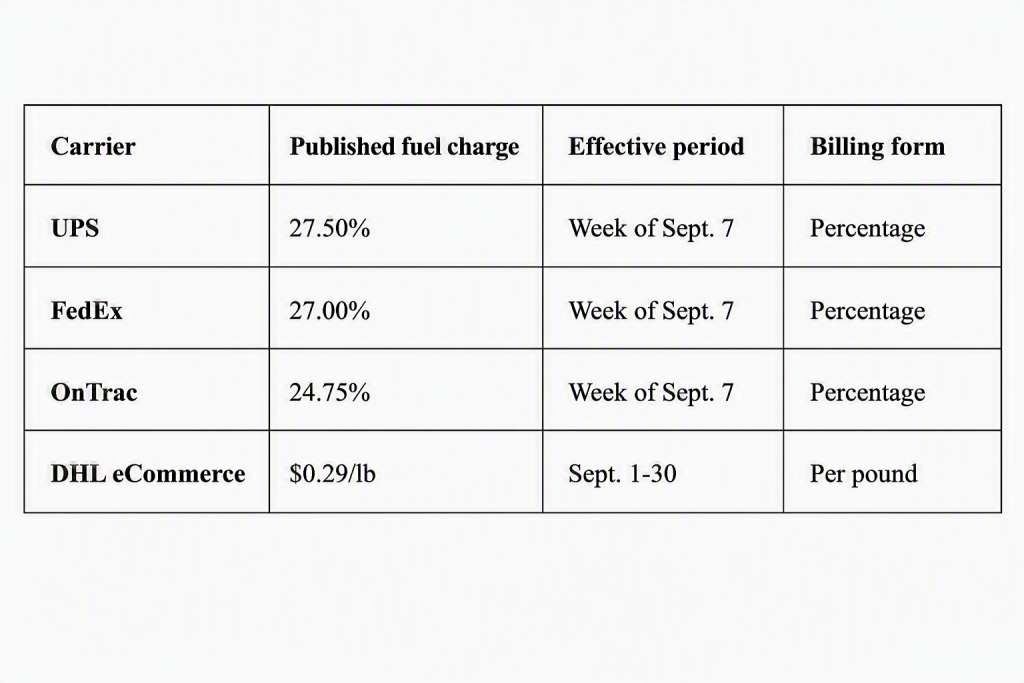
Table 1. Published domestic ground fuel charges for September 2026. DHL eCommerce uses a different billing basis and adjustment cadence.[1]
| DHL eCOMMERCE FUEL COSTS MORE THAN DOUBLED FROM Q1 DHL eCommerce’s published domestic fuel surcharge increased from $0.11 per pound in February and March 2026 to $0.29 per pound in August and September 2026. The September charge is approximately 164% above the $0.11 per-pound Q1 level.[2] |
DHL eCommerce rapid fuel-driven parcel inflation extends beyond percentage-based national and regional carrier programs. Its domestic charge moved to $0.30 per pound in June and July before settling at $0.29 per pound in August and September. Because DHL eCommerce bills fuel per pound rather than as a percentage of transportation charges, direct comparisons require shipment-level modeling.
Surcharge uncertainty creates multiple risks:
- Budgeting Risk: Weekly or monthly changes can create material variance between forecast and invoice.
- Compounding Impact: Fuel may apply to transportation charges and selected surcharges, depending on carrier terms.
- Minimum-Charge Sensitivity: Headline discounts may provide little benefit when contractual minimums determine the billed transportation charge.
- Comparability Risk: Percentage-based and per-pound fuel programs cannot be compared reliably without shipment-level data.
UPS, FedEx, USPS, and OnTrac have published 2026 holiday pricing that begins in late September or early October and continues into January 2027. These charges are layered onto normal transportation charges and other applicable surcharges rather than replacing them.[3]
| THE DOUBLE-SURCHARGE PROBLEM Elevated fuel charges will overlap with demand, residential, additional-handling, and oversize charges during the 2026 holiday period. |
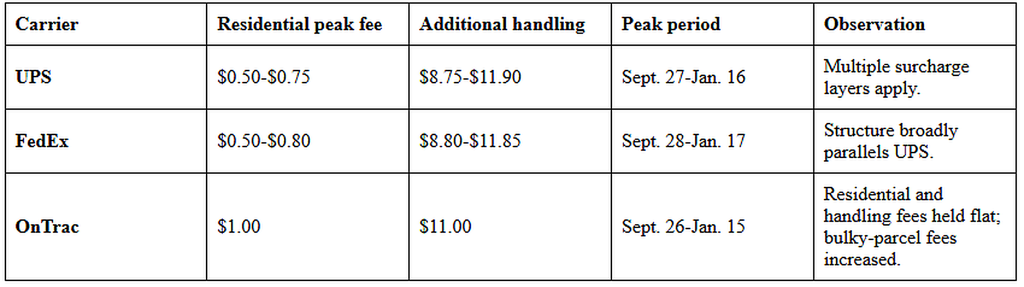
*Published 2026-27 peak-season demand surcharge schedules. Commercial terms may produce different effective costs.
OnTrac separately offers a “Ground Essentials” service with no residential surcharge and claims up to 30% lower costs than traditional economy services for qualifying shipments.[4]
| TOTAL COST IS HIGHLY SENSITIVE TO CONTRACTUAL MINIMUMS A seemingly aggressive base-rate discount may not translate into savings when minimum charges establish the effective price floor. |
In our experience, the largest parcel savings opportunities are rarely driven solely by negotiated transportation rates. Savings are increasingly created through disciplined management of:
- Fuel surcharges
- Peak-demand charges
- Residential surcharges
- Additional handling and dimensional fees
- Contractual minimum charges
- Strategic use of alternative carriers
While many organizations focus heavily on discounts versus published carrier rates, total parcel cost can be highly sensitive to surcharge structures and minimum-charge provisions embedded within carrier agreements. Shippers should evaluate total invoiced cost rather than transportation rates alone. A lower headline discount combined with lower minimum charges and fewer accessorials can produce a better economic outcome than a seemingly more aggressive base-rate discount.
Key questions include:
- How much did we spend on fuel and other surcharges by carrier, service, zone, and channel?
- How frequently do contractual minimums override otherwise applicable discounted rates?
- How do different percentage-based and per-pound fuel methodologies affect our shipment profile?
- How do all-in costs compare across national, regional, postal, and emerging alternatives?
- What operational changes could reduce the chargeable base without compromising service?
| 1 | Establish the Baseline Reconcile invoice detail to contractual rates, minimum charges and surcharge tables. |
| 2 | Normalize Carrier Mechanics Translate percentage-based and per-pound fuel charges into shipment-level cost. |
| 3 | Benchmark the Contract Compare fuel terms, minimum charges, accessorial treatment and service commitments. |
| 4 | Model the Overlap Estimate the combined impact of fuel, minimums, handling and peak-demand charges. |
| 5 | Act on Price and Operations Renegotiate addressable terms and route compatible volume to credible alternatives. |
| THE NEGOTIATION TARGET IS TOTAL DELIVERED COST Winning shippers manage the full parcel-cost equation, including fuel, peak fees, accessorials, minimum charges and carrier mix. |
Ankura’s Performance Improvement Fundamentals
Ankura’s Performance Improvement team has a proven track record of executing strategic plans that drive sustainable results — maximizing EBITDA, cash flow, and shareholder value. Our distribution and logistics experts collaborate with clients to streamline inbound and outbound logistics and deliver cost-effective solutions across transportation modes, shipping rates, and on-time delivery. We will support negotiations to achieve results based on our market insights and your specific requirements.
Sources
1. UPS, FedEx, and OnTrac published domestic ground fuel-surcharge methodologies and weekly schedules, accessed September 9, 2026.
2. DHL eCommerce, “Surcharge Policies,” domestic products history: $0.11/lb in February and March 2026; $0.12/lb in April; $0.15/lb May 1–29; $0.29/lb May 30–31; $0.30/lb in June and July; and $0.29/lb in August and September 2026.
3. Published 2026 holiday surcharge schedules for UPS, FedEx, USPS and OnTrac.
4. OnTrac, “Ground Essentials,” advertising no residential surcharge and up to 30% lower cost versus legacy carrier economy services.
© Copyright 2026. The views expressed herein are those of the author(s) and not necessarily the views of Ankura Consulting Group, LLC, its management, its subsidiaries, its affiliates, or its other professionals. Ankura is not a law firm and cannot provide legal advice.

