






Many construction JV failures begin long before any shovels hit the ground — in the way the venture is governed.
Ask a room full of construction executives what threatens a project JV, and you will hear familiar answers: cost overruns, schedule delays, labor shortages, supply-chain disruptions, or changing customer requirements.
Rarely does anyone answer: the governance model itself.
Large construction projects rarely fail quietly. A 2019 Oxford Business School analysis of 3,022 projects found that just 2.8% were on budget and on time.[1] Yet many of the disputes, delays, and execution challenges that emerge within construction JVs stem not from external events but from choices made long before construction begins — choices about which decisions require unanimity, what authority gets delegated, when issues are escalated, and who ultimately owns the outcome.
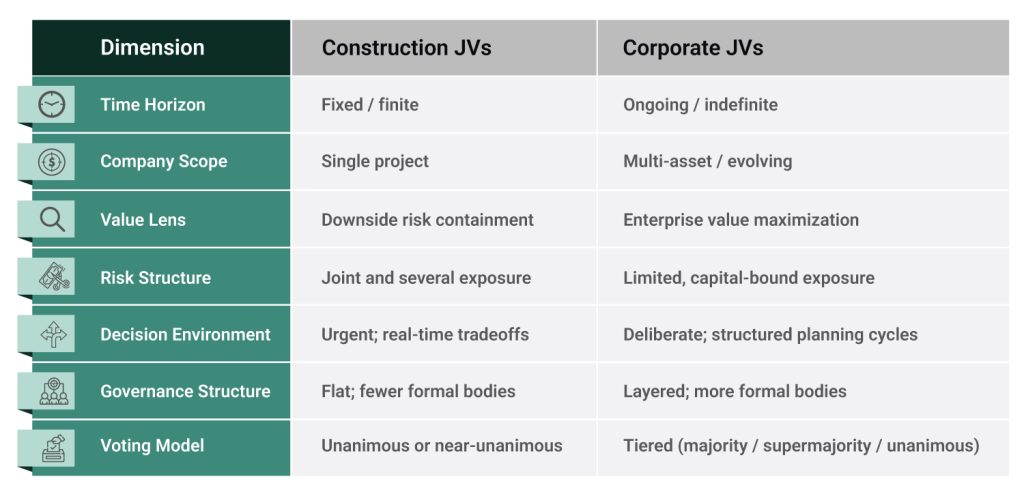
Construction JVs are a distinct JV archetype. They are purpose-built to deliver a single high-stakes project under intense time pressure, with concentrated risk and little tolerance for failure. Unlike long-term corporate JVs created to build and operate enduring businesses, construction JVs are designed from inception with a defined end point: successful project delivery followed by wind-down.
Those realities demand a different governance model. But they do not make construction JVs immune from lessons learned elsewhere. In fact, many of the execution challenges construction JVs face — blurred accountability, decision-making bottlenecks, cultural fracture, and difficulty managing ambiguity — have been confronted repeatedly in long-term corporate JVs. The opportunity is not to make construction JVs look more like corporate JVs, but to selectively borrow the governance disciplines that improve clarity, speed, and alignment while preserving the risk protections that construction partners rightly value.
How Construction JVs Differ — Structurally and Intentionally
Construction JVs are typically:
- Formed for a single asset or project
- Time‑limited, with no enterprise to optimize beyond delivery
- Exposed to joint and several liability
- Dependent on rapid, high‑quality decisions with imperfect information
This leaves every partner exposed to every burden, as any partner financial or operational failure leaves the others 100% on the hook to absorb the shortfall.
As a result, they emphasize:
- Unanimous or near‑unanimous decision‑making
- Tight partner oversight of execution
- Flatter governance structures with fewer governance bodies
These features are not inefficiencies. They are conscious design choices to manage extreme downside risk.
The opportunity lies not in copying long‑term corporate JV structures, but in learning where corporate JVs have solved analogous problems differently — and sometimes better.
Exhibit 1: Construction JVs vs. Corporate JVs
Lesson 1: Use Unanimity More Precisely, Not More Broadly
Unanimity is far more common in construction JVs than in corporate JVs — both at the project team and board / steering committee (SteerCo) levels. This reflects the reality that partners remain jointly and severally exposed throughout the project lifecycle and seek to be aligned on major decisions.
That said, how unanimity should be applied depends importantly on the ownership structure of the JV. In bilateral 50-50 JVs, unanimity is often a necessary and appropriate feature of governance, particularly at the Board/SteerCo level. Given symmetrical exposure, neither partner can — or should — be forced into decisions that materially affect risk, capital, or delivery. In this context, the goal is not to reduce unanimity, but to ensure there are effective mechanisms to resolve deadlock quickly when it arises.
In contrast, in multi-party JVs (three or more partners), the dynamics change. The likelihood of misalignment increases materially, and a universal unanimity requirement can create disproportionate delay and execution risk. Similarly, in majority/minority structures, it is often logical for the majority partner to have the ability to make certain decisions without full unanimity, particularly where speed is critical and exposure is asymmetrical.
Where construction JVs can learn from corporate practice is in discriminating more clearly between decisions that truly require unanimity and those that require alignment but not collective veto power.
Corporate JVs tend to be explicit about:
- Which decisions protect ownership and risk position — these are considered fundamental decisions and often require unanimity
- Which decisions require speed or resolution more than consensus — these are often majority or supermajority decisions as opposed to unanimous decisions
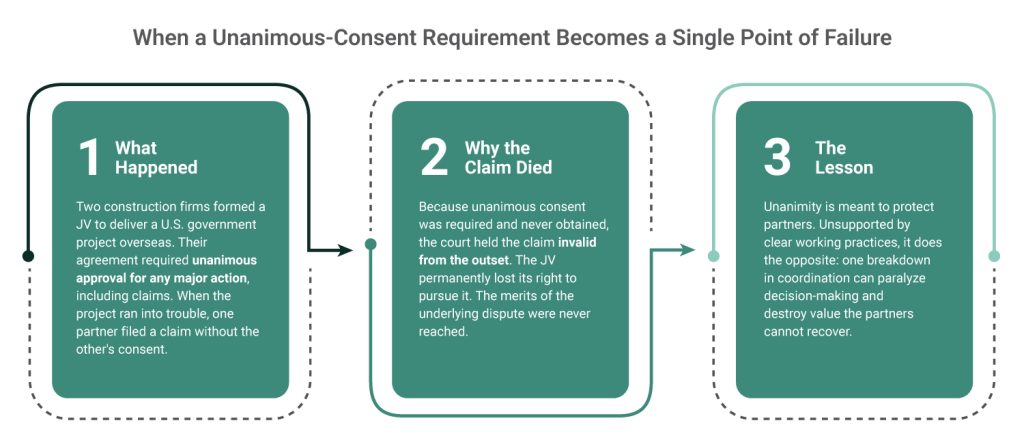
Construction JVs that apply this discipline — without abandoning unanimity where it matters — can reduce escalation volume, shorten decision cycles and the risk of deadlock, clarify accountability at the execution layer, and potentially avoid disputes like the one between Contrack Watts, Inc. (CWI) and Uejo Kogyo K.K. (Uejo) (see Exhibit 1).
After all, just because a decision does not legally require unanimity does not mean the partners cannot seek to agree in practice before proceeding. Reducing unanimity requirements does not need to, per se, reduce collaboration. It just provides an escape hatch to preserve value when collaboration and unanimity is elusive in a time-constrained environment.
Exhibit 2: Contrack Watts-Uejo Kogyo
Lesson 2: Treat Delegation as a Control Mechanism, Not a Trust Exercise
In construction JVs, delegation is often viewed as inherently risky, particularly given secondee‑heavy leadership teams and partner appointment rights. This reality — and a lack of trust — often leads construction JV partners to lean on the SteerCo for decision-making, particularly when authority delegated to the project director or directorate is not crystal clear.
In practice, unclear or very low delegations create their own risks:
- Overloaded senior forums
- Late decisions on time‑critical matters
- Project teams unsure where authority truly sits
- Operational decisions being made by people further from the business
Corporate JVs address this by engineering delegation, not relying on goodwill:
- Clear authority boundaries
- Explicit escalation triggers
- Transparency over “shadow approvals”
Construction JVs can apply the same mindset. Well‑defined delegations of authority do not reduce partner control; they surface issues sooner, when they are still manageable.
Lesson 3: Clarify the Ask When Elevating Issues to SteerCo
Unlike corporate JVs, construction JVs cannot rely on long lead‑time pre‑reads or extended deliberation cycles. SteerCos are pulled into real‑time decisions because time matters to the project.
Where construction JVs struggle is not escalation itself, but ambiguity about what is being requested.
Corporate JVs handle this structurally, separating forums for:
- Information sharing
- Input and challenge
- Formal approval
Information is shared through committees or shareholder teams, with committees frequently being the forum for input and challenge, while formal approvals often go to the JV board.
Construction JVs typically use the same forum for all four. As a result, SteerCo discussions can drift, accountability can blur, and project teams may believe decisions have moved “up,” while SteerCo believes responsibility remains “down.”
The learning is behavioral, not structural:
- Agendas should explicitly state whether the team is seeking approval, endorsement, input, or simply sharing information.
- Discussions should reinforce where accountability sits after the meeting.
- Decisions should be documented in a way that reflects the true intent of the interaction.
This clarity preserves speed while strengthening governance discipline.
Lesson 4: Build Team Identity Without Corporate Infrastructure
Corporate JVs often create identity structurally: a name, brand, logo, email addresses, systems, and offices that signal a new enterprise.
Construction JVs rarely do this. With a defined lifespan, they typically operate under parent branding and seconded resources — yet they still need a strong team identity to execute successfully.
Construction JVs can borrow from corporate practice by building identity intentionally rather than assuming it will emerge de novo:
- Establishing a shared vision that goes beyond “building Project X” (e.g., advancing a technology, enabling economic development, delivering infrastructure that serves millions)
- Defining near‑term waypoints that mark progress and create momentum
- Reinforcing “one‑team” behaviors through how secondees are managed, evaluated, and recognized
- Making clear what loyalty to the JV means in practice — especially under pressure
Culture in construction JVs is not a soft topic. It is a prerequisite for trust, speed, and safe escalation.
A Final Thought
Construction JVs are not flawed versions of corporate JVs. They are a specialized governance archetype built for execution under extreme constraints.
Those that perform best are not the ones that reject corporate JV lessons outright — but those that adapt them thoughtfully, preserving risk discipline while improving clarity, speed, and alignment.
But the learning runs both ways. Construction JVs offer a contrasting model of speed, escalation, and simplicity under pressure. They typically establish direct escalation pathways into parent organizations, with clearly designated senior executives empowered to resolve deadlock quickly. In contrast, corporate JVs often see decisions travel several levels up each parent organization, slowing resolution and diffusing accountability.
The goal is not convergence toward a single model, but intentional design. The most effective ventures recognize the tradeoffs embedded in each archetype, borrowing selectively to build just enough structure to support performance, while maintaining the speed, clarity, and decisiveness required to deliver it.
How Ankura Helps
Thinking of setting up a construction JV?
Ankura helps sponsors and contractors:
- Accelerate JV formation and governance design
- Avoid common pitfalls seen across complex construction JVs
- Translate JV agreements into practical ways of working
- Kick off new JVs so they are agile, aligned, and able to execute with certainty from day one
For more information, contact Tracy Pyle at tracy.pyle@ankura.com.
Notes
[1] Bent Flyvbjerg, “Why Megaprojects systemically fail – and what can be done about it?” Oxford Said Business School, 2019
© Copyright 2026. The views expressed herein are those of the author(s) and not necessarily the views of Ankura Consulting Group, LLC., its management, its subsidiaries, its affiliates, or its other professionals. Ankura is not a law firm and cannot provide legal advice.

