






Leveraging Emerging Multiparcel Shipping Services
Introduction
A new shipping model is challenging traditional Less-Than-Truckload (LTL) — and the savings are real. As shipping methods and business models continue to evolve, companies are exploring new shipping solutions to optimize logistics, reduce costs, and improve customer satisfaction. Historically, LTL shipments have been in a “pain point” for shippers, particularly with smaller LTL loads that attract charges at the low end of the rate table or incur annoying “minimums.” Multi-parcel services have emerged as a flexible alternative to traditional LTL services offered by major carriers like UPS and FedEx. This paper examines the mechanics of multi-parcel services, their cost structures, and the advantages and disadvantages compared to traditional parcel shipping.
Definition of Multiparcel Shipping Services
Multi-parcel services involve shipping multiple items together as a single shipment to one destination while allowing for varied weight classifications. Typically, shippers can categorize parcels based on a range of weights, enabling better pricing strategies. This flexibility contrasts with traditional parcel services, where each package is priced individually based on weight, dimensions, and delivery speed.
Multi-parcel services work in the following way:
- Shippers gather multiple parcels with the same origin and destination into a single consolidated shipment.
- The carrier determines a weight class for the shipment based on the total weight of the collected shipments.
- Carriers apply pricing models that consider weight ranges rather than exact weights. This may introduce reduced rates based on the total weight band of the aggregated shipment.
- Shipments are tracked as single units, simplifying logistics management while maintaining the ability to monitor individual parcels.
- Shipments move through the carriers’ parcel networks with the same service levels at lower cost than if they moved through corresponding freight networks.
Advantages of Multipackage Parcel Services
Multi-package parcel services offer a dual capability advantage.
- A core differentiator of multipackage parcel services is their ability to support both traditional parcel shipments and multi-parcel consolidated freight, offering flexibility across diverse shipping profiles. Regular parcel and multiparcel shipments can be loaded on the same truck, whereas shipping through the freight network would require separate pick-ups. Importantly, pallet unloading is sometimes preferred by shipper/receiver (e.g. 1 Stock Keeping Unit (SKU) together), but pallets need dock doors and pallet handling; cases require additional touches at receipt.
- Each customer’s shipping behavior and needs can vary significantly. Multipackage solutions allow for tailored pricing and routing strategies that adapt to shipment volume, weight distribution, cost, and frequency.
- UPS offers both UPS Hundredweight Service as its traditional LTL-style program, and UPS “Ground with Freight Pricing,”, which applies LTL-style, consolidated rating to qualifying multipackage ground shipments. Ground with Freight Pricing bases charges on shipment‑level characteristics — including total weight — and uses a defined set of surcharges that differ from standard LTL freight accessorials.
- With FedEx “Multiweight” integrated parcel optimization, FedEx uses the same infrastructure and systems for both traditional and multipackage shipments. The system automatically selects the most cost-effective option — either standard parcel rates or multipackage pricing — based on the shipment profile. Unlike UPS, accessorials are treated as if they are in standard parcel shipping contracts, maintaining consistency for FedEx customers
Multipackage vs. Traditional Parcel Services
| Feature | Multipackage | Traditional LTL Freight |
| Pricing Model | Weight ranges, tiered pricing | Actual weight, dimensional weight |
| Flexibility | High flexibility with multiple items | Limited to single item pricing |
| Cost Efficiency | Economical for bulk shipments | Higher costs for multiple small parcels |
| Operational Complexity | More complex due to consolidation | Simpler operations; each parcel handled separately |
| Tracking | Unified tracking for aggregated shipments | Individual tracking for each parcel |
| Delivery Speed Options | Varied based on the provider | Extensive options available |
| Customer Transparency | May lack granularity in pricing | Clear pricing structure |
Costing Model
Traditional carriers like UPS and FedEx charge based on several factors:
- Actual Weight: The physical weight of the package.
- Dimensional Weight: A pricing mechanism based on package dimensions if the volume exceeds a certain threshold.
- Delivery Speed: Faster delivery options come at a premium cost.
- Distance Traveled: Multiparcel shipments use the same zone grid pricing structure as standard parcel.
Multipackage services employ the following costing methodologies:
- Flat Rates: Some providers offer flat rates for specific weight ranges, simplifying budgeting
- Tiered Pricing: Weight categories establish pricing tiers, allowing for potential savings with larger shipments
- Limited Dimensional Pricing: Multipackage services may have fewer restrictions regarding dimensional weight, leading to a more straightforward pricing approach
Example
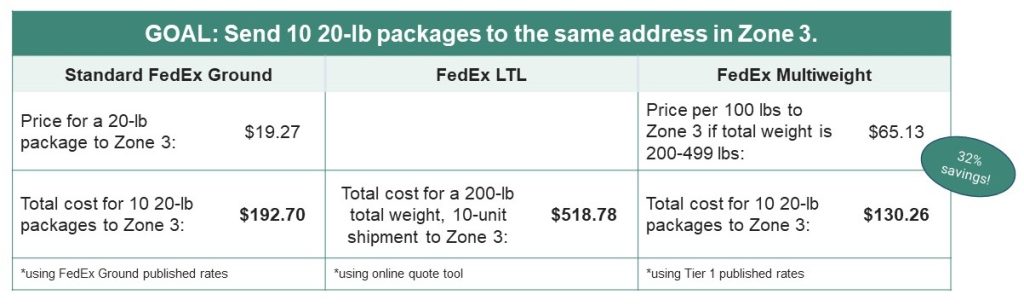
As an example, consider a scenario where a FedEx customer needs to ship 10 packages, all weighing 20 pounds, to the same Zone 3 address. Sending these packages via LTL is likely to be very expensive; using the quote tool on FedEx’s website shows a cost of over $500 for this shipment. Using FedEx Ground, on the other hand, is much more cost-effective, at $193 for all 10 packages. FedEx Multiweight, though, is the best of both worlds, allowing you to ship those 10 packages using a cost per 100 total pounds. The total cost for this shipment via multi-package is $130, or over a 30% savings when compared to FedEx Ground. Note that this pricing uses published rates and online quote tools, and individual corporate rates may vary. Ankura strongly recommends exploring these options when negotiating agreements with shippers to ensure that rates are optimized for your shipment profiles.
In a recent engagement, Ankura identified an opportunity to switch one-third of a client’s LTL shipments to a multipackage option at 28% lower cost.
Proprietary Systems and User Interface
FedEx and UPS each have proprietary platforms designed to facilitate multipackage shipping. While both are user-friendly, they vary in layout and features. Users may find that one system aligns best with their shipping needs. As a result, we recommend a thorough review of the functionality of both systems as part of your evaluation.
Conclusion
The logistics industry continues to adapt to the demands of a changing marketplace. Multipackage services offer a promising alternative to traditional shipping models, especially for businesses that routinely manage shipments of various weights.
When considering multi-package shipping, companies should evaluate shipping providers not only based on pricing but also on service reliability, efficiency of systems interface, and specific business requirements. Testing each service with sample shipments can help organizations gather real-world experience and make the best choice for their logistics needs. Also, negotiating contracts precisely tailored to your shipping requirements, origins, and destinations typically yield better costs than generic or Group Purchasing Organization-based pricing.
How Ankura Can Help
- Carrier Selection and Optimization – Benchmarking, Negotiating, and Modeling Costs
- Rate Structure Analysis – Dimensional (DIM) Pricing, Flat Rate vs. Multipackage Pricing, Zone pricing optimization, surcharge impact analysis
- Network Design and Strategy – Optimal Node Locations, Zone-Based Pricing Analysis, and Hybrid Strategies (Parcel and LTL), Zone-Skip Options
- Technology and Automation Assessment – Shipping Software Evaluation, Integrating Multi-Carrier Platforms, and Robotic Opportunities
- Automation Sourcing and Implementation – Capex Procurement Process
- Human Resources (HR) Support – Upskilling Talent to Support Automation (Recruit/Train/Retain)
Ankura Performance Improvement Fundamentals
We have a proven track record of executing on strategic plans to achieve sustainable performance improvement and targeted operating results aimed at maximizing EBITDA, cash flow and ultimately shareholder value.
We work side-by-side with management and other stakeholders to guide companies through periods of uncertainty and subsequently accelerate growth and value creation.
Ankura’s Performance Improvement professionals leverage the deep expertise across the firm to bring the appropriate specialized resources to deliver solutions to complex problems to create optimal outcomes.
Ankura Supports Manufacturers Through Identifying and Executing on Productivity and Profit Driving Opportunities
- Procurement and Supplier Collaboration
- Technology Adoption and Automation
- Quality Control, Assurance, and Compliance
- Manufacturing Capacity, Utilization, and Efficiency
- Demand Planning, Inventory Management, and Production Planning
- Supply Chain Network Optimization and Sales, Inventory, and Operations Planning (SIOP)
Visit Us at: Ankura Performance Improvement
email: performanceimprovement@ankura.com
© Copyright 2026. The views expressed herein are those of the author(s) and not necessarily the views of Ankura Consulting Group, LLC., its management, its subsidiaries, its affiliates, or its other professionals. Ankura is not a law firm and cannot provide legal advice.

